
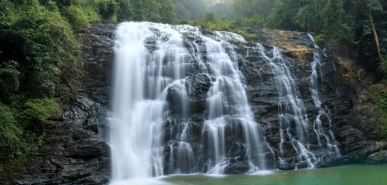
Among the geographical concepts most relevant to agricultural land investment in India, the rain shadow effect deserves specific attention — because understanding it explains why some Indian agricultural regions face chronic water stress while others like Coorg have structural water abundance, and this difference has direct investment implications.
What the Rain Shadow Effect Is
When moisture-laden air masses move inland from the ocean and encounter a mountain range, they are forced upward. As the air rises, it cools and loses the ability to hold moisture — precipitation falls on the windward (ocean-facing) side of the mountains. After passing over the range, the now-dry air descends on the leeward side, warming as it descends and creating conditions that are dramatically drier than the windward side. The leeward side of the mountain range is said to be in the “rain shadow” — receiving only a fraction of the rainfall that falls on the windward side.
This phenomenon is one of the most powerful determinants of agricultural potential in India and globally. The difference in annual rainfall between windward and leeward sides of major mountain ranges can be extraordinary — sometimes two thousand or three thousand millimetres annually on the windward side versus three hundred to five hundred millimetres on the leeward side, a difference that fundamentally determines what crops can be grown, whether irrigation infrastructure is viable, and what the long-term agricultural value of land in each zone is.
India’s Rain Shadow Zones: The Agricultural Consequence
In India, the Western Ghats mountain range runs parallel to the west coast, and the southwest monsoon — coming from the Arabian Sea — is forced upward by the Ghats when it reaches the coast. The windward side of the Ghats receives the extraordinary rainfall figures associated with Coorg, Chikmagalur, Wayanad, and the Malabar coast — two thousand to six thousand millimetres annually in different locations.
The leeward side — the Deccan plateau that makes up most of Maharashtra, Karnataka’s northern and central districts, Andhra Pradesh, and Telangana — is in the rain shadow. Districts like Marathwada in Maharashtra, Rayalaseema in Andhra Pradesh, and Karnataka’s Bidar and Kalaburagi districts receive six hundred to eight hundred millimetres annually — and in drought years, this falls to three hundred to four hundred millimetres, triggering agricultural crisis.
The agricultural investment implications of this geography are profound. Agricultural land in rain shadow zones is structurally water-vulnerable — its productivity depends on groundwater that is being depleted faster than it recharges, and on surface water systems that are becoming less reliable as climate variability increases. Land values in these zones face structural headwinds as the agricultural viability of water-scarce farming becomes more challenging.
Coorg’s Position: The Windward Advantage
Coorg and Kodagu district sit on the windward (western) side of the Western Ghats — facing the Arabian Sea and capturing the full force of the southwest monsoon as it rises over the Ghats. The orographic rainfall that the Ghats generate from this moisture-laden air falls primarily on the windward slopes — which is exactly where Coorg’s coffee and spice estates are located.
This is not incidental geography — it is the defining fact of Coorg’s agricultural character. The two thousand five hundred to three thousand five hundred millimetres of annual rainfall that makes Coorg’s coffee and spice cultivation possible is a consequence of this windward position, maintained by the same physical geography that has existed for millions of years and will continue regardless of year-to-year monsoon variability.
The Investment Implication of Rain Shadow Geography
For an investor comparing agricultural land across different Indian regions, the rain shadow boundary is one of the most important geographic variables to understand. Land on the windward side of the Western Ghats — in Coorg, Chikmagalur, Wayanad, the Nilgiris — is structurally water-abundant by geography. Land on the leeward rain shadow side — most of the Deccan plateau — is structurally water-stressed by the same geography.
These are not conditions that can be changed by government investment, irrigation infrastructure, or management practices. The physics of moisture-laden air rising over mountain ranges has been operating the same way for geological time, and it will continue operating the same way for the foreseeable future. Investing in agricultural land on the windward side of a major orographic rainfall range is investing in a physical geography that provides water security independent of policy, management, or short-term climate variability.
This is the deepest and most fundamental reason why Coorg farmland is a different category of agricultural investment from land elsewhere in Karnataka or the Deccan plateau. The rain shadow does not affect it because it sits on the right side of the mountain.
Contact Nature N Me at naturenme.in or WhatsApp +91 98805 21637.