
For many investors, the most challenging part of a Coorg farmland investment is not the due diligence, the documentation, or the decision itself. It is the conversation at home — with a spouse who is cautious about illiquid investments, a parent who is unfamiliar with agricultural land, or a family member who has heard vague warnings about land disputes in rural Karnataka. Getting family alignment on a significant financial decision is its own skill, and this blog addresses it directly.
Understanding Why Family Members Are Hesitant
Before attempting to convince anyone, it helps to genuinely understand their hesitation. The most common family objections to Coorg farmland investment fall into a few recognisable categories.
The legal fear: “I’ve heard stories about land disputes in rural Karnataka.” This concern is real but addressable with documentation. The difference between properly verified freehold agricultural land with clean RTC, encumbrance certificate, and registered sale deed, and informally occupied or title-challenged land is enormous — and the due diligence process specifically exists to ensure you are in the former category.
The liquidity concern: “What if we need the money urgently?” A genuinely important point that deserves a direct answer: farmland is not liquid, and the amount invested should genuinely be surplus money that is not needed for emergency, medium-term, or planned expenditure. If a family member raises this objection and they are right — if the money might be needed — then the timing or amount of the investment should be reconsidered, not the objection dismissed.
The unfamiliarity concern: “We don’t know anything about farming.” This is where the managed farmland model is the most relevant explanation — you do not need to know anything about farming. The agricultural team handles everything. You own the land and receive the income without any farming knowledge or involvement being required.
The distance concern: “Coorg is so far, how will we manage it?” The managed farmland answer applies here too — distance is irrelevant to management because the management team is local and handles everything. But also: Coorg is five to six hours from Bangalore, with flights available via Mangaluru. It is not inaccessible, and visiting is something the whole family can enjoy.
Bringing the Decision to Life for a Sceptical Spouse
Abstract financial arguments — return percentages, tax savings, appreciation rates — rarely convince a sceptical spouse. What works better is making the investment tangible before the decision is made. Propose a family trip to Coorg — not explicitly as an investment scouting visit but as a holiday, during which you visit a working coffee estate and let the place speak for itself. Most people who see a productive, beautiful Coorg estate in person do not need further convincing — the physical reality of the investment is more persuasive than any spreadsheet.
Show the monthly farm updates from other investors if available — actual photographs of actual farms, actual harvest activity, actual income statements. Concrete evidence of how the investment works in practice, with real images rather than conceptual descriptions, shifts the conversation from abstract risk to documented reality.
Involving the Family in the Farm
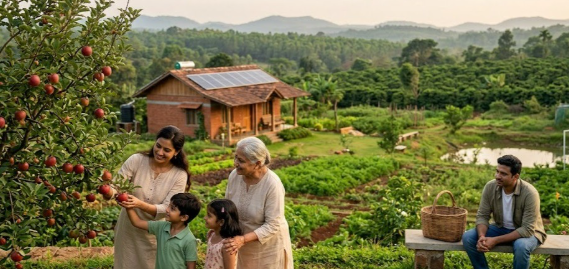
One of the most effective ways to get family buy-in on a farmland investment is to make the farm a family project from the beginning. Visit together before purchase. Let children choose the name for the estate. Have a family photograph taken on the plot on the registration day. Plan the first harvest visit as a family event. These gestures transform the investment from one family member’s financial decision into a shared family asset with emotional ownership across the household.
Children who have visited their family farm in Coorg — who have picked a coffee cherry, seen a cardamom plant, walked through a mist-covered estate — carry a different relationship to the asset than children who were never taken. They grow up knowing the farm is theirs, understanding something about where food comes from, and having a genuine connection to a beautiful piece of the Western Ghats that will be more meaningful to them as adults than any financial inheritance described in abstract terms.
The Conversation With Parents
Explaining a farmland investment to a parent’s generation involves a different framing than for a spouse. This generation often has an intuitive understanding of the value of land — many grew up in or near agricultural communities — but may be unfamiliar with the managed farmland model specifically. The concepts to emphasise are those that resonate with their framework: this is real land, with a government-registered deed, in your name. The income is tax-free. The land cannot disappear like shares can. You can visit it. You can leave it to your children.
These are the characteristics that make agricultural land feel trustworthy to a generation that has lived through financial market crises, bank failures, and the memory of times when physical assets were the only reliable store of value. For this generation, the farmland investment often needs less convincing than for a younger, financially sophisticated spouse — once the legal security is established, the inherent value of owning good land in a good place is self-evident.
When the Family Sees It For Themselves
The conversation guides and persuasion strategies in this post all point toward the same eventual destination: a visit to Coorg. No family objection survives a morning walk through a productive coffee estate in the Western Ghats with the farm manager, a glass of estate-grown coffee on the verandah, and the view of the valley below. The investment that was an abstract financial decision in a Bangalore living room becomes something the family owns, relates to, and is glad of.
Schedule the visit. The conversation will take care of itself.