
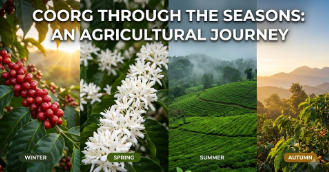
Owning farmland in Coorg means owning a stake in a landscape that transforms dramatically across twelve months. No two visits to a Coorg estate feel identical because the region’s seasonal rhythm — driven by two monsoon systems, a vivid dry season, and the biological cycles of coffee, spice, and forest plants — creates a completely different sensory and agricultural reality in each quarter of the year. This guide is for farmland owners and prospective investors who want to understand what the Coorg year actually looks like, month by month.
January: The Harvest Month
January is arguably the most exciting month on a Coorg coffee estate. The harvest is underway — picking crews move through the rows from dawn, and the sound of ripe cherries dropping into collection baskets fills the estate. The mornings are cool and clear, the light golden through the canopy, and the coffee trees laden with clusters of bright red cherries are visually at their most striking.
The wet mill is active — the hum of the pulping machine, the smell of fermenting coffee, the raised drying beds filling with pale parchment coffee spread to dry in the winter sun. This is when the agricultural reality of the investment is most viscerally real. If you can visit your Coorg farmland only once a year, January is the month that shows you what the estate is producing and why.
Cardamom harvest is also active in January, and pepper reaches peak ripeness. The estate is producing simultaneously across all its main crops — the most industrious and income-generating month of the year.
February: Post-Harvest Calm and Processing
Coffee harvest winds down by late January or early February. The estate quietens, the picking crews disperse, and the processing work continues — turning the remaining drying parchment, cleaning the wet mill, bagging and storing the dried coffee for sale. February is also when cardamom capsules continue to be harvested in late-bearing plots.
The weather is still pleasant — days are warm and sunny, evenings cool. The coffee trees begin their post-harvest pruning cycle, and the farm manager plans the crop care interventions for the coming season.
March and April: Blossom Season
As described in our earlier post on coffee flowering, March to April is the blossom season — one of Coorg’s most celebrated natural spectacles. The first pre-monsoon shower triggers simultaneous flowering across the estate, filling the air with jasmine-like fragrance for two to three days. If the January harvest is the most agriculturally active time to visit, March to April is the most romantically beautiful — warm, fragrant mornings, white coffee blossoms against dark green foliage, and the knowledge that this flowering sets the course of next season’s harvest.
Pre-monsoon agricultural work begins: soil preparation, fertiliser application based on the post-harvest soil test results, and replanting of any gaps in the coffee rows or spice beds.
May: The Heat Before the Rain
May is Coorg’s warmest month — temperatures reach the upper twenties and occasionally low thirties at mid-altitude locations. The landscape is drier than at any other time of year, the streams running lower, the soil hard-packed between the coffee rows. A few scattered pre-monsoon showers create temporary relief.
This is the quietest tourist and visitor month — not a bad time for a working visit to the farm, when the roads are uncrowded and the farm team can give full attention to any questions or inspections. The coffee cherries set by the March-April blossom are now developing as small green fruits on the branches.
June: The Monsoon Arrives
The southwest monsoon typically hits Coorg in the first week of June — abruptly, dramatically, and completely. Within days of the monsoon onset, the estate transforms. Every surface turns green — intensely, suddenly, as if a switch has been flipped. Streams fill, waterfalls appear where there was dry rock a week before, and the air becomes cool and thick with moisture and forest fragrance.
Farm activity during the monsoon focuses on drainage management — ensuring water moves off the plot without eroding soil or waterlogging coffee roots — and monsoon weeding, which must be managed regularly as vegetation growth accelerates in the wet heat. This is the hardest season for farm management work and the most rewarding for landscape visitors willing to accept some rain.
July and August: The Monsoon’s Peak
The heaviest rainfall of the year falls in July and August. The estate is lush, dramatic, and sometimes inaccessible on its earthen access tracks. Farm work continues — shade management, disease monitoring for leaf rust that peaks in high-humidity conditions, and maintaining the irrigation infrastructure that will be needed when the monsoon ends.
Abbey Falls near Madikeri runs at its most powerful during these months. The Cauvery’s headwaters run full through the Kodagu hills. Coorg’s rivers and streams are at their most dramatic — beautiful if you are positioned to observe safely, and an important reminder of the water wealth that underlies the estate’s year-round agricultural productivity.
September and October: The Monsoon Retreats
The southwest monsoon begins withdrawing from Coorg in late September. October brings the northeast monsoon — lighter than the southwest but still significant. The landscape remains green and lush, but the heavy daily rain gives way to intermittent showers. Temperatures moderate, the humidity begins to ease, and the post-monsoon light — golden afternoons, clear mornings — gives Coorg its most photogenic weather of the year outside of the dry season.
Coffee cherries, which set during March-April blossom and have been developing through the monsoon, are now enlarging rapidly and beginning to change colour from green toward yellow. The harvest is still months away, but its promise is visible on every branch.
November and December: Pre-Harvest Preparation
The estate team completes the pre-harvest assessment — walking the rows, estimating volumes, planning harvest crew requirements. Silver oak trees are pruned to manage canopy density before the harvest season, ensuring adequate light and airflow during picking. Coffee cherry colour continues advancing toward full ripeness.
The first small quantities of fully ripe cherry appear by late November or early December on the earliest-ripening plants. The harvest has begun its slow start. The farm is calm and prepared, the year cycling back to January and the productive intensity of the main harvest.
The Gift of Seasonal Awareness
Owning land in Coorg gives you a relationship with seasonal time that urban life systematically removes. The month you are in shapes what is happening on your farm, what the photos in your update show, what the farm manager’s message contains. Over years of ownership, the seasonal rhythm becomes personal — not abstract agricultural knowledge but lived familiarity with a specific piece of land and its annual story.