
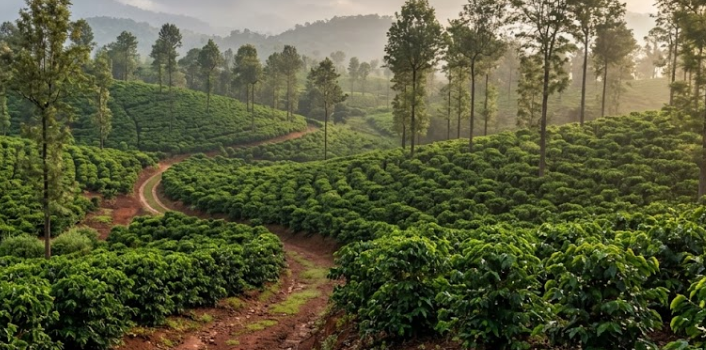
Most discussions of Coorg farmland returns present crop income as a spending resource — a stream of tax-free income that supplements your salary, covers lifestyle expenses, or adds to annual cashflow. This is a completely valid use of the income, and for many investors it is the intended one. But investors who think about their Coorg farmland as a long-term wealth creation vehicle, rather than an income supplement, should understand what happens when crop income is not spent but reinvested — and the compounding mathematics are striking.
The Base Case: Land Appreciation Alone
Consider an investor who purchases five acres in Madikeri for twenty-five lakhs. At twelve percent annual land appreciation, this investment grows as follows across a fifteen-year holding period. At year five, the land is worth approximately forty-four lakhs. At year ten, approximately seventy-seven lakhs. At year fifteen, approximately one crore thirty-seven lakhs. Land appreciation alone has created over one crore ten lakhs in wealth from a twenty-five lakh investment over fifteen years — a compelling return even before any income is considered.
Adding Crop Income Without Reinvestment
Now add the crop income component. From year three onwards, the five-acre plot generates approximately two to three lakhs per year in net agricultural income, growing as plants mature. Over fifteen years, at an average of two and a half lakhs per year, the cumulative crop income received is approximately thirty-seven and a half lakhs — all tax-free.
Total wealth created in the no-reinvestment scenario: one crore ten lakhs in land appreciation plus thirty-seven and a half lakhs in crop income received equal approximately one crore forty-seven lakhs from a twenty-five lakh investment. An excellent return on any measure.
The Reinvestment Scenario: What Changes
Now consider the investor who, instead of spending the annual two to three lakhs in crop income, reinvests it each year — putting it into a diversified equity mutual fund earning twelve percent annually, or a similar growth vehicle.
Two and a half lakhs invested annually for fifteen years at twelve percent annual return grows to approximately one crore twenty-five lakhs through the power of compound growth on the reinvested income stream alone. This is a fund that costs nothing additional to create — it is built entirely from tax-free agricultural income that would otherwise have been consumed.
Total wealth in the reinvestment scenario: one crore ten lakhs in land appreciation plus one crore twenty-five lakhs in reinvested income fund equal approximately two crore thirty-five lakhs from the same twenty-five lakh investment over fifteen years.
The reinvestment of tax-free crop income does not just add to returns — it nearly doubles the total wealth outcome relative to the spending scenario.
Why Tax-Free Income is Especially Powerful When Reinvested
The tax advantage of agricultural income is most powerfully expressed when the income is reinvested rather than spent. When crop income is spent on lifestyle, the tax saving is real but its impact is limited to the spending period. When crop income is reinvested into a growth vehicle, every rupee saved in tax becomes a rupee of additional capital that compounds at whatever growth rate the reinvestment vehicle earns — indefinitely, for as long as the investment is held.
A thirty percent bracket investor reinvesting two and a half lakhs per year of tax-free crop income is effectively investing the equivalent of three and a half lakhs per year of gross pre-tax income — the additional one lakh per year in tax saving, compounded over fifteen years at twelve percent, adds approximately twenty-two lakhs of additional wealth in the reinvestment fund alone.
This is the full expression of the tax efficiency advantage: not just the annual saving, but the compounding of that saving over decades.
The Practical Discipline
The intellectual case for reinvestment is clear; the practical discipline requires some intentionality. Crop income arrives as a lump sum once or twice a year after each harvest — which makes it well-suited for investment rather than spending, if the investor establishes the practice of directing it immediately to a designated investment vehicle rather than letting it blend into current account spending.
Many Nature N Me investors who think about their farmland in long-term wealth creation terms have set up standing instructions to invest crop income disbursements directly into their mutual fund portfolio on receipt — creating an automatic reinvestment discipline that requires no ongoing decision-making after the initial setup.
The Broader Point
A Coorg farmland investment is not just a single asset — it is a wealth creation system that, when managed with intention, generates compounding returns across multiple dimensions simultaneously: appreciating land value, growing crop income, and the secondary compounding of reinvested crop income in other vehicles. Understanding and deliberately designing around these multiple dimensions is what distinguishes investors who build serious long-term wealth from farmland from those who simply hold a pleasant physical asset.