
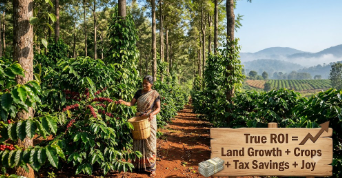
When evaluating any investment, return on investment is the number that matters most. But ROI on managed farmland in Coorg is more layered than most asset classes — and investors who only look at one dimension consistently underestimate the true return. Here is how to calculate it properly.
Component 1: Land Appreciation
The first and most visible return is capital appreciation — the increase in market value of your land over time. Coorg agricultural land, particularly in the Madikeri zone, has been appreciating at 12–15% per year over the past five years. At 12% annual appreciation, the rule of 72 tells you that your land doubles in value approximately every 6 years.
On a ₹20 lakh investment: after 6 years, land value approximately ₹40 lakhs. After 12 years, approximately ₹80 lakhs. This appreciation is unrealised until you sell — but it is real, and it compounds.
Component 2: Annual Crop Income
Crop income from coffee, cardamom, pepper, and fruit crops on a well-managed Coorg agroforestry plot typically runs at 8–12% of the land’s current market value annually, once plants reach full production (years 4–5 onwards). On a ₹20 lakh plot, this is ₹1.6–2.4 lakhs per year.
Crucially, this income is 100% exempt from income tax as agricultural income under Section 10(1). For a 30% bracket investor, ₹2 lakhs of farm income is worth ₹2.86 lakhs of gross salary in after-tax terms. The effective pre-tax equivalent return is therefore higher than the face value suggests.
Component 3: The Tax Saving Value
This is the component most investors fail to quantify explicitly. If you are in the 30% tax bracket and earn ₹2 lakhs per year in tax-free agricultural income, you are saving ₹60,000 per year in income tax compared to earning the same amount from a taxable source like rent or FD interest.
Over a 10-year holding period, that cumulative tax saving is ₹6 lakhs — a meaningful additional return that does not appear in any land appreciation or crop income figure but is very real money that stays in your pocket.
Component 4: Management Fee Deduction
Managed farmland is not a zero-cost passive investment. The management fee — typically a percentage of crop revenue shared with the operator — must be deducted from gross crop income to arrive at net income to the investor. Always calculate returns on net crop income, not gross. Ask your farmland operator exactly what the fee structure is and model your returns on the net figure.
Putting It Together: A 10-Year Example
Investment: ₹20 lakhs for 4 acres in Madikeri in year 1.
Land value after 10 years at 12% appreciation: approximately ₹62 lakhs. Net crop income over 10 years (average ₹1.8 lakhs per year net of management fees): ₹18 lakhs. Tax saved over 10 years (30% bracket): ₹5.4 lakhs.
Total value created: ₹62 lakhs (unrealised) + ₹18 lakhs (received) + ₹5.4 lakhs (tax saved) = ₹85.4 lakhs from a ₹20 lakh investment over 10 years.
That is a total return of approximately 327% over 10 years — or a CAGR of approximately 15.6% including all components. After tax. From a physical asset.
What This Comparison Looks Like Against Alternatives
A ₹20 lakh equity mutual fund at 12% CAGR over 10 years becomes ₹62 lakhs before capital gains tax of 10% above ₹1 lakh. Net post-tax value: approximately ₹57–58 lakhs. A ₹20 lakh FD at 7% for 10 years becomes ₹39 lakhs before 30% income tax on interest. Net post-tax value: approximately ₹31–33 lakhs.
Farmland at ₹85 lakhs equivalent total value creation over the same period, with zero income tax on agricultural income. The comparison speaks clearly.
The Variable You Cannot Quantify
None of the above figures include the lifestyle value — the ability to visit a productive estate in the Western Ghats that belongs to you, to watch the coffee harvest, to walk your land. This is not a financial return. But it is a real benefit that no FD, mutual fund, or urban apartment investment can replicate, and for many investors it is what tips the decision.
To model the ROI of specific plots currently available in Coorg and Madikeri, contact Nature N Me at naturenme.in or WhatsApp +91 98805 21637.
“Interested in investing? View our available managed farmland in coorg“
Frequently Asked Questions
Q: What are the main components that make up the total ROI of managed farmland?
A: Total ROI includes land appreciation, annual tax-free crop yield, tax savings under Section 10(1), minus the management fee deduction.
Q: What is the typical land appreciation rate for farmland in Coorg?
A: Agricultural land in key Coorg zones (like Madikeri) has historically appreciated at around 12–15% annually.
Q: How much annual crop income can an investor expect from a managed plot?
A: Once coffee, pepper, and agroforestry crops reach maturity, net yield typically ranges between 8–12% of the land’s current market value.
Q: Is crop income from Coorg farmland subject to income tax?
A: No, agricultural crop income is 100% exempt from income tax in India under Section 10(1) of the Income Tax Act.
Q: Why should you calculate returns based on net crop income rather than gross income?
A: Farmland operators retain a management fee for handling daily operations, labor, and harvesting, so net returns reflect actual money received.