
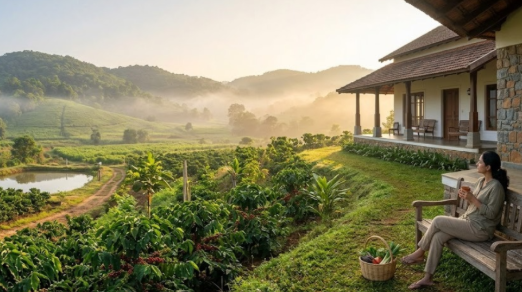
There’s a quiet revolution happening on the outskirts of India’s major cities. On Friday evenings, thousands of urban professionals — doctors, tech executives, entrepreneurs, and young families — pack their bags and head not to a five-star resort, but to their own piece of farmland.
They’re going home. To their farm.
Weekend farm living has emerged as India’s most compelling new lifestyle statement — a response to the relentless pace of urban life, the growing hunger for authentic experiences, and a deeper desire to own something real, rooted, and restorative.
This isn’t rural migration. This is a conscious, curated lifestyle choice — and it’s redefining what luxury means for a new generation of affluent Indians.
The Rise of the Weekend Farmer
A decade ago, owning farmland was the domain of inherited landholding families or large agribusinesses. Today, an IT professional from Whitefield or a startup founder from Koramangala can own a 2-acre organic mango farm in Coorg — complete with a farmhouse cottage, drip irrigation infrastructure, and a professional team that keeps it productive year-round.
They don’t farm full-time. But on weekends? They step into a version of life that no apartment, luxury condo, or five-star stay can replicate.
Several forces are driving this shift:
Post-pandemic priorities — The pandemic fundamentally reshaped how people evaluate time, space, and wellbeing. Having outdoor space, clean air, and a relationship with nature moved from nice-to-have to non-negotiable for many.
The burnout economy — Urban professionals are increasingly aware of the long-term cost of unchecked stress. Weekend farm retreats offer a genuine reset — not a curated hotel simulation of nature, but actual nature.
The Instagram farm aesthetic — Farm living has become aspirational content. Sunrise over coffee estates, meals made from garden-to-plate produce, barefoot mornings in the orchard — these experiences resonate deeply with audiences tired of identical luxury hotel imagery.
Smarter investment thinking — Unlike a second city apartment that sits empty, a managed farm is a productive asset that generates income even when you’re not there.
What Weekend Farm Living Actually Looks Like
Morning
You wake up without an alarm. There’s no traffic hum, no delivery notifications, no meeting reminders — just the sound of birds, wind through bamboo, and the smell of coffee brewing in the farm kitchen. You step onto the verandah of your farmhouse cottage. The mist is still lifting off the valley.
After breakfast — fresh eggs, garden tomatoes, farm-pressed juice — you do a walk through your orchard with the farm manager. The mangoes are coming along. The coconut palms have been tended. The drip lines are running on schedule.
Afternoon
Lunch is slow. Real slow. Perhaps with family or friends who’ve driven down. Children are running barefoot across grass for the first time in weeks. You sit under a tree with a book. No one checks their phone.
Later, a bonfire. Stories. Dinner cooked outdoors. Stars — actual stars — overhead. This is something your city apartment will never offer.
Sunday Evening
You drive back to Bangalore (or Mumbai, or Hyderabad) with cleaner lungs, a quieter mind, and a strange sense of having been somewhere that mattered. Not a hotel. Your place.
Weekend Farms vs. Second Homes: Why Farms Win
Urban Indians have long purchased second homes — a flat in Goa, a villa in the hills, a studio near a tourist town. But weekend farm living offers something fundamentally different:
FeatureSecond Apartment/VillaManaged Weekend FarmConnection to natureMinimalDeep and sensoryIncome potentialRental yield (if managed)Crop revenue + appreciationMaintenance burdenHigh (repairs, management)Handled by farm teamExperience qualityResidentialAgri-lifestyle, uniqueScalabilityFixedCan expand acreageSocial cachetCommonAspirational and rareChildren’s educationLimitedFarm-to-fork, ecology, life skills
The farm isn’t just a retreat. It’s a living, breathing, productive asset — one that teaches children where food comes from, gives you a reason to unplug every week, and grows in value as land scarcity intensifies.
The Lifestyle Elements That Make It Luxury
Modern managed farmlands designed for lifestyle investors are far removed from rustic subsistence agriculture. The best projects combine:
Farmhouse accommodation — Well-designed cottages or bungalows with modern amenities: hot water, Wi-Fi, comfortable beds, outdoor seating. Rustic aesthetic, urban comfort.
Curated farm experiences — Farm walks with agronomists, fruit picking, organic gardening workshops, cooking sessions using farm produce. Every visit is experiential.
Wellness integration — Many premium farmlands now include yoga decks, meditation spaces, and organic spa treatments using farm-grown ingredients like coffee, turmeric, and essential herbs.
Community of like-minded owners — Neighbouring plot owners are often professionals from similar walks of life. Weekend farm living naturally creates a community — barbecues, harvest festivals, children’s nature camps.
Farm-to-table dining — Every meal on your farm is inherently organic, seasonal, and fresh. There’s a quiet pride in eating something you’ve watched grow on your own land.
What Does It Cost?
Weekend farm living is accessible across a range of investment levels, particularly through managed farmland models:
- Entry-level plots (1 acre, intercropped): ₹25–40 lakhs in peri-urban Karnataka
- Mid-range estates (2–3 acres with farmhouse): ₹60–90 lakhs in Coorg / Chikkamagaluru region
- Premium developments (3+ acres, luxury cottage, curated crops): ₹1–3 crore in prime locations
These are not holiday home rentals. These are ownership investments — with your name on the sale deed and land that continues to grow in value.
Is It Really Sustainable Luxury?
The most compelling aspect of weekend farm living is that it aligns luxury with sustainability — perhaps for the first time in Indian lifestyle consumption.
Your farm absorbs carbon. It regenerates soil. It supports local agricultural workers. It produces organic food. It conserves water through precision irrigation. And it offers you an annual harvest — something tangible that grows from your investment in the literal sense.
Luxury has evolved. It’s no longer just what you consume. It’s what you create, conserve, and connect with.
Who Is This Lifestyle For?
Weekend farm living resonates particularly with:
- Urban professionals (35–55) seeking a meaningful lifestyle upgrade beyond material possessions
- Parents who want to give their children regular exposure to nature and agriculture
- Wellness-focused individuals who value clean air, organic food, and mental decompression
- Investors who want their lifestyle expenditure to double as a wealth-building asset
- Retirees or pre-retirees planning a graceful transition from urban to semi-rural living
Conclusion
Weekend farm living isn’t a trend — it’s a recalibration. It’s urban India recognising that the most profound luxury isn’t another floor in a high-rise or another stamp in a passport. It’s a piece of land that’s yours. That feeds you. That restores you. That you can walk on, breathe in, and leave for your children.
The new luxury has roots. Literally.
Curious about weekend farm living near Bangalore? [Explore our farmland projects] and schedule a site visit to experience it for yourself.