
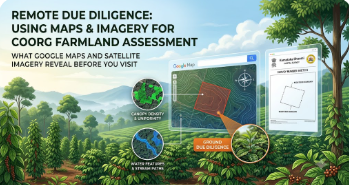
Serious farmland due diligence requires a physical site visit — no digital tool replaces the experience of walking a plot and observing it directly. But digital tools available for free to any investor can provide significant useful information about a Coorg farmland plot before the visit, helping to formulate better questions and making the physical visit more productive. This guide explains what satellite imagery and mapping tools can and cannot tell you about a plot under consideration.
What Satellite Imagery Reveals
Google Maps and Google Earth satellite imagery of Coorg’s Madikeri zone is typically captured at resolution sufficient to distinguish individual trees from undergrowth, identify canopy cover patterns, and observe the general topographic characteristics of a plot. Key observations possible from satellite imagery include the following.
Canopy density and uniformity — from satellite view, an estate with well-managed, uniform shade canopy appears as a consistent texture of medium-green tree cover. Gaps in the canopy, visible as lighter or bare patches, may indicate areas of disease, wind damage, or uneven management. The pattern of canopy density across the slope is visible and can indicate whether the estate has been managed consistently or has neglected sections.
Slope and drainage — satellite imagery combined with the terrain view in Google Earth (which shows contour-like shading based on elevation data) reveals the topography of the plot. A consistently sloping, well-drained plot is visible as a uniform gradient. Flat depressions within an otherwise sloping plot may indicate areas that collect water and drain poorly — a potential concern for coffee root health.
Water features — perennial streams in Coorg are visible in satellite imagery as green corridors of denser, darker vegetation within the surrounding estate landscape. The presence and approximate location of streams adjacent to or within a plot can be preliminarily assessed before the visit, though ground-level verification is essential to confirm whether the stream runs within the surveyed boundaries or merely adjacent.
Access roads — the track or road that provides access to the plot is often visible in satellite imagery. Its width, the quality of its surface (visible through colour and texture), and whether it appears to be regularly used (fresh tyre tracks visible after recent satellite image capture) or infrequently used can be assessed from above.
Neighbouring land use — what surrounds the plot matters. Adjacent well-managed estates are visible as similar-textured canopy. Adjacent scrub or apparently unmanaged land is visible as more irregular, open vegetation. Proximity to any large structures that might indicate commercial development, industrial use, or significant road infrastructure is visible at the neighbourhood level.
What Satellite Imagery Cannot Reveal
Satellite imagery cannot replace several critical components of site assessment. Ground-level crop health — the specific condition of individual coffee plants, signs of disease on leaf undersides, the density and health of cardamom in the understorey — is not visible from satellite altitude. Bore well condition, yield, and water quality are not observable by any remote means. The exact position of boundary markers relative to the surveyed boundary cannot be confirmed by satellite. The quality of the access road surface — what it feels like to drive it in a standard vehicle — requires ground-level experience.
Satellite imagery should be used to prepare for and complement a site visit, not to replace it.
The Bhoomi Survey Sketch as a Companion Tool
The survey sketch for the plot’s survey number — downloadable from the Karnataka Bhoomi portal — shows the formal registered boundary of the plot in relation to adjacent survey numbers, roads, and water features. Overlaying this survey sketch mentally against the satellite imagery of the same area allows preliminary assessment of whether the physical plot visible in satellite imagery corresponds approximately to what the survey records describe.
Significant discrepancies — where the surveyed boundary appears to include areas that satellite imagery shows as different land use than the rest of the plot — are worth investigating further in the physical visit and in the legal due diligence documentation.
Google Street View: Limited but Worth Checking
Google Street View coverage in Coorg’s rural roads is patchy but worth checking. Where Street View imagery exists for the access road to a plot, it provides a ground-level preview of the road surface, width, surrounding landscape character, and the visual experience of the approach. This can be useful for assessing practical accessibility and for giving family members or co-investors a visual sense of the location before they commit to the physical visit.