
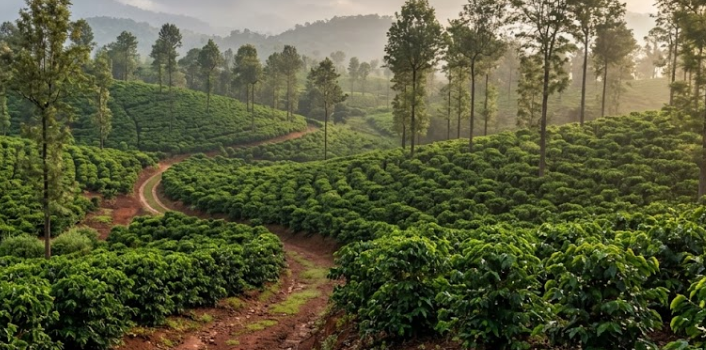
Investment culture tends to celebrate the quick return, the well-timed exit, the investor who bought at the bottom and sold at the top. Agricultural land investment in Coorg rewards exactly the opposite instinct — the investor who bought and did nothing, who held through quiet years and active years, who resisted the temptation to take profits when a buyer appeared, and who is still holding today. The best Coorg farmland returns in the past decade have gone to people who did very little after they bought — and the compounding of their patience is the most powerful argument for the investment.
What Patience Earns That Activity Cannot
Consider an investor who purchased three acres in Madikeri in 2016 for twelve lakhs. In 2019, someone offered them sixteen lakhs — a thirty-three percent gain in three years. They sold. The buyer held. By 2026, that same land is worth thirty-five to forty lakhs. The seller captured a thirty-three percent gain over three years. The buyer’s gain over seven years is one hundred and ninety percent and rising, plus seven years of crop income that the seller also foregone.
This pattern repeats across every documented resale in Coorg’s farmland market. The investors who have generated the best real-world outcomes are almost universally those who held longest — not because they were smarter about when land would appreciate, but because they did not interrupt compounding that was already working.
The Three Enemies of Long-Term Farmland Returns
The first enemy is impatience — the desire to realise gains that feel large before the compounding has finished. A thirty percent gain in three years feels satisfying until you watch the same asset double again in the following five years while you hold cash that is earning far less.
The second enemy is liquidity anxiety — the fear that if you needed money urgently, you would not be able to access it from the land. This is a legitimate concern for money that might actually be needed, which is why properly sized farmland investment only uses genuinely surplus capital. Money that does not need to be liquid can afford to be patient, and patience is where the returns accumulate.
The third enemy is comparison — watching a friend’s equity mutual fund gain forty percent in a bull year and wondering whether the farmland is underperforming. Agricultural land appreciation is not linear — it moves in steps rather than continuously, with periods of apparent stasis between price increases. An investor who compares their land’s value in a quiet year against a bull equity market will always find the equity market temporarily more impressive. The same comparison made over ten years almost invariably reverses.
Compounding in Multiple Dimensions Simultaneously
Patience in Coorg farmland investment does not mean accepting stagnation. While the investor waits, multiple forms of value are compounding simultaneously: land appreciation at twelve to fifteen percent annually on the capital value, crop income growing as plants mature and farm management improves pricing, tax-free income accumulating that would otherwise have been reduced by thirty percent for a bracket investor, and timber value building in the trees that grow through every quiet period of apparent stasis.
These multiple compounding streams do not pause when the investor is not paying attention. They continue through quiet years, through market downturns elsewhere, through the periods when the investor almost sold and decided not to. The patience is not passive in an agricultural sense — the farm is working whether or not the investor is watching.
The Practical Discipline
Patience as an investment strategy requires a specific practical infrastructure: investing money that genuinely does not need to be accessed, maintaining adequate liquid emergency funds and insurance independently, and having a clear enough holding horizon in mind that short-term comparison temptations do not divert the long-term strategy.
For investors who establish this infrastructure correctly — and for whom Coorg farmland represents appropriately allocated illiquid capital within a broader portfolio — patience is not a psychological challenge but the natural condition of holding an asset that rewards time intrinsically.
The investors who will look back in 2036 and describe their best financial decision are the ones sitting in Madikeri farmland today, planning to stay.
Contact Nature N Me at naturenme.in or WhatsApp +91 98805 21637.