
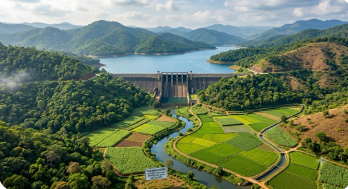
Among the water infrastructure assets that underpin Coorg’s agricultural reliability, one stands at a larger scale than individual bore wells, check dams, and perennial streams: the Harangi reservoir, formed by the Harangi dam on the Harangi River — one of the Cauvery’s primary tributaries originating in the Kodagu hills. For farmland investors thinking about the regional water security picture, understanding the Harangi system adds an important dimension to the already-strong natural water availability that characterises Coorg.
The Harangi Dam and Reservoir
The Harangi dam, located near Hudikeri in Kodagu district, impounds the Harangi River to form a reservoir with a storage capacity of approximately 8.4 thousand million cubic feet (TMC). It was constructed primarily to provide irrigation water to downstream areas in the Cauvery basin — supporting paddy and sugarcane cultivation in Hassan and Mysuru districts — but also provides regulated water release to the Harangi River system within Kodagu itself.
The reservoir’s existence affects the broader water balance of the Harangi catchment in ways that benefit farmland within and adjacent to the river’s drainage area. During dry season months when rainfall is minimal, the regulated release of stored water maintains river flow in the Harangi and its tributaries — sustaining the stream and groundwater levels that farmland in the catchment depends on for dry-season irrigation.
The Groundwater Recharge Effect
Large water bodies in elevated terrain — reservoirs, lakes, and even large check dams — create a regional groundwater recharge effect through seepage from the reservoir base and banks into the surrounding aquifer. The Harangi reservoir, sitting in the laterite and granitic geology of the Kodagu hills, contributes to sustained groundwater levels in its vicinity through this seepage mechanism.
Bore wells on farmland within the broader Harangi catchment benefit from this regional groundwater maintenance — sustaining yield levels during dry season months that bore wells in less hydrologically supported terrain might not achieve. This is not a dramatic effect that is easily quantified for any specific plot, but it is a background hydrological benefit that adds to the already strong natural water security of Coorg farmland.
The River Corridor as a Water Resource
For farmland plots adjacent to or near the Harangi River and its named tributaries, the dry-season regulated release from the Harangi reservoir maintains river flow that would otherwise reduce significantly without storage regulation. This sustained river flow supports the irrigation needs of estates drawing water directly from the river system through pumping, and maintains the riparian vegetation along river banks that contributes to the forest cover and biodiversity discussed in our earlier post on Coorg’s forest connection.
Flood Risk Management
The Harangi reservoir’s flood storage function is also relevant to farmland investors. During extreme monsoon years, the reservoir absorbs peak flows from the Harangi catchment, reducing flood peaks downstream and moderating the risk of riverine flooding on adjacent farmland. Without the dam, extreme monsoon events would produce higher peak flood flows through the lower Harangi valley — the dam’s flood attenuation function provides a measure of flood risk management for downstream areas.
The Broader Water Infrastructure Picture
The Harangi reservoir is part of a broader water infrastructure picture in Kodagu that includes smaller government-constructed irrigation tanks and check dams across multiple taluks, the Kabini reservoir on the Kabini River (which originates in Kodagu), and the natural water storage provided by Kodagu’s forest cover and laterite soils. Together, this water infrastructure — natural and engineered — creates the hydrological foundation that makes Coorg’s agricultural water security significantly more robust than most Indian agricultural regions.
For farmland investors, understanding this regional water infrastructure context provides confidence that the water security of their investment is not dependent on any single source or structure, but on a layered system of natural and engineered water management that has been built and maintained over decades.
Contact Nature N Me at naturenme.in or WhatsApp +91 98805 21637.