
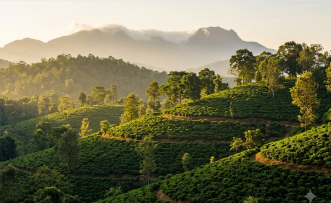
Among all the variables that determine the income potential of a specific Coorg farmland plot — soil type, water access, crop composition, canopy management — one factor towers above most others in its importance to the coffee crop specifically: elevation. The altitude at which your coffee plants grow is the primary determinant of the quality of the bean they produce, the price that bean commands in the market, and therefore the coffee income component of your agricultural returns.
Why Altitude Matters to Coffee Quality
The connection between elevation and coffee quality is one of the most well-established principles in specialty coffee science. At higher altitudes, temperatures are cooler and more stable. Coffee cherries develop more slowly in cooler temperatures — taking longer to ripen — and this extended development period allows the bean to accumulate more sugars, acids, and aromatic compounds than a cherry that ripens quickly in warm lowland conditions.
The result is a denser, more complex bean that produces a brighter, more nuanced cup — the flavour profile that specialty coffee buyers seek and pay premium prices for. High-altitude Arabica from Coorg and other premium origins produces cupping scores above eighty points and commands specialty pricing; lower-altitude coffee produces adequate commodity-grade beans but lacks the complexity that unlocks premium pricing channels.
Coorg’s Altitude Range and What It Means
Kodagu district spans a significant altitude range — from approximately 500 metres above sea level in the lower river valleys of Virajpet taluk to approximately 1,700 metres at the highest estate locations in the Madikeri and Brahmagiri zones. Within this range, coffee quality tracks altitude in a predictable way.
Below 800 metres: suitable primarily for Robusta coffee, which is more heat-tolerant and produces at lower altitudes but commands lower prices. Robust income, but limited access to specialty premium pricing. From 800 to 1,000 metres: transitional zone where both Arabica and Robusta can be grown; Arabica at this elevation produces reasonable quality but is below the optimal specialty profile. From 1,000 to 1,400 metres: prime Arabica zone — this is where Coorg’s most celebrated coffee grows, producing complex, bright, specialty-grade beans that access premium buyers. Above 1,400 metres: exceptional quality zone, though fewer estates operate at these extreme elevations due to access challenges and temperature management requirements.
Nature N Me’s primary project areas in Madikeri taluk sit predominantly in the 1,000 to 1,400-metre range — the prime Arabica zone that accesses both the GI tag premium and specialty market pricing.
The Price Differential: What Elevation Is Worth in Rupees
The income difference between a low-altitude Robusta-producing plot and a high-altitude specialty Arabica-producing plot of identical area is substantial. Robusta at commodity prices: one hundred and fifty to two hundred and fifty rupees per kilogram. Standard commercial Arabica: two hundred and fifty to three hundred and fifty rupees per kilogram. Specialty-grade high-altitude Arabica: three hundred and fifty to six hundred rupees per kilogram and above for exceptional lots.
For a plot producing one hundred kilograms of dried coffee per acre per year (a realistic yield at full production), the income from that hundred kilograms ranges from fifteen thousand rupees (Robusta commodity) to sixty thousand rupees (specialty Arabica) — a four-fold difference in income from the same land area, the same number of plants, and the same management effort. The only variable is elevation.
What to Ask When Evaluating Any Coorg Coffee Plot
The altitude question is therefore one of the first and most important to ask when evaluating any Coorg farmland investment. What is the elevation of this plot in metres above sea level? Is the coffee variety planted Arabica or Robusta, and does the elevation support specialty-grade Arabica production? What cupping scores has coffee from this estate or zone achieved in recent seasons?
A managed farmland operator who cannot clearly answer the altitude and variety question, or who is evasive about whether the elevation supports specialty-grade Arabica, is providing incomplete information on the most important determinant of coffee crop income.
Nature N Me’s plot documentation includes elevation data for every available plot, with crop variety composition clearly stated. Contact us at naturenme.in or WhatsApp +91 98805 21637 to review elevation and crop data for available plots.