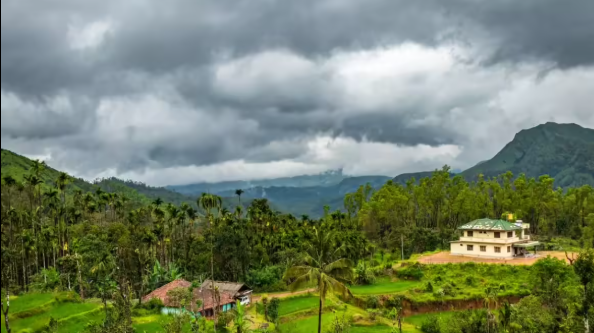
Investors researching Coorg farmland focus naturally on agricultural specifics — soil type, water access, crop composition, land appreciation rates. What receives less attention but is perhaps the most fundamental long-term value determinant of Coorg land specifically is something that exists beyond any individual plot’s boundaries: the surrounding forest cover that makes Kodagu district exceptional among Karnataka’s agricultural regions.
Kodagu’s Forest Statistics
Kodagu district has approximately forty-one percent of its total geographical area under forest or dense tree cover — the highest proportion of any district in Karnataka and among the highest of any agricultural district in India. This figure encompasses reserved forests, protected forests, and the private estate canopy that blurs the line between commercial agroforestry and forest ecology.
This forest cover is not a historical relic being slowly depleted. Karnataka’s forest department records show that Kodagu’s forest area has remained relatively stable over the past two decades, supported by the natural regeneration capacity of the Western Ghats ecosystem and by the coffee estate canopy that has historically functioned as a semi-natural forest.
How Surrounding Forest Affects Your Farmland’s Agricultural Productivity
The forest surrounding private farmland in Coorg performs multiple functions that directly support agricultural productivity on the farm. Microclimate regulation — forests maintain local humidity, moderate temperature extremes, and generate the orographic rainfall that Coorg depends on — all of which benefit the coffee, cardamom, and spice crops on adjacent private farmland. Pollinator habitat — the forest supports the native bee diversity discussed in our previous post, providing populations of wild pollinators that visit and fertilise crops on nearby farmland during flowering season. Pest predator habitat — birds, small mammals, and insects that predate agricultural pests live in the forest and forage across the adjacent farmland, providing natural pest suppression that reduces the management cost of chemical pest control.
Water cycle support — the forest’s root systems, leaf litter, and biomass maintain the hydrological cycle that feeds the perennial streams flowing through private farmland in Coorg. Without the forest, these streams would be seasonal rather than perennial — a direct loss of the water security that is one of Coorg farmland’s primary investment attributes.
How Forest Cover Affects Land Value
From a land valuation perspective, forest-adjacent agricultural land in Coorg commands a consistent premium over agricultural land in deforested or forest-distant locations — all else being equal. The reasons are multiple: more beautiful views, better microclimate, higher ecological quality, greater water security, and the biodiversity presence that is increasingly valued by lifestyle buyers and farmstay visitors.
As environmental consciousness among urban Indian investors grows, land that sits within or adjacent to a functioning ecosystem is increasingly recognised as qualitatively different from agricultural land in degraded or monotonous landscapes. This ecological premium is not yet fully priced into Coorg farmland valuations — but it is building, and investors who own forest-adjacent farmland in the Western Ghats are positioned to benefit as this recognition increases.
The Responsibility That Comes With the Connection
Owning farmland within or adjacent to the Western Ghats forest system carries an implicit responsibility that serious investors should acknowledge. Management practices that damage the forest-farm interface — burning crop residues that kill forest-edge biodiversity, chemical runoff that affects stream ecosystems, clearing of riparian vegetation for cultivation — erode the ecological foundation that makes the land valuable in the first place.
Nature N Me’s sustainable farming approach is not merely a marketing position — it is a recognition that the ecological health of the surrounding forest and the agricultural productivity of the managed farmland are fundamentally linked. Protecting that connection is both an ethical obligation and a long-term investment protection strategy.
The forest that surrounds your Coorg farmland is not a separate asset class — it is the living infrastructure that makes your investment what it is. Understanding this connection deepens both the investment case and the meaning of owning land in this particular part of the world.