
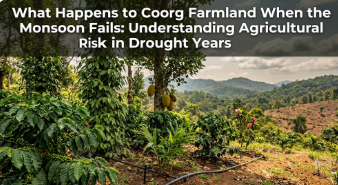
Transparency requires addressing scenarios that do not appear in optimistic investment projections. One of the most important of these for any agricultural investment is the drought year question: what actually happens to your crop income when the monsoon underperforms? For Coorg farmland specifically, this question has a more reassuring answer than for most Indian agricultural regions — but an honest assessment requires looking at what below-average rainfall years have actually produced.
How Coorg’s Rainfall Holds Up in Poor Monsoon Years
As discussed in our earlier post on the Western Ghats’ climate resilience, Kodagu receives rainfall from two monsoon systems rather than one, and its orographic rainfall mechanism provides structural resilience that plain-land and rain-shadow agricultural regions do not have. In years when India’s overall monsoon is classified as deficient — meaning aggregate national rainfall is below eighty percent of long-period average — Coorg typically receives sixty to eighty percent of its own average, rather than experiencing the forty to fifty percent deficits that drought-prone Deccan districts experience.
This difference matters enormously. A coffee plant that receives sixty percent of its usual water availability in a given year, supplemented by drip irrigation, will have reduced yield but will not suffer plant-level stress or mortality. The same plant receiving forty percent, without irrigation backup, faces fruit drop, abortion of developing cherries, and potentially plant-level stress affecting multiple subsequent seasons.
What Actually Happens to Coffee Yield in a Below-Average Rain Year
Based on documented experiences from Coorg coffee estates during years with below-average rainfall, the realistic yield impact on a well-managed, irrigated estate is a reduction of fifteen to thirty percent from the expected normal yield — not a total crop failure. For a plot with a normal expected yield of one hundred kilograms of dried coffee, a drought year might produce seventy to eighty-five kilograms. Crop income falls proportionally, but the income stream continues.
On a multi-crop agroforestry plot, this impact is further cushioned by the different water sensitivities of different crops. Cardamom is more water-sensitive than coffee and may see more significant yield reduction in a dry year. Pepper, climbing on established trees with deeper root access, is more resilient. Fruit trees on mature root systems — mango, jackfruit — are relatively drought-tolerant. The multi-crop income stream dampens the drought impact relative to a single-crop estate.
The Role of Irrigation Infrastructure
This is where the irrigation infrastructure discussed in our rainwater harvesting post becomes directly relevant to drought-year risk. An estate with a perennial stream, functional bore well, and water storage infrastructure can supplement natural rainfall during the dry season and partially compensate for monsoon deficit years. An estate dependent entirely on rainfall with no irrigation infrastructure is more vulnerable to yield loss in below-average rain years.
Nature N Me’s managed farmland plots include irrigation infrastructure as standard — not as a luxury addition but as a fundamental risk management element. The bore well depth and yield, the presence of perennial stream access, and the water storage capacity on each plot are specifically assessed in our pre-sale documentation precisely because of their drought-year significance.
Land Value in a Drought Year
Land values in Coorg do not fall during individual drought years. Agricultural land is not a traded commodity that reprices on annual conditions — it is a long-term asset whose value reflects multi-decade productivity potential and regional scarcity. A single below-average rainfall year does not affect the underlying water security, soil quality, or long-term agricultural potential that drives Coorg farmland appreciation.
This is a meaningful distinction from financial assets: an equity portfolio falls in value when current conditions are poor. Agricultural land holds its value because buyers are pricing long-term potential, not current-year conditions. The drought year affects income, not capital value — and the income recovers in the following season when rainfall returns to normal.
The Honest Bottom Line
Coorg farmland is not immune to drought risk, and investors should not expect crop income to be completely stable year to year. What is realistic is that drought-year income on a well-managed, irrigated Coorg estate will be reduced but not eliminated — and that the long-term average income across good and poor years represents the investment return, not any single year’s figure.
For investors modelling crop income conservatively, using seventy to eighty percent of the stated normal yield as a stress-year scenario is a reasonable planning assumption for Coorg — significantly better than the fifty to sixty percent stress-year scenario appropriate for drier agricultural regions.