
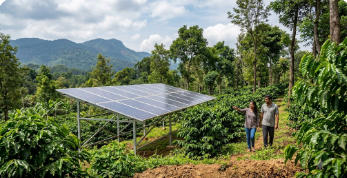
As managed farmland operations in Coorg mature and infrastructure investments become more sophisticated, one area gaining increasing attention is on-site renewable energy — specifically, solar power installations that reduce operating costs, improve resilience, and align with the sustainable farming philosophy that already underpins organic agroforestry management.
The Electricity Challenge in Rural Coorg
Rural electricity supply in parts of Kodagu, as in much of rural Karnataka, can experience periodic outages — particularly during heavy monsoon periods when storms can affect transmission infrastructure across hilly terrain. For farm operations dependent on electric pumps for irrigation — particularly during the dry season when irrigation matters most — power reliability affects the consistency of water delivery to crops.
A backup or primary solar power system addresses this directly: solar panels paired with battery storage or solar-direct pumping systems can operate irrigation infrastructure independent of grid reliability, ensuring that water reaches coffee, cardamom, and other crops on schedule regardless of grid conditions.
Solar Water Pumping: The Most Direct Application
Solar-powered water pumps — drawing from bore wells, streams, or storage tanks — are one of the most directly applicable solar technologies for Coorg farmland. The Indian government’s PM-KUSUM scheme has promoted solar pump adoption for agricultural use nationally, with subsidies available for farmers installing solar pump sets, though specific subsidy availability and terms vary by state and should be verified for current applicability in Karnataka.
A solar pump system sized appropriately for a farmland plot’s irrigation needs eliminates the recurring electricity cost of running pumps from grid power, while providing the reliability benefit of being independent of grid outages — particularly valuable during the dry-season months when irrigation demand is highest and coincides with periods when grid reliability in some rural areas can be more variable.
Solar for Processing Infrastructure
Beyond irrigation, solar power can support other farm electricity needs — lighting for processing areas, power for small equipment used in coffee processing (pulping machine motors, for instance), and battery charging for farm management communication equipment (important for maintaining the WhatsApp update communication discussed in an earlier post, particularly in areas with limited grid reliability).
For farms developing farmstay infrastructure, as discussed in earlier posts, solar power provides a sustainability dimension that resonates with the eco-conscious positioning that Coorg farmstays increasingly market — guests value staying somewhere that demonstrably minimises its environmental footprint, and visible solar infrastructure communicates this directly.
The Sustainability Alignment
Nature N Me’s broader approach to managed farmland emphasises organic, low-chemical agricultural practices that work with rather than against the Western Ghats ecosystem, as discussed in our earlier post on organic farming. Solar power is a natural extension of this philosophy — reducing reliance on grid electricity (which in Karnataka still includes a thermal generation component) aligns the farm’s energy profile with its agricultural philosophy.
For investors who think about their Coorg farmland holistically — as both a financial asset and a small-scale demonstration of sustainable land use — solar infrastructure is a tangible expression of that approach, visible during farm visits and meaningful to the overall positioning of the estate.
Cost Considerations
Solar pump and power installations represent an upfront capital cost — typically ₹1.5–4 lakhs for a system sized for a few acres of irrigation, depending on pump capacity and whether battery storage is included. This cost is recovered over time through eliminated electricity costs, with payback periods typically in the 4–7 year range depending on prior electricity usage and local tariff structures.
For larger managed farmland plots — 5 acres and above — where irrigation electricity costs are a more meaningful recurring expense, the economics of solar investment are generally more favourable, making it a consideration worth discussing as part of overall farm infrastructure planning.
To discuss whether solar infrastructure is appropriate for your plot’s irrigation and processing needs, contact Nature N Me at naturenme.in or WhatsApp +91 98805 21637.