
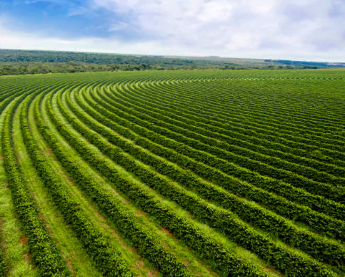
Most discussions of farmland investment focus on demand-side factors — who wants to buy, why, and what returns they expect. Less commonly discussed, but arguably more fundamental, is the supply side: how much agricultural land does India actually have, how is that supply changing over time, and what does this mean for the long-term trajectory of land values in productive agricultural regions?
India’s Land Area: A Fixed Denominator
India’s total geographical area is approximately 328 million hectares — a number that, obviously, does not change. Of this, agricultural land (including net sown area, fallow land, and land available for cultivation) has historically constituted roughly 55–60% of total area, though this proportion has been under continuous pressure from competing land uses.
The pressures reducing agricultural land area in India are well-documented and structural: urbanisation and urban expansion converting agricultural land at city peripheries into residential and commercial use, infrastructure development — highways, railways, airports, and industrial corridors — consuming agricultural land, particularly in economically dynamic states, and land degradation — soil erosion, waterlogging, salinity, and desertification in various regions reducing the productive capacity of land that remains classified as agricultural.
Per-Capita Agricultural Land: A Declining Trend
India’s population has grown from approximately 850 million in 1990 to over 1.4 billion today — while the total agricultural land area has remained roughly static or declined slightly. The mathematical consequence is straightforward: per-capita agricultural land availability in India has been declining for decades, and this trend shows no signs of reversing given continued population growth (even as the growth rate slows) and continued urbanisation.
This is not a uniquely Indian phenomenon — most rapidly developing economies experience similar dynamics. But it establishes a fundamental supply-side reality: agricultural land, as a category, is becoming scarcer per person in India over time, even as demand for agricultural produce (driven by population and rising consumption standards) grows.
Quality Agricultural Land Is Scarcer Still
Within the broader category of “agricultural land,” the subset that is genuinely productive — with reliable water access, good soil quality, suitable climate for high-value crops, and reasonable accessibility — is considerably smaller than the total agricultural land figure suggests. Large areas of India’s agricultural land face water stress, soil degradation, or climate conditions that limit productivity, as discussed in our earlier post on Western Ghats climate resilience.
The Western Ghats region — including Kodagu — represents a small fraction of India’s total agricultural land area, but a disproportionately high-quality fraction: high and reliable rainfall, good soil, suitable for high-value perennial crops, and increasingly connected to urban markets and export channels. This is precisely the kind of land that is structurally scarce — not because of any single policy or event, but because of the basic geography of where high-quality agricultural conditions exist in India.
The Investment Implication of Structural Scarcity
When a resource is structurally scarce and demand for it is growing — driven by population, by urban investor interest in alternative assets (as covered in earlier posts on the 2020 Karnataka Land Reforms Act and growing urban farmland investment), and by the increasing recognition of climate-resilient agricultural land as a distinct and valuable category — basic economics suggests sustained upward pressure on prices over the long term.
This is different from a speculative bubble, where prices rise based on expectations of future buyers rather than underlying scarcity. The scarcity of high-quality agricultural land in regions like Kodagu is a physical, geographic reality — there is a finite area of land at the right altitude, with the right rainfall, the right soil, and reasonable accessibility. That area is not increasing. The number of people and amount of capital seeking exposure to it is increasing.
A Long-Term Framing
For investors thinking about Coorg farmland over a 10–20 year horizon, the land scarcity argument provides a structural underpinning to the more immediate drivers discussed in our earlier post on the 2030 outlook — infrastructure, specialty markets, NRI interest, and climate repricing. All of those drivers operate against a backdrop of genuinely finite supply of the specific type of land that makes Coorg valuable.
Land, unlike most financial assets, cannot be created in response to demand. A company can issue more shares; a mutual fund can accept more inflows and buy more securities. The supply of high-altitude, high-rainfall, fertile agricultural land in the Western Ghats is what it is — and has been, geologically speaking, for a very long time.
To discuss how this scarcity framing applies to currently available plots in Madikeri, contact Nature N Me at naturenme.in or WhatsApp +91 98805 21637.