When you begin researching farmland investment in Coorg and Karnataka, you quickly encounter a vocabulary that is entirely unfamiliar if you have only ever purchased urban apartments or financial instruments. RTC, mutation, EC, DC conversion, surki, pahani, guideline value — these terms are used matter-of-factly by legal teams and farm managers, but mean nothing to the first-time agricultural land investor.
This glossary explains the key terms clearly, so that your conversations with lawyers, farm managers, and Nature N Me’s team are fully informed from the first meeting.
RTC — Record of Rights, Tenancy and Crops
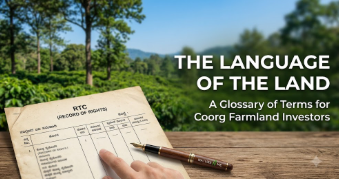
The RTC is the most fundamental document in Karnataka agricultural land. Sometimes called a Pahani, it is a government record maintained by the village accountant (Revenue Inspector) that documents the legal owner of the land, the survey number and extent in acres and guntas, the soil classification, the crops currently being grown, the water source (irrigated or rain-fed), and any rights, encumbrances, or liabilities registered against the land. The RTC is updated when ownership changes (mutation) or when crop records are revised. Always ask for the latest RTC — obtained within the past 30 days — before any purchase.
Pahani
Pahani is another name for the RTC — the terms are used interchangeably in Karnataka. In common usage among local farmers and officials, Pahani is the more frequently used term. When your lawyer or Nature N Me‘s team refers to the Pahani, they mean the RTC document.
Mutation (Khata Transfer)
Mutation is the process by which the RTC is updated to reflect a new owner’s name after a land purchase, gift, or inheritance. When you buy agricultural land in Karnataka, the sale deed transfers legal ownership — but the RTC still shows the previous owner’s name until mutation is completed. Mutation is applied for at the local taluk office and typically takes 4–8 weeks. A completed mutation with your name in the RTC is the confirmation that the administrative ownership transfer is fully complete.
Encumbrance Certificate (EC)
The EC is a document issued by the sub-registrar’s office showing all registered transactions on a specific property over a defined period — typically 13 to 30 years. It lists all sale deeds, mortgage deeds, gift deeds, and any court orders or attachments registered against the property. A clean EC with no encumbrances is essential before purchase. EC can be obtained from the Kaveri Online Services portal in Karnataka.
Survey Number
Each piece of agricultural land in Karnataka is identified by a unique survey number within its village and hobli. The survey number is the identifier that links the physical land on the ground to all government records — RTC, mutation, EC, and the sale deed. When you purchase farmland in Coorg, your sale deed will specify the survey number (and sub-division number if the plot has been divided) you are acquiring. This is the specific parcel that becomes yours.
Guntas
Agricultural land in Karnataka is measured in acres and guntas. One acre equals 40 guntas. Smaller plots are described in guntas — a plot of “12 guntas” is 12/40ths of an acre, or 0.3 acres. Survey extracts and RTCs frequently show land area in acres and guntas together (for example, “2 acres 16 guntas” means 2.4 acres).
DC Conversion
DC Conversion refers to a Divisional Commissioner order that converts agricultural land to non-agricultural use. Land that has undergone DC conversion is no longer classified as agricultural — it may be used for residential, commercial, or industrial purposes depending on the conversion order. From a farmland investment perspective, DC conversion is generally something to avoid: a plot with conversion status loses its agricultural income tax exemption and may be subject to different land-use regulations. Verify that any plot you are considering has not been converted, and check the RTC classification carefully.
Guideline Value
The guideline value is the Karnataka government’s minimum registered value per unit area for land in a specific locality. It is published by the stamps and registration department and updated periodically. Stamp duty on a land purchase is calculated on the higher of the guideline value or the actual transaction value. Understanding the guideline value helps investors verify that a quoted land price is reasonable relative to government benchmarks, and estimate stamp duty liability before purchase.
Patta
Patta is a term used more commonly in Tamil Nadu than Karnataka, referring to the document of title for land. In Karnataka, the equivalent concept is captured in the RTC and sale deed. You may encounter the term patta in conversations with sellers or brokers who use pan-South Indian land terminology loosely — clarify that in Karnataka, the RTC and registered sale deed serve the function that patta serves in Tamil Nadu.
Hobli
A hobli is an administrative subdivision of a taluk — a cluster of villages under a revenue inspector’s jurisdiction. Land records in Karnataka are organised by district, taluk, and hobli. When identifying a plot’s administrative location, you will see it described as, for example, “Madikeri Taluk, Balele Hobli” — this tells you exactly which revenue circle the land falls under.
Taluk
A taluk is an administrative division of a district. Kodagu district has three taluks: Madikeri, Virajpet, and Somwarpet. The taluk determines which sub-registrar’s office handles the land registration and which taluk office processes mutations. Nature N Me’s primary projects are in Madikeri taluk.
Agroforestry
Agroforestry is the deliberate integration of trees, crops, and sometimes livestock on the same piece of land in a designed, multi-layered system. In Coorg’s context, this means coffee under the shade of silver oak and teak, with pepper vines climbing the shade trees, cardamom in the understorey, and fruit trees interspersed throughout — all on the same acre, producing multiple income streams simultaneously.
Bhoomi Portal
Bhoomi is Karnataka’s online land records portal (landrecords.karnataka.gov.in) where RTCs, mutation records, and other land information can be accessed by survey number. Investors can use Bhoomi to independently verify the ownership records of any Karnataka agricultural land plot before or after purchase.
Kaveri Online Services
Kaveri (kaverionline.karnataka.gov.in) is the Karnataka government’s online portal for stamp duty and registration-related services, including the ability to obtain encumbrance certificates online. It is the primary tool for verifying that a plot has no registered encumbrances before purchase.
Management Agreement
In the managed farmland context, the management agreement is the contract between the landowner (investor) and the management company (Nature N Me) that specifies the scope of agricultural management services provided, the fee structure, income-sharing terms, reporting obligations, and the duration of the arrangement. Always read the management agreement carefully and have it reviewed by a lawyer before signing.
Armed with this vocabulary, your conversations about Coorg farmland purchase and management will be significantly more confident and productive. For any term not covered here, Nature N Me’s team is happy to explain it clearly before you commit to any decision.