
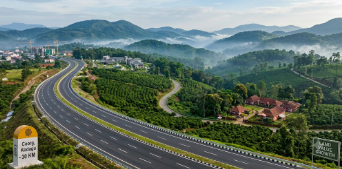
Land appreciation is driven by many factors — soil quality, agricultural productivity, tourism demand, and buyer sentiment. But one of the most powerful and often underestimated drivers is infrastructure development. When road connectivity improves, travel times shorten, and a region becomes more accessible, land values respond — sometimes dramatically.
Coorg and the surrounding Kodagu region are currently in the middle of exactly this kind of infrastructure-driven value shift, and understanding it helps explain why land price appreciation in the region has been running significantly ahead of broader Karnataka averages.
The NH-275 Upgrade: Bangalore to Mysuru
The National Highway 275 connecting Bangalore to Mysuru was upgraded to a six-lane access-controlled expressway, dramatically cutting travel time between the two cities to under 90 minutes. This improvement has a direct knock-on effect on Coorg: Mysuru is the primary junction on the route to Madikeri, and a faster Bangalore-Mysuru connection reduces the effective distance between Bangalore and Coorg.
What was once a full-day journey from Bangalore to Coorg is now routinely completed in 5–5.5 hours, with the Bangalore-Mysuru leg taking just 90 minutes and the Mysuru-Madikeri leg via Hassan or Kushalnagar taking 3–3.5 hours. This accessibility shift has meaningfully expanded the pool of Bangalore investors and weekend visitors who consider Coorg within practical reach.
The Mysuru-Mangaluru NH-275 Extension
Work on the national highway connecting Mysuru to Mangaluru — passing through Kushalnagar and the Coorg valley — has been ongoing with significant stretches upgraded or under improvement. Better road quality on this corridor reduces travel time from Bangalore to Madikeri by 30–45 minutes compared to five years ago, and further improvements are planned.
Mangaluru International Airport, 120 km from Madikeri, becomes more practically accessible as this highway corridor improves — opening Coorg to air-connected investors from Mumbai, Chennai, Hyderabad, and abroad.
Proposed Kodagu Airport
There have been ongoing discussions and proposals around developing a small regional airport in Kodagu district itself, which would dramatically transform accessibility — potentially reducing door-to-door travel time from major metros to under 2 hours by air. While this project is at planning stages and timelines are uncertain, even the discussion of it reflects the growing economic importance being placed on the Coorg region by state authorities.
Historically, confirmed airport development in proximity to any Indian region produces immediate and sustained land value appreciation. Investors who buy ahead of confirmed airport development — as has happened near Kempegowda International Airport’s second runway zone, or around Dholera in Gujarat — capture the full appreciation wave.
Growing Tourism Infrastructure
Coorg has seen significant growth in its formal hospitality sector over the past five years. New resorts, estate hotels, and premium farmstays have opened across Madikeri and Virajpet taluks, attracting domestic and international tourists and raising the profile of the region as a serious leisure destination. The more established Coorg becomes as a tourism destination, the higher the demand for land in the region — from both hospitality investors and individuals seeking a private retreat.
Tourism infrastructure growth is a self-reinforcing cycle: better facilities attract more visitors, more visitors raise the region’s profile, higher profile attracts more investors, more investors fund better facilities.
What This Means for Your Land Purchase Timing
Infrastructure improvements and tourism growth in Coorg are structural, not speculative. The highways are already built. The tourism growth is already happening. The investor awareness is already spreading nationally. The question for investors is not whether Coorg will appreciate — it has, and the drivers are intact — but whether you buy now, while prices are still at current levels, or later, after further appreciation has already occurred.
Infrastructure-driven land appreciation follows a predictable pattern: slow recognition in early stages, rapid acceleration once improvements are complete and widely known, plateau once the market is fully priced in. Coorg appears to be in the acceleration phase of this cycle.