
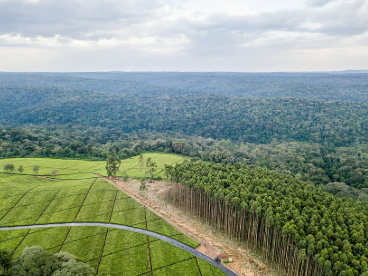
Something quietly significant is happening on the outskirts of Bengaluru and in the lush hills of Karnataka.
Every weekend, chartered accountants, IT professionals, startup founders, doctors, and NRIs are making trips — not to buy a flat or a villa — but to walk through coffee estates, areca nut plantations, and mango orchards. They are asking about soil quality, water sources, and crop yields. And many of them are writing cheques for farmland.
The trend of Bangalore investors buying farmland has accelerated dramatically since 2021, and it shows no sign of slowing down. In fact, land registrations for agricultural plots within 200 km of Bengaluru have grown year on year, with popular destinations like Coorg, Sakeleshpur, Chikmagalur, Kodihalli, and Ramanagara recording all-time highs in enquiries from urban buyers.
So what is driving this? Is it a passing trend or a fundamental shift in how India's wealthiest city thinks about wealth?
THE CITY THAT OUTGREW ITSELF
Bengaluru is one of the fastest-growing cities in Asia. Home to over 13 million people and the engine of India's technology economy, it has created more millionaires per square kilometre than almost any other Indian city.
But that prosperity has come at a cost.
Real estate prices in Bengaluru have become punishing. A 3BHK apartment in Whitefield or Sarjapur now costs ₹1.2 – 2.5 crore. Commercial real estate in prime zones is priced beyond most individual investors. And with the city expanding in every direction, the quality of life — traffic, air quality, water scarcity, noise — has steadily declined.
For a generation of Bangalore investors who are asset-rich, time-poor, and increasingly conscious about quality of life, farmland has emerged as the obvious alternative.
It offers what the city cannot: open space, clean air, connection to nature, strong returns, and the psychological comfort of owning something real.
7 REASONS WHY BANGALORE INVESTORS ARE BUYING FARMLAND
1. FARMLAND PRICES ARE STILL AFFORDABLE (COMPARED TO CITY REAL ESTATE)
The most immediate reason is simple arithmetic.
A 1 BHK apartment in a good Bengaluru locality costs ₹60 – 90 lakh. For the same amount, a Bangalore investor can buy 3 to 6 acres of productive farmland in Sakeleshpur, Ramanagara, or Kolar — land that generates actual income from crops and has significant appreciation potential.
Farmland near Bangalore is still affordable relative to urban property, giving investors more asset for their money, a diversified income source, and a hedge against city-specific real estate risks.
2. CONSISTENT ANNUAL RETURNS FROM CROPS
Unlike an apartment that generates rental income of 2–3% per year (before maintenance, vacancy, and taxes), farmland generates active income from crops.
Popular crops grown on managed farmland near Bangalore include:
- Areca nut (betel nut): ₹10 – 18 lakh per 5 acres annually
- Coffee (Robusta/Arabica): ₹8 – 15 lakh per 5 acres annually
- Sandalwood: Long gestation but high terminal value (₹6,000+ per kg)
- Mango, banana, and horticulture: ₹3 – 8 lakh per acre depending on variety
- Teak and timber: Passive wealth creation over 15–20 years
For investors using managed farmland models, annual yield distributions of 4–8% on invested capital are common, with additional returns from land appreciation.
3. TAX BENEFITS THAT URBAN REAL ESTATE CANNOT MATCH
This is one of the least-discussed but most powerful reasons why Bangalore investors are buying farmland.
Agricultural income in India is completely exempt from income tax under Section 10(1) of the Income Tax Act. This means:
- Crop income, farm produce sales, and lease income from agricultural operations are tax-free
- There is no GST on the sale of unprocessed agricultural produce
- Long-term capital gains on agricultural land in rural areas are exempt from capital gains tax under Section 54B (with reinvestment conditions)
For a high-income IT professional or business owner in the 30% tax bracket, this is enormously attractive. Earning ₹10 lakh per year from an areca nut farm, completely tax-free, is the equivalent of earning ₹14.3 lakh in taxable salary income.
No other legal investment class in India offers this combination of income exemption and capital gains protection.
4. LAND APPRECIATION IN EMERGING FARM BELTS
The real wealth creation story of farmland near Bangalore is appreciation.
Look at what has happened in areas that were once ignored:
- Kanakapura Road land prices rose 4x between 2010 and 2020
- Ramanagara farmland, priced at ₹5 – 8 lakh per acre in 2015, now commands ₹18 – 30 lakh
- Sakeleshpur land values have grown 15 – 22% CAGR as investor interest accelerates
- Coorg estate prices have compounded at 12 – 18% annually over the last decade
Infrastructure projects — new expressways, highway widening, industrial corridors near Hassan and Tumkur — are consistently unlocking new belts of appreciation for farmland investors who get in early.
5. MANAGED FARMLAND — ZERO EFFORT, REAL RETURNS
One of the biggest historical barriers to farmland investment was the requirement of personal involvement. Most Bangalore investors do not have the time, knowledge, or inclination to manage crop cycles, labour, irrigation, and marketing.
Managed farmland companies have solved this problem.
These are professionally run platforms — many SEBI-registered as Alternative Investment Funds (AIFs) — that acquire land, develop it into productive farms, and manage all operations on behalf of investors. Investors receive:
- Quarterly or annual distributions from crop income
- Transparent reporting on yield, expenses, and net income
- Professional management of soil health, water systems, and crop selection
- An exit mechanism through resale at appreciated land values
6. LIFESTYLE ASSET AND WELLNESS RETREAT
Beyond the financial rationale, there is a powerful emotional and lifestyle driver behind the Bangalore farmland trend.
After the COVID-19 pandemic, there was a fundamental reassessment of how people wanted to live. The trauma of being locked in apartments for months made green spaces feel like a necessity rather than a luxury.
Owning a farmland retreat — even 2 hours from the city — gives Bangalore investors and their families:
- A private weekend escape from the noise and congestion of the city
- A place to grow organic vegetables and fruits for personal consumption
- An opportunity to host friends, conduct outdoor events, or run a homestay
- A legacy asset to pass down to children and grandchildren
- A connection to the land and seasonal rhythms that city life cannot provide
Many investors report that the lifestyle benefit alone is worth the investment — with the financial returns being the bonus.
PORTFOLIO DIVERSIFICATION AND INFLATION HEDGE
For investors who are already heavy in equities, mutual funds, and urban real estate, farmland represents a fundamentally different asset class.
Land is a finite resource. Its value does not correlate with stock market movements. Agricultural income is driven by crop prices, which are linked to food inflation — meaning farmland often appreciates fastest during the periods when other assets are underperforming.
This makes farmland near Bangalore an effective inflation hedge and a true diversification tool for high-net-worth investors managing portfolios across multiple asset classes.
WHERE ARE BANGALORE INVESTORS BUYING FARMLAND?
Based on current market activity, here are the top farmland investment destinations for Bangalore investors in 2025:
COORG (KODAGU) — 250 to 290 km from Bangalore
Best for: Premium coffee estate investment, luxury homestay income, lifestyle retreat
Average price: ₹25 – 60 lakh per acre
Crop highlights: Arabica and Robusta coffee, pepper, cardamom
Investor profile: HNI, NRI, lifestyle buyer, premium investor
Why now: Limited available land, strong tourism economy, proven appreciation
SAKELESHPUR (HASSAN DISTRICT) — 220 to 250 km from Bangalore
Best for: High-yield areca nut farming, high growth appreciation, emerging tourism
Average price: ₹10 – 28 lakh per acre
Crop highlights: Areca nut, Robusta coffee, black pepper
Investor profile: Growth-focused investor, first-time farmland buyer, managed farmland seeker
Why now: Lower entry price, 15–22% CAGR appreciation, improving infrastructure
CHIKMAGALUR — 240 to 260 km from Bangalore
Best for: Coffee estate and tourism, weekend retreat
Average price: ₹20 – 45 lakh per acre
Crop highlights: Coffee, pepper, vanilla, ginger
Investor profile: Lifestyle investor, tourism income seeker
RAMANAGARA AND KANAKAPURA — 50 to 90 km from Bangalore
Best for: Proximity to Bengaluru, horticulture and organic farming, weekend farm
Average price: ₹15 – 35 lakh per acre
Crop highlights: Mango, pomegranate, vegetables, mulberry
Investor profile: Weekend farm buyer, proximity-driven investor, organic farming enthusiast
KOLAR AND CHINTAMANI — 70 to 100 km from Bangalore
Best for: Affordable entry, mango orchards, proximity to tech corridors
Average price: ₹8 – 20 lakh per acre
Crop highlights: Tomatoes, mango, grapes, groundnut
Investor profile: Budget-conscious investor, first-time buyer
FARMLAND VS REAL ESTATE — THE HONEST COMPARISON
Many Bangalore investors ask: should I buy a flat or farmland?
Here is a direct comparison:
RETURNS
- Apartment rental yield: 2 – 3% per year (taxable)
- Farmland crop yield: 4 – 8% per year (tax-exempt for agricultural income)
Winner: Farmland
CAPITAL APPRECIATION
- Urban apartment (Bengaluru average): 6 – 10% CAGR
- Farmland near Bengaluru (growth belt): 10 – 22% CAGR depending on location
Winner: Farmland (in growth belts)
TAX EFFICIENCY
- Rental income: Taxable as income
- Agricultural income: Exempt under Section 10(1)
- Capital gains on apartment: 20% LTCG after indexation
- Capital gains on rural agricultural land: Exempt under Section 54B
Winner: Farmland (significantly)
MAINTENANCE AND MANAGEMENT
- Apartment: Society maintenance, tenant management, vacancy risk
- Managed farmland: Handled by professional management company
Winner: Farmland (with managed model)
LIFESTYLE VALUE
- Apartment: None beyond living
- Farmland: Weekend retreat, organic food, nature access, legacy asset
Winner: Farmland
LIQUIDITY
- Apartment: Moderate (can sell in 1 – 3 months)
- Farmland: Lower (may take 3 – 12 months, legal checks required)
Winner: Real estate
Overall: For investors with a 5+ year horizon, farmland consistently outperforms urban real estate on a risk-adjusted, after-tax basis.
IMPORTANT THINGS TO KNOW BEFORE BUYING
1. Karnataka Land Reforms Act: Only agriculturalists can buy agricultural land in Karnataka. Non-farmers (most urban investors) must either purchase DC-converted land, invest through a managed farmland AIF, or form an agricultural cooperative.
2. Legal Due Diligence: Always check the title through the Karnataka Bhoomi portal, obtain a 30-year Encumbrance Certificate, verify RTC documents, and confirm there are no government acquisition notices.
3. Water Source: Confirm borewell depth, yield, and any water-sharing agreements before purchase. Crop viability depends entirely on reliable water access.
4. Managed Farmland Compliance: If investing through a managed farmland platform, verify the company is registered with SEBI, has clean title to the land, and provides a transparent lease or co-ownership agreement.
5. Infrastructure Check: Verify road access, power connection, and proximity to the nearest town for labour and logistics.
IS NOW A GOOD TIME TO BUY FARMLAND NEAR BANGALORE?
Yes — and here is why.
Land near Bengaluru and in the Western Ghats belt is still in the early-to-mid phase of a long appreciation cycle. Infrastructure projects — the Bengaluru–Mysuru Expressway, the peripheral ring road, the Hassan–Mangaluru highway upgrade — are systematically unlocking new investment belts.
The managed farmland industry in India is projected to grow significantly over the next decade as institutional capital, regulatory clarity, and investor awareness combine to professionalise the sector.
Urban buyers who get in now — before land prices in Sakeleshpur, Ramanagara, and Kolar reach Coorg-level valuations — will look back on 2025–2026 as the ideal entry window.
The fundamentals are clear: limited land, growing urban demand, strong crop economics, unmatched tax efficiency, and a lifestyle premium that is only going to increase as Bengaluru continues to grow.
CONCLUSION
The Bangalore farmland investment trend is not a fad. It is a rational, data-backed response by one of India's most financially sophisticated investor populations to a simple truth: land is finite, food will always be needed, and the combination of tax-free agricultural income, strong appreciation, and lifestyle value is simply too compelling to ignore.
Whether you are a first-time buyer looking at a 2-acre mango orchard in Ramanagara, a seasoned HNI evaluating a coffee estate in Coorg, or an NRI exploring managed farmland options in Sakeleshpur — the opportunity is real, the market is active, and the time to act is now.
Start with your budget. Define your goals — income, appreciation, or lifestyle. Do your legal due diligence. And find land that fits.
Because in 10 years, the investors who are buying farmland near Bangalore today will be the ones who made the smartest move of their financial lives.