
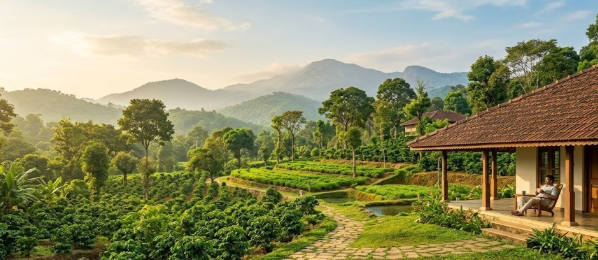
A deep-dive comparison of Karnataka’s two most sought-after agricultural destinations — from land prices and crop yields to ROI and lifestyle appeal.
“Karnataka’s Western Ghats have quietly become the most exciting frontier for farmland investment in India — and two names dominate every conversation: Coorg and Sakeleshpur. But which one is right for your portfolio?”
At a Glance
Both Coorg (Kodagu) and Sakeleshpur (Hassan district) sit in the mist-laden folds of the Western Ghats. Both produce world-class coffee, pepper, and cardamom. But beneath the surface, they are strikingly different propositions — in land prices, scalability, infrastructure, and investment thesis
Coorg (Kodagu)
India’s Coffee Capital
Avg. land price₹25–60 L/acre
Primary cropsCoffee, pepper, cardamom
Elevation900–1750 m
Tourism pullVery High
Entry barrierHigh
Nearest cityMysuru (~120 km)
Sakeleshpur
Emerging Green Corridor
Avg. land price₹10–28 L/acre
Primary cropsCoffee, areca nut, pepper
Elevation800–1400 m
Tourism pullModerate (rising)
Entry barrierModerate
Nearest cityHassan (~30 km)
Land Prices & Investment Potential
Coorg farmland for sale commands a premium — and for good reason. Decades of brand equity, a robust tourism economy, and limited available land have pushed prices in Madikeri, Virajpet, and Somwarpet to ₹30–60 lakh per acre for developed coffee estates. Entry-level parcels near periphery zones start around ₹25–30 lakh.
Price Appreciation
Coorg estate prices have appreciated 12–18% CAGR over the last decade, driven by tourism infrastructure and NRI demand. Sakeleshpur, by contrast, is seeing 15–22% CAGR from a lower base — making it the higher-growth bet for capital appreciation in the 5–10 year window.
Sakeleshpur farmland investment offers what Coorg offered 15 years ago: affordability, growth headroom, and the same Western Ghats microclimate. At ₹10–20 lakh per acre, investors can acquire 3–5x more land for the same budget, diversifying crop risk and increasing lease income.
Crops, Yield & Annual Returns
Both regions are classified as Zone A coffee-growing areas by the Coffee Board of India. However, crop diversity and revenue mix differ meaningfully.
Coorg Crop Profile
Arabica and Robusta coffee dominate, with pepper grown as an intercrop on shade trees. Cardamom cultivation in the higher elevations commands premium export pricing. A mature 5-acre estate can generate ₹8–15 lakh/year in gross farm income.
Sakeleshpur Crop Profile
Sakeleshpur’s star is areca nut (betel nut) — one of India’s most profitable commercial crops — alongside Robusta coffee and black pepper. Areca nut alone on a 5-acre plot can yield ₹10–18 lakh/year, often surpassing equivalent Coorg estates in pure cash flow.
For investors seeking managed farmland with turnkey operations, both regions now have professional farm management companies offering lease-back models at 4–7% annual returns on investment value, with upside on land appreciation.
Tourism, Homestays & Secondary Income
Coorg is one of India’s top-5 tourist destinations, receiving over 3 million visitors annually. This creates a lucrative secondary income stream: coffee estate homestays in Coorg can generate ₹5–12 lakh per year from hospitality alone, often doubling the total return on investment.
Sakeleshpur’s tourism economy is nascent but accelerating. Improved connectivity via the 4-lane Hassan–Mangaluru corridor and growing interest in offbeat destinations is bringing weekend visitors. Early-mover homestay operators here report occupancy rates of 60–75% during peak season at competitive rates — with far less competition than Coorg.
Infrastructure & Connectivity
Coorg is well-connected via Mysuru and Mangaluru, with proposals for a regional airport in advanced planning. Internal roads are well-developed. The flip side: traffic congestion during peak tourist months (October–March) is a real challenge.
Sakeleshpur sits on NH-75 (Hassan–Mangaluru highway), providing seamless connectivity to both the coast and Bengaluru (approx. 220 km). The region benefits from Hassan’s growing HSRP industrial corridor, which is bringing urbanisation pressure — a tailwind for land values.
The Verdict — Who Should Buy Where?
Choose Coorg if…
You want brand recognition, tourism income, proven estate management, and are comfortable paying a premium for lower risk and established infrastructure.
Choose Sakeleshpur if…
You want higher growth potential, more land per rupee, strong areca nut cash flows, and are positioned to benefit from an emerging market before it matures.
For capital appreciation
Sakeleshpur offers the stronger appreciation trajectory (2026–2033 window) as infrastructure and urban spillover from Hassan and Mangaluru accelerate.
For lifestyle + income
Coorg wins on lifestyle value — it’s India’s most coveted farmstay destination, with a mature tourism economy underpinning homestay revenue year-round.
Key Considerations Before Buying
Whether you’re looking at buy agricultural land in Karnataka for the first time or expanding an existing portfolio, keep these factors in mind:
Due Diligence Checklist
1. Title & encumbrance check — Karnataka land records (Bhoomi portal) and 30-year EC are non-negotiable.
2. Non-agricultural conversion — Verify if the land is DC-converted for residential/commercial use, which affects resale value significantly.
3. Water source — Borewells, natural streams, and irrigation rights are critical for coffee and areca nut cultivation.
4. Managed farmland models — If you are NRI or non-farmer, opt for SEBI-registered AIF farm funds or lease-back models to remain compliant with Karnataka land reform laws.
Disclaimer: The information provided in this article is for educational and informational purposes only and does not constitute legal, financial, or real estate investment advice. Land prices, crop yields, ROI estimates, and tourism figures mentioned are based on current market trends and historical data, which are subject to change over time. Farmland investments carry inherent market and agricultural risks. Prospective buyers are strongly advised to conduct independent due diligence—including title verification via official channels like the Bhoomi portal and consulting with qualified legal and financial experts—before making any property purchases or investment decisions in Karnataka.
Frequently Asked Questions
Q1: Which region offers a lower entry cost for buying farmland?
A: Sakeleshpur is significantly more affordable, with land prices starting around ₹10–28 lakh per acre compared to Coorg’s ₹25–60 lakh per acre.
Q2: Which location is better for capital appreciation?
A: Sakeleshpur offers higher growth potential (15–22% CAGR) due to ongoing infrastructure developments and entry-level land valuations.
Q3: Can non-farmers buy agricultural land in Karnataka?
A: Yes. Under the revised Karnataka Land Reforms Act, non-agriculturists can purchase agricultural land, though title verification and compliance checks are still essential.
Q4: Which region generates better secondary income from homestays?
A: Coorg leads in hospitality income due to its established tourist footfall, allowing estate owners to generate ₹5–12 lakh annually from farmstays.
Q5: What are the primary crops grown in Coorg vs. Sakeleshpur?
A: Coorg primarily produces Arabica/Robusta coffee, black pepper, and cardamom, while Sakeleshpur yields Robusta coffee, pepper, and high-revenue areca nut.
Q6: What is the distance to these destinations from Bengaluru?
A: Sakeleshpur is closer at approximately 220 km via the 4-lane NH-75 highway, whereas Coorg is roughly 240–260 km away.