
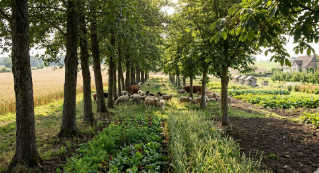
For decades, clearing trees from farmland was called progress. Today, farmers are planting them back — and the results are hard to argue with.
Agroforestry — the practice of integrating trees with crops or livestock — is gaining traction across the world, and the reasons are both ecological and economic.
More Than Shade
Trees do far more than block sun. Their deep roots break up compacted soil, draw up nutrients that shallow-rooted crops can’t reach, and reduce water runoff during heavy rainfall. Nitrogen-fixing species like alder and black locust actively fertilize the land around them. Over time, the soil beneath a well-managed agroforestry system becomes richer, not poorer — the opposite of what conventional monocultures typically produce.
For livestock farmers, trees in pasture mean lower heat stress on animals, better forage persistence through dry summers, and reduced reliance on expensive supplementary feed. Studies consistently show improved weight gain and milk yields in shaded paddocks compared to open ones.
A Second Income Stream
Trees also produce things. Timber, fruit, nuts, cork, fodder — depending on species, a tree planted today becomes a revenue-generating asset in five, ten, or thirty years. That income is largely decoupled from the commodity price swings that make conventional farming financially precarious.
Add carbon credits and biodiversity payments — both increasingly available to farmers who integrate trees — and the economics become even more compelling.
The Catch
Agroforestry asks farmers to think in decades, not seasons. Trees take time, and the upfront costs of establishment — seedlings, guards, fencing — are real. Extension support remains thin in most regions, and agricultural policy has been slow to fully reward integrated systems.
But those gaps are closing. And the farmers who planted trees ten years ago aren’t asking whether it was worth it.