
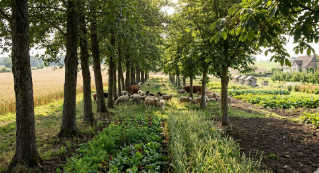
Across the tropics and temperate zones alike, a quiet agricultural revolution is taking root — quite literally. Farmers from Karnataka to Kansas are rediscovering what indigenous communities have practiced for millennia: that trees and crops are not rivals for the land, but partners in it. This is agroforestry, and it may represent one of the most powerful tools humanity possesses for simultaneously feeding the world and healing it.
At its simplest, agroforestry is the intentional integration of trees or shrubs into crop and livestock systems. But the simplicity of that definition belies the extraordinary complexity and richness of what such integration can produce. A well-designed agroforestry system does not merely grow two things in one place — it generates an emergent whole that is more productive, more resilient, more biologically diverse, and more economically stable than the sum of its parts.
In an era defined by the twin crises of climate breakdown and ecological degradation, agroforestry occupies a rare position: it is simultaneously a mitigation strategy, an adaptation strategy, and a livelihood strategy. Understanding why requires looking closely at both the ecological mechanics of what trees do in a landscape, and the economic realities of what they mean for the farmers who tend them.
01
What Is Agroforestry — and Why Now?
Agroforestry is not a single practice but a family of land-use systems that share a defining characteristic: the deliberate presence of woody perennials — trees, shrubs, bamboo — alongside annual crops, pastures, or livestock. The World Agroforestry Centre (ICRAF) identifies over a dozen major system types, each suited to different climates, cultures, and economic contexts.
| System Type | Description | Common Examples |
|---|---|---|
| Alley Cropping | Crops grown in alleys between rows of trees or shrubs | Maize between leucaena hedgerows in West Africa |
| Silvopasture | Trees integrated into grazing land for shade and fodder | Pine-grassland systems in the southeastern USA |
| Homegardens | Multilayered mixed gardens near dwellings | Javanese pekarangan gardens in Indonesia |
| Windbreaks / Shelterbelts | Tree rows protecting crops and soil from wind | Planted hedges across the Sahel region |
| Forest Farming | Cultivating shade-tolerant crops under tree canopy | Ginseng or mushrooms under oak canopies |
| Riparian Buffers | Trees and shrubs along waterways | Willow and alder strips bordering streams |
| Taungya | Crops grown between newly planted trees until canopy closes | Traditional teak + food crop systems in Myanmar |
What unites all these systems is a recognition that trees are not passive background features of a farm — they are active, functional infrastructure. They shape microclimates, regulate hydrology, fix nitrogen, provide habitat, and create economic outputs of their own. The question in agroforestry is always: how do we design the combination so that the trees amplify rather than compete with what the rest of the farm needs to do?
The urgency of this question has never been greater. Industrial monoculture — the dominant paradigm of 20th-century agriculture — has delivered extraordinary yield gains, but at severe ecological cost. Soil degradation now affects roughly one-third of Earth’s agricultural land. Synthetic fertilisers and pesticides have polluted waterways globally. Deforestation driven by agricultural expansion accounts for approximately 10–12% of annual greenhouse gas emissions. These are not peripheral problems. They are existential ones — and they are increasingly visible to farmers themselves, who confront erratic rainfall, declining soil health, and market volatility with fewer and fewer buffers.
02
How Agroforestry Heals the Environment
The environmental case for agroforestry is multi-dimensional and, in aggregate, compelling. Trees in agricultural landscapes do not merely perform one function — they perform many simultaneously, and those functions interact and reinforce each other in ways that conventional, tree-free agriculture cannot replicate.
🌿
Carbon Sequestration
Trees absorb carbon dioxide and store it in biomass and soil. Agroforestry systems can sequester 2.5 to 9 tonnes of carbon per hectare per year — meaningfully more than conventional cropland. The IPCC recognises agroforestry as a significant natural climate solution with realistic global potential of over 1 gigaton of CO₂-equivalent annually.
💧
Water Cycle Regulation
Tree roots channel rainfall deeper into the soil profile, recharging groundwater and reducing runoff. Their canopies intercept and evaporate rain before it can compact bare soil. In watershed studies across Asia and Africa, agroforestry plots consistently show 30–50% lower surface runoff and significantly reduced flooding risk during intense rainfall events.
🌱
Soil Health Restoration
Leaf litter, root exudates, and biological nitrogen fixation by leguminous trees all feed the soil microbiome. Studies in sub-Saharan Africa have documented remarkable soil recovery under Faidherbia albida agroforestry systems, with organic matter content doubling within a decade and maize yields increasing 100–400% without additional fertiliser inputs.
🦋
Biodiversity Corridors
Agricultural land is among the most biodiversity-depleted on Earth. Trees in fields provide nesting sites, food sources, and movement corridors for birds, insects, and mammals. Research in Costa Rica and Ethiopia shows that agroforestry landscapes harbour 50–100% more bird species than equivalent monoculture plots, and significantly higher pollinator diversity.
🌡️
Microclimate Moderation
Tree shade reduces peak soil and air temperatures by up to 8°C, a critical buffer as climate change pushes temperatures beyond the thermal tolerance thresholds of many crops. For coffee, cocoa, and tea — crops inherently vulnerable to heat stress — shade trees are transitioning from optional to essential within the coming decades.
🌬️
Erosion Control
The United Nations estimates that 24 billion tonnes of fertile topsoil are lost globally each year, largely through wind and water erosion on bare agricultural land. Tree roots bind soil while canopies absorb the kinetic energy of rainfall. Hedgerow systems on slopes can reduce erosion rates by over 90% compared with unprotected cropland.
90%Reduction in soil erosion rates with agroforestry hedgerows on sloped land
8°CLower peak temperatures under agroforestry canopy vs open monoculture
2×Increase in bird species diversity in agroforestry vs equivalent monoculture land
Perhaps most importantly, these benefits are not additive in a simple sense — they are synergistic. When a tree cools the microclimate, it also reduces the water stress on crops, which reduces the need for irrigation, which reduces energy use and aquifer depletion. When a tree fixes nitrogen, it reduces fertiliser demand, which reduces emissions from fertiliser production and application. Ecosystem services in well-designed agroforestry systems compound upon each other, creating resilience that no single intervention could achieve alone.
There is also the question of deforestation pressure. One of the primary drivers of tropical forest loss is the expansion of agricultural frontier — smallholders and large estates alike clearing forest for new cropland as existing land degrades. Agroforestry, by maintaining and restoring productivity on existing agricultural land, can reduce the economic pressure to clear new forest. In Ethiopia, landscape-scale agroforestry programmes have been credited with reversing regional deforestation trends that persisted for decades.
03
How Agroforestry Benefits the Farmer
Environmental arguments, however compelling, rarely by themselves drive agricultural transformation. Farmers make decisions based on economic realities: income, risk, labour, capital, and market access. For agroforestry to scale, it must make sense on the farm balance sheet. And increasingly, the evidence suggests that it does — often dramatically so.
Field Evidence · Bihar, India
In India’s Bihar state, an ICRAF-supported programme introduced poplar-wheat agroforestry to smallholder farmers on plots averaging under two hectares. Within five years, participating farmers reported a 35–40% increase in total farm income compared with wheat monoculture. The poplars, harvested on an eight-year rotation for timber, provided a lump-sum payment that many farmers used to pay school fees, invest in irrigation equipment, or repay debt — assets unavailable to neighbours farming the same land conventionally.
The economic logic of agroforestry for farmers operates on several levels simultaneously, each addressing a different vulnerability in the conventional model.
Income diversification is perhaps the most fundamental. A farmer growing only wheat is exposed to wheat prices. A farmer growing wheat alongside timber trees, fruit trees, and fodder shrubs has four income streams with different market cycles, different risk profiles, and different harvest timings. The timber is a long-horizon asset — slow, patient capital that grows in value while requiring minimal ongoing input. The fruit tree provides annual income. The fodder shrub reduces livestock feed costs. The wheat pays the immediate bills. No single bad season or market downturn can destroy this system’s economic foundation.
Research across multiple continents consistently shows that agroforestry farmers display substantially lower income variance than monoculture counterparts — not necessarily higher average income (though that is common too), but importantly, lower risk. For smallholder households operating at or near subsistence margins, risk reduction is often more valuable than yield maximisation. A system that reliably produces adequately is more valuable than one that sometimes produces abundantly and sometimes fails.
The role of trees as living capital assets deserves particular emphasis. In many rural communities in the developing world, formal financial infrastructure — savings accounts, credit, insurance — is either unavailable or prohibitively expensive. Trees on a farm function as a form of savings that cannot be inflated away, that accumulate value over time, and that can be liquidated when needs arise. Anthropologists studying agroforestry adoption in West Africa have documented farmers explicitly describing their trees in these terms — as a “bank account” for emergencies, school fees, or social obligations like weddings and funerals.
35%Average income increase for smallholders adopting agroforestry (ICRAF, multi-country data)
40%Reduction in purchased fertiliser costs through nitrogen-fixing agroforestry systems
3×More stable income variability vs monoculture in drought years
Input cost reduction is another major economic advantage, though it is often underappreciated because it shows up as avoided costs rather than earned income. Nitrogen-fixing trees — leucaena, Faidherbia, Gliricidia, Tephrosia — can supply 50–200 kg of nitrogen per hectare per year through leaf litter and root turnover, substantially reducing dependence on purchased synthetic fertiliser. In countries where fertiliser must be imported and subsidies are declining, this is not a marginal benefit — it is transformative. Studies in Malawi found that farmers practicing “fertiliser tree” agroforestry spent 40–60% less on fertiliser while maintaining or improving yields.
Trees also provide climate adaptation benefits that translate directly into economic resilience. As rainfall becomes more erratic and heat events more frequent, the microclimate buffering provided by tree cover increasingly functions as yield insurance. Coffee farmers in Central America growing under shade trees showed 30–40% less yield loss during the 2015–16 El Niño drought compared with farmers in full-sun monoculture systems. The trees were not just an environmental good — they were a hedge against climate risk with quantifiable economic value.
Field Evidence · Sahel, West Africa
Across Niger, Burkina Faso, and Mali, a movement known as Farmer-Managed Natural Regeneration (FMNR) — essentially a low-cost agroforestry approach where farmers selectively protect and manage spontaneously regenerating trees on their cropland — has transformed agricultural outcomes for millions of families. Studies led by researcher Chris Reij documented that farmers practicing FMNR produced on average 500 kg more millet per hectare than neighbours on treeless fields, and maintained far higher yields during drought years. The approach requires virtually no capital input — only a change in how farmers relate to the trees already present in their landscape.
The timber and non-timber forest product revenues that agroforestry generates should not be underestimated. Globally, non-timber forest products — fruits, nuts, resins, medicines, dyes, fibres — represent a multi-billion dollar market, much of which is supplied by agroforestry systems. Indian farmers growing amla (Phyllanthus emblica) in agroforestry plots sell to a lucrative Ayurvedic medicine market. Ethiopian farmers managing wild-coffee agroforests supply premium shade-grown coffee to specialty roasters commanding triple the commodity price. Peruvian smallholders growing cacao in forest gardens earn certified organic premiums unavailable to conventional producers. These market linkages are expanding, as consumer demand for sustainably and traceable-produced food grows in high-income markets globally.
04
Barriers, Challenges, and the Path Forward
If agroforestry is so beneficial — ecologically and economically — why has it not already displaced industrial monoculture? The question is fair, and the honest answer is that agroforestry faces real, structural barriers that go beyond farmer conservatism or lack of awareness.
The most fundamental is time. Trees take years to mature. A farmer who plants nitrogen-fixing trees today will not see their full nitrogen contribution for three to five years. A farmer planting timber trees may wait ten to thirty years for harvest. This temporal mismatch between investment and return is manageable for farmers with financial security, but deeply challenging for those operating at subsistence margins where cash is needed now, not in a decade. Bridging finance, payment for ecosystem services, and insurance products calibrated to agroforestry timelines are all emerging, but slowly.
Land tenure insecurity is an equally powerful barrier. A farmer who does not have secure, long-term rights to their land has no rational incentive to plant trees — someone else may harvest them. Across sub-Saharan Africa, South Asia, and Southeast Asia, land tenure reform is a prerequisite for agroforestry adoption at scale. Where tenure security has been established — through formal land titling, community land rights, or customary tenure recognition — agroforestry adoption consistently accelerates.
Agricultural policy and support systems have historically been calibrated to monoculture. Extension services, credit products, subsidy structures, research investment, and market infrastructure have all been designed around treeless farming. Redirecting these systems toward agroforestry requires political will and institutional reform that is slow and contested. There are encouraging signs — the European Union’s Common Agricultural Policy now includes agroforestry-specific payments, and India has introduced a National Agroforestry Policy — but these represent beginnings, not conclusions.
There is also the genuine complexity of agroforestry systems themselves. Getting tree-crop combinations right requires ecological knowledge — about root competition, shading dynamics, allelopathy, and nutrient cycling — that varies enormously by location. There is no single agroforestry formula that works everywhere. This means that effective agroforestry requires better localised research, better extension services, and better farmer-to-farmer knowledge networks than most countries currently possess. The knowledge infrastructure is being built, but not yet at the speed the climate situation demands.
05
Agroforestry and the Future of Food
The world will need to feed roughly ten billion people by 2050, on roughly the same amount of agricultural land that exists today, while simultaneously reducing agriculture’s greenhouse gas emissions by at least fifty percent to stay within safe climate limits. This is not a problem that industrial monoculture — as currently practised — is equipped to solve. It is too dependent on fossil-fuel-derived inputs, too ecologically fragile, and too carbon-intensive.
Agroforestry does not promise to solve every problem in food systems. But it offers something increasingly rare in sustainability discourse: a genuinely systemic intervention that addresses multiple problems simultaneously, builds on ecological processes rather than fighting them, and works within — rather than against — the economic realities of farming.
The scale of potential is staggering. The World Resources Institute estimates that restoring or establishing agroforestry on degraded agricultural land globally could sequester the equivalent of 5–8 gigatons of CO₂ annually by 2050 — comparable to closing hundreds of coal power plants. The FAO estimates that scaling agroforestry could bring over 700 million people out of rural poverty while restoring ecosystem services worth trillions of dollars in avoided costs. These are not utopian projections — they are grounded in documented outcomes from existing systems, extrapolated to the land area that could plausibly be converted.
Realising this potential requires treating agroforestry not as a niche or alternative practice, but as mainstream agricultural infrastructure — funded, researched, taught, and incentivised with the same seriousness as the green revolution technologies of the 20th century. The precedents exist. The science is mature. The farmer demand, where policies create enabling conditions, is real.
What remains is the political and institutional will to put trees back where they belong — in and among the fields, the pastures, and the landscapes on which human civilisation depends.
“The forest and the farm were never meant to be separate.”
Agroforestry is not a return to the past. It is a synthesis — combining the ecological wisdom embedded in centuries of indigenous land management with modern soil science, climate modelling, and agronomy. It is farming that thinks in decades, not seasons. Farming that builds while it harvests.
For the farmer standing at the edge of a degraded field, uncertain whether this season’s rain will come in time, the tree is more than a symbol. It is shade for the crop. It is nitrogen for the soil. It is timber for the future. It is a living argument that productivity and restoration are not opposites — but the same act performed with patience and care.
Research drawn from ICRAF, FAO, World Resources Institute, IPCC Working Group III, and peer-reviewed literature in Agroforestry Systems, Nature Sustainability, and Global Food Security.