
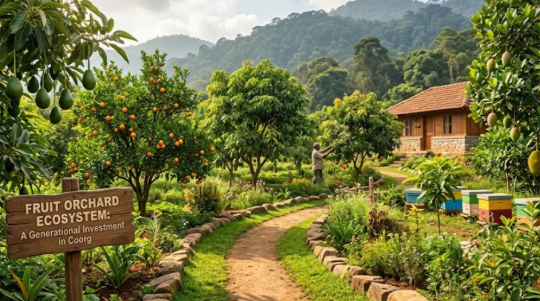
In a world where most investments exist only on screens, fruit orchards offer something beautifully real.
They grow.
They breathe.
They produce food.
They restore the environment.
And over time, they become living ecosystems that continue giving back for decades.
Today, fruit orchards are no longer viewed as just agricultural spaces. Across India and many parts of the world, orchards are becoming symbols of sustainable wealth, wellness, and future-focused living.
From mango groves and avocado farms to citrus plantations and mixed-fruit ecosystems, modern orchards are quietly becoming one of the most meaningful forms of land ownership.
And places surrounded by fertile soil and rich biodiversity — like Coorg and Madikeri — are naturally suited for this green transformation.
Why Fruit Orchards Are Making a Comeback
For years, farming focused heavily on short-term seasonal crops.
But now, many landowners are shifting toward long-term regenerative systems like orchards because they provide:
- Sustainable productivity
- Lower long-term soil damage
- Multi-generational value
- Better biodiversity
- Natural climate resilience
Unlike fast-growing seasonal farming, orchards teach patience.
A fruit tree takes time to mature.
But once established, it can continue producing for years — sometimes even decades.
That long-term relationship with the land is what makes orchards emotionally and environmentally powerful.
An Orchard Is More Than a Farm
A modern fruit orchard is not just rows of trees.
It can become:
- A biodiversity zone
- A wellness space
- A food forest
- An eco-tourism destination
- A sustainable lifestyle project
- A carbon-rich ecosystem
Many orchard owners are now combining fruit cultivation with:
- Beekeeping
- Rainwater harvesting
- Agroforestry
- Organic farming
- Farm stays
- Nature trails
This creates farms that are both productive and environmentally regenerative.
The Emotional Beauty of Orchard Living
There’s something deeply calming about walking through an orchard.
The sound of leaves moving in the wind.
The smell of ripening fruit.
The cool shade beneath trees.
The rhythm of seasonal harvests.
Unlike urban environments that constantly demand attention, orchards create stillness.
And in today’s overstimulated world, that stillness has become rare.
Many people who visit orchards describe feeling mentally lighter and emotionally calmer because nature naturally slows the nervous system.
Why Orchards Support Biodiversity
One of the biggest environmental benefits of fruit orchards is biodiversity restoration.
Healthy orchards attract:
- Birds
- Bees
- Butterflies
- Earthworms
- Pollinators
- Beneficial insects
This creates a balanced ecosystem where nature begins supporting itself.
Unlike chemically intensive monoculture farming, diversified orchards improve:
- Soil fertility
- Water retention
- Air quality
- Carbon storage
- Ecological balance
In many ways, orchards act like mini forests that also produce food.
The Rise of “Experience Farming”
Today, people no longer want only products.
They want experiences.
This is why orchard tourism is growing rapidly.
Visitors are increasingly interested in:
- Fruit-picking experiences
- Farm-to-table meals
- Orchard walks
- Organic farming workshops
- Nature photography
- Wellness retreats
For urban families and children, orchards offer educational experiences that reconnect them with where food actually comes from.
And for content creators and travelers, orchards create visually rich, peaceful environments that naturally attract attention online.
Why Fruit Orchards Are Future-Friendly Investments
As climate concerns rise globally, sustainable land systems are becoming more valuable.
Fruit orchards support:
- Long-term ecological stability
- Reduced land degradation
- Sustainable food systems
- Green cover preservation
They also align with the growing global demand for:
- Organic produce
- Locally grown fruits
- Sustainable tourism
- Eco-conscious lifestyles
This makes orchards not only environmentally important — but economically relevant for the future.
Coorg’s Climate Is Ideal for Orchard Ecosystems
Regions like Coorg naturally support orchard development because of:
- Fertile soil
- Moderate temperatures
- Rich rainfall
- Biodiversity-friendly landscapes
Depending on elevation and climate conditions, orchards in the region can support:
- Avocado
- Orange
- Mango
- Jackfruit
- Passion fruit
- Rambutan
- Guava
- Sapota
- Citrus varieties
When integrated with agroforestry methods, orchards can become highly resilient ecosystems that continue improving over time.
The Hidden Lesson Orchards Teach Us
Modern life often conditions people to expect instant results.
But orchards teach something different:
growth takes time.
A fruit tree grows slowly.
It survives storms.
It adapts to seasons.
And eventually, it gives back abundantly.
In many ways, orchards mirror life itself.
They remind people:
- To be patient
- To nurture consistently
- To think long-term
- To live closer to nature’s rhythm
That may be one reason why orchard spaces feel emotionally grounding.
Final Thoughts
Fruit orchards are no longer just agricultural landscapes.
They are becoming symbols of:
- Sustainable living
- Ecological restoration
- Wellness-focused lifestyles
- Long-term land value
- Conscious future planning
As more people search for meaningful ways to reconnect with nature, orchards offer something uniquely powerful:
A space where food, environment, peace, and purpose can grow together.
And perhaps that is why the future of farming may not simply be about producing more.
It may be about growing better.