
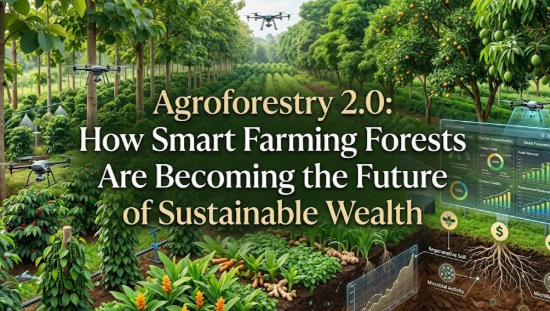
In a world where farming is battling climate change, water scarcity, declining soil fertility, and unpredictable market prices, a quiet revolution is taking root — literally. It’s called Agroforestry 2.0, a modern evolution of traditional agroforestry that blends trees, crops, technology, biodiversity, and carbon economics into one powerful farming system.
But this is not the old idea of “just planting trees on farms.”
Today’s agroforestry is becoming a high-value, climate-smart ecosystem that can generate multiple income streams while restoring the land. Across the globe, innovative farmers are turning farmland into self-sustaining green economies — and this movement is only beginning.
What Exactly Is Agroforestry?
Agroforestry is the practice of integrating trees with crops, livestock, or both on the same land. Traditionally, farmers used this system to improve soil fertility and provide shade. But modern agroforestry goes much deeper.
Today’s agroforestry combines:
- Timber trees
- Fruit orchards
- Medicinal plants
- Spice crops
- Bee farming
- Carbon farming
- Rainwater harvesting
- AI-based farm monitoring
- Regenerative soil systems
The result? Farms that are more profitable, resilient, and environmentally restorative.
Why Agroforestry Is Suddenly Gaining Global Attention
Modern agriculture has created a dangerous dependency on chemical fertilizers, monocropping, and groundwater exploitation. While crop yields increased temporarily, the long-term damage became severe:
- Soil organic matter declined
- Groundwater levels dropped
- Heat stress increased
- Biodiversity disappeared
- Farmers became vulnerable to market crashes
Agroforestry offers a solution that works with nature instead of against it.
According to environmental researchers, agroforestry systems can:
- Store significantly more carbon than traditional farming
- Reduce soil erosion naturally
- Improve rainfall absorption
- Lower farm temperatures
- Increase pollinator activity
- Create long-term passive income
And unlike seasonal farming, trees continue generating value year after year.
The Rise of “Food Forest Farming”
One of the newest and most exciting trends is the concept of food forests.
Instead of growing a single crop in straight lines, food forests mimic natural ecosystems. Different layers of crops grow together:
Upper Layer
Tall timber or fruit trees like teak, jackfruit, mango, or silver oak.
Middle Layer
Coffee, cocoa, pepper vines, moringa, banana, or papaya.
Ground Layer
Turmeric, ginger, leafy greens, herbs, or medicinal plants.
Soil Layer
Microbes, fungi, and earthworms that naturally rebuild fertility.
This multi-layer farming system creates a self-supporting ecosystem where every plant benefits another.
The best part? A single acre can produce multiple harvests throughout the year instead of depending on one seasonal crop.
Agroforestry Is Becoming a Climate Business
Here’s something most people still don’t know:
Farmers may soon earn money not only from crops — but from carbon.
Trees absorb carbon dioxide from the atmosphere. Governments and companies worldwide are now investing heavily in carbon credits, where landowners get paid for maintaining green cover and regenerative ecosystems.
This means future agroforestry farms could generate income from:
- Timber
- Fruits
- Spices
- Medicinal plants
- Eco-tourism
- Carbon credits
- Farm stays
- Organic produce
- Honey production
For younger generations, this transforms farming from a survival activity into a long-term asset-building business.
The Technology Changing Agroforestry Forever
The modern agroforestry movement is also powered by technology.
Today farmers are using:
Drone Mapping
To monitor tree health and water distribution.
AI Soil Analysis
To understand nutrient deficiencies without excessive chemical usage.
Smart Irrigation
Watering systems that reduce wastage using sensors and weather prediction.
Satellite Monitoring
Helping large farms track crop stress and forest density.
Agroforestry Design Software
Used to calculate ideal spacing between crops and trees for maximum productivity.
This fusion of ecology and technology is creating a new generation of “smart green farms.”
Why Younger Farmers Are Choosing Agroforestry
A surprising trend is emerging: many young entrepreneurs are leaving corporate jobs and investing in regenerative farmland.
Why?
Because agroforestry offers something modern life often lacks:
- Long-term sustainability
- Healthier lifestyles
- Multiple income sources
- Environmental impact
- Land appreciation
- Lower long-term risk
Unlike monocropping, diversified agroforestry systems are more resistant to climate shocks and market fluctuations.
If one crop fails, another survives.
That resilience is becoming incredibly valuable in today’s uncertain world.
India’s Massive Opportunity in Agroforestry
India is uniquely positioned to become a global leader in agroforestry because of its:
- Diverse climate zones
- Indigenous tree species
- Traditional farming wisdom
- Rising organic food demand
- Large rural workforce
Regions like Coorg, Wayanad, Chikmagalur, and parts of Karnataka are already seeing increased interest in integrated farming systems combining:
- Coffee plantations
- Pepper vines
- Fruit trees
- Medicinal crops
- Rainwater harvesting
- Eco-living spaces
This is creating a new category of sustainable land investment.
The Hidden Psychological Impact of Agroforestry
One lesser-discussed aspect is how agroforestry affects human well-being.
Studies increasingly show that biodiverse green environments reduce stress, improve mental clarity, and reconnect people with natural rhythms.
Unlike industrial farms, agroforestry landscapes feel alive.
Birds return.
Soil becomes softer.
Water retention improves.
Temperatures cool naturally.
In many ways, agroforestry is not just restoring land — it is restoring the human relationship with nature.
The Future Farm Will Look More Like a Forest
The future of farming may not be endless empty fields.
Instead, farms of the future could resemble thriving ecosystems filled with trees, biodiversity, water bodies, edible forests, and renewable energy systems.
Agroforestry is proving that productivity and sustainability do not have to compete.
They can grow together.
And as climate concerns rise globally, the farms that survive the future may not be the ones using the most chemicals — but the ones designed most intelligently with nature.
Final Thoughts
Agroforestry is no longer an alternative experiment.
It is becoming one of the most important solutions for the future of food, climate resilience, and sustainable wealth creation.
The farms that adapt early could become the most valuable landscapes of the next decade.
Because in the future, the most powerful farms may not look like factories.
They may look like forests.