
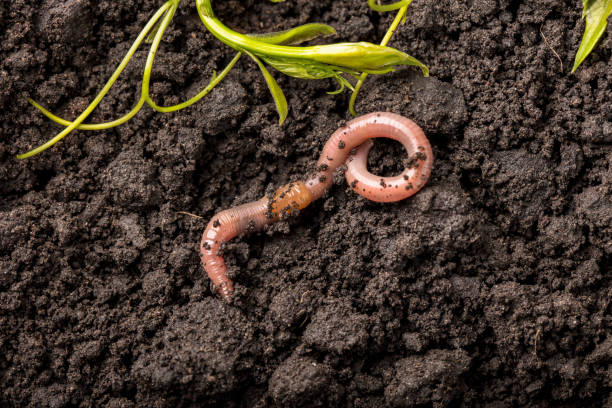
Among all the biological indicators of soil health that agricultural science has identified, earthworms are the most accessible, the most practically assessable during a site visit, and arguably the most revealing about the long-term agricultural productivity of any piece of agricultural land. The earthworm population in an agroforestry soil is not merely an ecological curiosity — it is a direct predictor of the biological processes that determine whether the soil will maintain productivity without escalating input costs or will gradually degrade despite management efforts.
What earthworms actually do in agricultural soil
Earthworms are not simply passengers in the soil ecosystem. They are active, functional engineers of the soil environment that produce measurable and important agricultural services.
Physical mixing and aeration: Earthworms burrow continuously through the soil profile, creating channels that improve water infiltration, air movement, and root penetration. Earthworm burrows are the primary pathways through which rainfall reaches the subsoil rather than running off the surface — soils with abundant earthworms infiltrate water two to five times faster than equivalent soils with few earthworms.
Organic matter processing: Earthworms consume organic matter — leaf litter, dead roots, fungal mycelium, bacteria — and process it through their digestive systems, releasing a portion of the nutrients as plant-available forms in their excreta (castings). Earthworm castings are significantly higher in plant-available nitrogen, phosphorus, and potassium than the surrounding soil — creating concentrated nutrient zones around every earthworm burrow.
Microbial inoculation: As earthworms move through the soil, they carry bacteria, fungi, and other microorganisms on their body surfaces and through their digestive systems, continuously spreading beneficial microbial populations through the soil profile. This microbial inoculation maintains the biological diversity and activity that drives nutrient cycling.
Aggregate formation: The mucus secretions of earthworms bind soil particles into stable aggregates — the crumb structure that gives healthy soil its characteristic texture and that is responsible for the water retention, aeration, and root penetration characteristics of good agricultural soil.
How many earthworms indicate healthy agroforestry soil?
Agricultural soil scientists use earthworm population density as a quick field indicator of soil biological health. As a practical assessment guide:
Fewer than five earthworms per thirty-by-thirty-by-thirty centimetre soil sample (approximately one-third of a cubic foot) indicates poor soil biological health — typically associated with compaction, low organic matter, high pesticide use, or poor drainage.
Five to fifteen earthworms per sample indicates moderate soil health — adequate for agricultural production but with room for improvement through organic matter addition and management changes.
More than fifteen earthworms per sample indicates good soil biological health — the level associated with productive, biologically active soil that supports agroforestry productivity without heavy external input requirements.
In well-managed agroforestry systems with consistent organic matter return (leaf litter, compost, green manure), earthworm populations of thirty to fifty per sample are achievable — the level at which the soil’s biological services significantly substitute for purchased fertiliser inputs.
How to assess earthworm populations during a site visit
The practical field assessment is simple and requires no equipment. Dig a sample hole approximately thirty centimetres square and thirty centimetres deep in the most actively managed section of the estate. Count all earthworms visible in the excavated soil and the hole walls. Repeat in three to four locations across the estate.
Compare the counts to the benchmarks above. A consistent pattern of low earthworm counts across multiple sample locations indicates soil management issues that will affect long-term productivity regardless of how well the above-ground crops look at the time of the visit.
During the post-monsoon period (October to November), when soil moisture is highest and earthworm activity is at its peak, is the best time to assess earthworm populations. Dry season sampling will undercount because earthworms migrate to deeper, moister soil layers during surface dryness.
What low earthworm counts tell you about a farm’s management history
Low earthworm populations on agricultural land are almost always the consequence of specific management practices: high synthetic fertiliser use (particularly ammonium sulphate, which is toxic to earthworms at high rates), synthetic pesticide use (several common fungicides and insecticides are acutely toxic to earthworms), soil compaction from heavy tillage or vehicle traffic, and low organic matter input that leaves earthworms without adequate food.
An estate with consistently low earthworm counts has a soil health history that suggests these practices have been present — and the soil is likely more degraded biologically than its surface appearance suggests. Restoring earthworm populations to healthy levels requires two to four years of management change — during which the estate’s input costs are higher and productivity gains are slower than on a farm with an already-healthy earthworm population.