
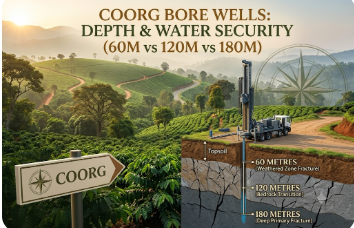
Bore well depth is among the most frequently quoted but least explained specifications in Coorg farmland documentation. Sellers and operators routinely state bore well depth without explaining what the depth means for dry-season performance, yield reliability, or the specific groundwater system the bore well is tapping. This blog explains specifically what different bore well depths mean for your estate’s water security.
The Geology Beneath Coorg’s Agricultural Zones
Coorg’s laterite and granitic geology determines where groundwater occurs and at what depth. The uppermost soil layer — red laterite, typically five to twenty metres deep — has good porosity and stores water that it releases slowly, supporting the base flow of streams and the shallow root zone moisture of coffee plants. Below the laterite, the underlying rock (typically gneiss or granite) contains fractures and fissures that hold the deeper groundwater that bore wells tap.
The depth at which productive water-bearing fractures are encountered varies across the landscape — influenced by topography, proximity to streams, depth of the weathering profile, and structural geology of the bedrock. A bore well drilled at sixty metres may be tapping a shallow weathered zone fracture system; one drilled at one hundred and eighty metres is reaching deeper primary fractures in the bedrock.
What a 60-Metre Bore Well Means
A bore well that reached productive water at sixty metres is in relatively shallow groundwater — typically the weathered zone above the primary bedrock. This shallow water occurs close to the ground surface and is therefore more closely connected to the active monsoon recharge cycle.
The advantages: rapid seasonal recovery. When the monsoon arrives, the shallow water table responds quickly — bore wells in this depth range typically recover from dry-season low to full level within two to three weeks of monsoon onset. This quick recovery provides confidence that the water source is reliably recharged each year.
The potential concern: shallow groundwater is also more sensitive to single-year drought. In a severely below-average monsoon year, the shallow water table may not recharge adequately, and bore well yields in this depth range may decline more than those in deeper, more buffered systems.
What a 120-Metre Bore Well Means
A bore well reaching productive water at one hundred and twenty metres is tapping the primary weathered-to-fresh bedrock transition zone — a deeper, more buffered groundwater system that is less immediately responsive to a single season’s rainfall and more dependent on multi-year recharge accumulation.
The advantages: greater buffer against single-year drought. The deeper water table is sustained by longer-cycle recharge and does not respond as dramatically to single-season rainfall deficits. In a below-average monsoon year, the one-hundred-and-twenty-metre bore well may maintain adequate yield while a shallower bore well shows more significant decline.
The characteristics: slower seasonal recovery than shallower bore wells. After a dry season, the deeper water table takes longer to respond to monsoon recharge — potentially three to six weeks rather than one to two weeks. The drilling cost is higher, and pumping costs are slightly higher due to the greater lifting head.
What a 180-Metre Bore Well Means
A bore well at one hundred and eighty metres is in the deep primary bedrock fracture system — very deep water with multi-decade recharge cycles. This depth typically indicates that shallower water-bearing zones were inadequate and the driller had to go significantly deeper to find productive water.
This depth profile warrants specific scrutiny. It may indicate that the surface water table in this location is relatively poor — the shallower zones did not provide adequate yield, requiring deeper drilling. A bore well that produces adequate yield at one hundred and eighty metres but shows poor yield at sixty and one hundred and twenty metres is telling you something about the groundwater character of this specific location.
Before accepting a one-hundred-and-eighty-metre bore well as a positive water security signal, ask specifically: what was the yield at shallower depths during drilling? Was the well drilled to one hundred and eighty metres specifically because shallow yields were inadequate? What is the dry-season yield after sustained pumping at this depth?
The Most Important Single Number: Dry-Season Sustained Yield
Regardless of depth, the number that matters most for agricultural water security is the dry-season sustained yield — specifically, how many litres per hour the bore well produces after four hours of continuous pumping during March to May (the driest period). This number, measured at the worst seasonal moment rather than after the monsoon when all bore wells perform at their best, is the reliable planning figure for irrigation capacity.
Ask for this specific measurement for any plot you are seriously considering. If it has not been measured in the dry season, request that it be done before purchase. The cost of dry-season yield testing (arranging a pumping test during the critical months) is small relative to the information it provides.