
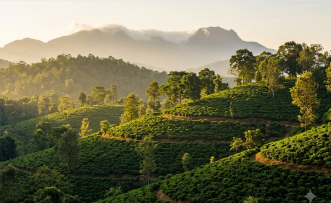
Kodagu (Coorg) district has the highest percentage forest cover of any district in Karnataka — approximately seventy percent of the district’s area is classified as forest or dense vegetation. This is not coincidental — it is the result of the same geographical conditions (altitude, rainfall, soil) that make the region an extraordinary agricultural zone. Understanding the specific connections between this high forest cover and the value of the agricultural land within the forest landscape provides insight into one of Coorg farmland investment’s most durable value drivers.
The Hydrological Service of Forest Cover
Coorg’s forest cover performs a specific hydrological service that directly benefits the agricultural estates within the forested landscape. Forested areas intercept rainfall in the canopy, slow its movement to the ground, allow it to infiltrate the soil rather than running off the surface, and gradually release it to the groundwater and stream systems that agricultural estates depend on for irrigation.
The perennial streams that flow through Madikeri’s coffee estates — the streams that provide the most reliable dry-season irrigation water — originate in and are sustained by the forest-covered catchment areas above. The forest is the natural infrastructure that captures monsoon rainfall and releases it continuously through the dry season as stream flow.
In this specific sense, Coorg’s forest cover is not separate from the agricultural land investment — it is the upstream infrastructure that makes the agricultural land’s water security possible. An estate that sits within or adjacent to a forested landscape has better water security than an equivalent estate in a deforested landscape, because the forest’s hydrological function is sustaining the water systems that the estate depends on.
The Microclimate Benefit of Forest Adjacency
Forest cover at scale creates regional microclimatic effects — maintaining local humidity, moderating temperature extremes, and creating the atmospheric moisture conditions that the Western Ghats’ characteristic mist reflects. Agricultural land within a predominantly forested landscape benefits from these microclimate services continuously — the cool, humid conditions that coffee and cardamom need are partly products of the surrounding forest’s evapotranspiration, not purely of the altitude and rainfall.
In contrast, agricultural land in a predominantly deforested landscape — even at the same altitude and with the same rainfall — experiences more extreme temperature swings, lower humidity between rain events, and greater evaporation from the soil surface. The forest’s microclimate service is invisible but real, and it contributes to the specific quality of Coorg Arabica coffee that high-altitude, high-humidity, forest-adjacent growing conditions produce.
The Biodiversity Reservoir Function
Coorg’s forest cover serves as a reservoir of biodiversity — including the native bee species, predatory insects, birds, and soil organisms that provide ecological services on adjacent agricultural land. As discussed in our native bees post, the pollinators and pest predators that improve coffee yield and reduce pest management costs on Coorg estates are sustained by the diverse habitat of the surrounding forest.
An estate surrounded by forest has a continuous supply of pollinators from the forest ecosystem — the forest diversity ensures that a wide range of bee species with different foraging ranges and flowering season preferences are always present on the estate throughout the flowering season. An estate in a deforested landscape depends on whatever pollinator populations survive within or near the estate itself — typically a less diverse and less abundant community.
The Investment Premium This Creates
Forest adjacency is a permanent, non-replicable characteristic of an agricultural estate’s location. You cannot plant a forest on an adjacent plot and immediately replicate the ecological services that a mature, ancient forest provides. The forest that surrounds a Madikeri coffee estate has been there for centuries — its ecological maturity is embedded in the soil biology, the stream systems, and the species communities it has developed over geological time.
This permanent, non-replicable characteristic of forest-adjacent agricultural land in the Western Ghats is one of the clearest reasons why Coorg’s prime zone agricultural land commands a premium over agricultural land elsewhere in Karnataka. The forest cover is not just scenery — it is ecological infrastructure with real agricultural economic value, and its presence distinguishes Coorg farmland from any agricultural land investment in India’s forest-depleted Deccan plateau regions.
Disclaimer: The information provided in this article is for general educational, environmental analysis, and informational purposes only and does not constitute financial, investment, legal, or real estate advice. Ecological factors such as forest adjacency, water table stability, microclimates, and ecosystem services vary by specific plot location, topography, and seasonal weather patterns. Historical agricultural yields or environmental performance are not guarantees of future crop returns or asset appreciation. Readers and prospective land buyers should perform independent due diligence, verify plot boundaries, and consult with qualified agricultural consultants and financial advisors before making any estate investment decisions.