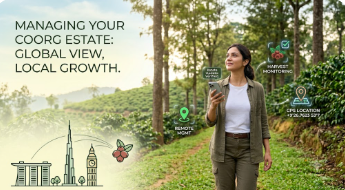
A significant and growing proportion of Nature N Me’s investor enquiries come from Indian professionals living and working abroad — in Singapore, Dubai, London, the United States, Canada, and Australia. These investors have a specific question that the general managed farmland investment information does not directly address: can you effectively be a Coorg coffee estate owner when you live twelve thousand kilometres away and visit India once or twice a year?
The answer is yes — and the managed farmland model was specifically designed for exactly this kind of remote ownership. This guide explains what effective remote ownership looks like in practice.
The Monthly Update: Your Primary Estate Window
For an overseas investor, the monthly farm update from Nature N Me’s management team is the primary communication channel through which the estate’s condition and progress are tracked. As detailed in our earlier post on reading monthly updates, these updates include photographs of specific estate sections, agricultural activity reports, seasonal observations, and any items requiring the investor’s awareness.
From Singapore or Dubai, these updates arrive on WhatsApp or email on the same day they are sent — with no time zone or communication barrier that affects their content. An overseas investor reviewing a January harvest update from their estate can see the cherry picking photographs, the wet mill operation, and the harvest weight records in real time, the same day they are available.
The monthly update rhythm — twelve substantive communications per year, each timed to the estate’s agricultural calendar — provides a level of ongoing transparency that makes remote ownership practically very similar to ownership from Bangalore, in terms of information flow if not in terms of visit frequency.
Digital Verification: The Overseas Investor’s Independent Check
Karnataka’s digital land record infrastructure — the Bhoomi portal for RTC verification and the Kaveri portal for encumbrance certificate — is accessible from any internet-connected device anywhere in the world. An overseas investor can verify their estate’s ownership status from Singapore as easily as from Bangalore — checking that the RTC still shows their name as pattadar and that no unexpected charges have been registered.
This digital verification capability, available at any time without involving any local intermediary, provides the overseas investor with an independent ownership confirmation mechanism that is as reliable from abroad as it is from India.
Income Remittance: Receiving Agricultural Income Abroad
Agricultural income from a Coorg farmland estate is credited to an Indian bank account in the investor’s name — typically an NRO (Non-Resident Ordinary) or regular savings account. The income arrives as a rupee credit from Nature N Me’s crop income disbursement.
For overseas investors who want to repatriate this income to their foreign bank account, the general FEMA rules on remittance from NRO accounts apply — typically permitting remittance of up to one million US dollars annually subject to appropriate declaration and banking documentation. The specific conditions of repatriation should be discussed with the investor’s Indian chartered accountant and banking advisor, as the rules are subject to RBI guidelines that may evolve.
The Annual or Biannual Visit: Making the Most of India Time
For overseas investors who visit India once or twice a year — typically for family visits and during Indian festival seasons — coordinating a Coorg estate visit within the India trip is the primary estate engagement activity. A visit to Madikeri from Bangalore adds one additional day of travel to a Bangalore-based India visit, and from other Indian cities can be combined with a Bangalore connection.
The January harvest visit — when the estate is at maximum agricultural activity — is the most rewarding single visit of the year for an overseas investor. Seeing the harvest in progress, meeting the farm manager, and experiencing the estate at its most productive is worth specifically scheduling the India visit around if the investor’s schedule permits.
What Overseas Investors Should Establish Before Leaving India
Before returning to their overseas location after purchase, overseas investors should establish specific operational arrangements: a clear communication protocol with the Nature N Me team (preferred WhatsApp or email, frequency of specific updates), a designated Indian resident family member or trusted advisor who can attend to any in-person administrative requirements (mutation follow-up, Gram Panchayat applications, etc.) with a registered Power of Attorney, and a clear income disbursement arrangement with an Indian bank account set up to receive agricultural income credits.
These arrangements, put in place during the purchase and first-visit period, ensure that the investment runs smoothly from abroad without requiring the investor’s physical presence for any routine operational matter.
Disclaimer: The information provided in this article is for general educational and informational purposes only and does not constitute legal, tax, financial, or regulatory advice. Currency repatriation, FEMA regulations, NRO bank account operations, and NRI/OCI property ownership rules are subject to Reserve Bank of India (RBI) guidelines, Income Tax Act provisions, and local Karnataka land laws, which may change periodically. Overseas investors and Non-Resident Indians (NRIs) should consult a qualified Chartered Accountant (CA), tax consultant, or legal counsel specializing in cross-border property transactions before making any investment decisions.