
The property investment conversation in Karnataka in 2026 has three mainstream options: apartments in Bangalore’s established residential markets, plots in the city’s expanding periphery, and agricultural land in Karnataka’s rural districts. Most investors treat these as interchangeable in the sense that all three involve buying Karnataka property — but they are fundamentally different assets with fundamentally different return and experience profiles.
Among all Karnataka property categories, Coorg coffee estate land through a managed farmland model occupies a specific position that no other option matches: it is simultaneously a financial investment generating passive income, an appreciating land asset, and a genuine lifestyle destination. No Bangalore apartment and no peripheral plot offers all three of these simultaneously.
The Passive Income Dimension: How It Actually Works
A Bangalore apartment generates passive income through rental — twelve to twenty thousand rupees per month if well-located, subject to tenant management, vacancy periods, maintenance costs, and income tax at full slab rates. The net passive income after costs and tax is typically four to seven percent of the property value annually.
A Coorg coffee estate managed by Nature N Me generates passive income from coffee, cardamom, pepper, and fruit — growing progressively from year three, reaching full production levels by year six to eight. This income is completely exempt from income tax, requires zero management from the investor, and compounds as the estate matures. The passive income is genuinely passive in a way that rental income never is — no tenant calls, no maintenance requests, no vacancy management.
The Appreciation Dimension: Why It Outperforms
Bangalore’s established apartment markets have delivered appreciation of five to eight percent annually in most micro-markets over the past five years. The peripheral plot speculation plays have delivered variable results — some areas appreciating strongly when infrastructure materialised, others stagnating when it did not.
Madikeri prime zone coffee estate land has appreciated at twelve to fifteen percent annually over the same period — driven by structural supply constraints and growing urban investor demand that are independent of any infrastructure announcement or development thesis. The appreciation is agricultural land appreciation based on productive value and scarcity, not speculation-dependent.
The Lifestyle Dimension: What No Other Karnataka Property Provides
A Bangalore apartment provides a place to live — valuable but not a lifestyle in the sense of providing a fundamentally different quality of experience from the surrounding urban environment. A peripheral plot provides nothing in terms of lifestyle — it is an investment asset with no experiential use.
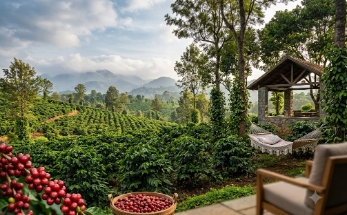
A Coorg coffee estate managed through Nature N Me provides a specific place in the Western Ghats — a farm you own, on land you can walk and stand on, managed by a team that knows it intimately, producing real crops from real soil, in one of Karnataka’s most beautiful and ecologically rich landscapes. The monthly farm updates, the estate visits, the harvest season experience, the wildlife adjacency — these are experiences that no apartment or plot investment generates.
The Unique Position
The convergence of these three dimensions — passive income, appreciation, and lifestyle — in a single investment is what makes Coorg coffee estate land through a managed farmland model genuinely distinctive rather than simply one property investment among many. Each dimension alone would justify attention. All three together, in a single investment that requires zero ongoing management from the investor, create a proposition that the Karnataka property market has no equivalent to.
| Asset Type | Passive Income | Appreciation (5 yrs) | Lifestyle Value |
|---|---|---|---|
| Bangalore apartment | 4–7% net, taxable | 5–8% p.a. | Urban living only |
| Bangalore peripheral plot | None | Variable | None |
| Coorg coffee estate (managed) | Tax-free crop income | 12–15% p.a. | Farm + homestay + nature |
Disclaimer: The information provided in this article is for general informational and educational purposes only and does not constitute financial, legal, or real estate investment advice. Property investments and agricultural yields are subject to market risks and environmental conditions. Prospective buyers should conduct their own independent due diligence and consult with qualified legal and financial advisors before making any investment decisions.
Frequently Asked Questions
Is income from Coorg coffee estate tax-free?
Yes. Under Section 10(1) of the Indian Income Tax Act, agricultural income derived from coffee and plantation farming in India is exempt from Central Income Tax, though state-level agricultural rules or partial processing rules (if coffee is further processed/manufactured beyond basic curing) may apply.
How much does Coorg farmland appreciate per year?
Prime coffee estate land in Coorg (especially in well-connected belts like Madikeri) typically appreciates at an average rate of 12% to 15% annually, driven by strict land supply constraints and steady demand for managed farmland.
Is Coorg coffee estate better than a Bangalore apartment?
It depends on your investment goal. Coorg coffee estates offer higher capital appreciation potential (12–15% vs. 5–8%), tax-exempt agricultural revenue, and lifestyle value. Bangalore apartments offer higher immediate liquidity and reliable monthly rental cash flow (4–7% yield), but come with tenant management and full income tax liabilities.
Frequently Asked Questions
Is income from a Coorg coffee estate tax-free?
Yes. Under Section 10(1) of the Indian Income Tax Act, raw agricultural revenue derived from growing and curing crops like coffee, pepper, and cardamom is exempt from Central Income Tax. However, if the produce undergoes commercial processing (such as roasting and grinding), composite tax rules apply, subjecting a fraction of the income to business tax.
How much does Coorg farmland appreciate per year?
Prime coffee estate land in Coorg (particularly in active belts like Madikeri) typically appreciates at 12% to 15% annually. This rate is largely driven by strict land supply constraints in the Western Ghats and steady urban demand for managed agricultural plots.
Is a Coorg coffee estate better than a Bangalore apartment?
It depends on your specific investment priorities:
- Coorg Coffee Estate: Best for higher long-term capital appreciation (12–15% p.a.), tax-exempt agricultural returns, and personal lifestyle benefits (nature retreats).
- Bangalore Apartment: Best for liquidity and regular monthly rental cash flow (4–7% net yield), though it incurs ongoing tenant management, maintenance overhead, and fully taxable rental income.