
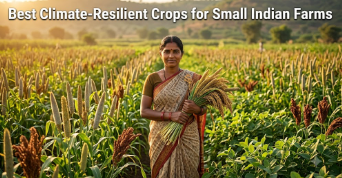
As unpredictable monsoons, heatwaves, and soil degradation pose growing challenges to Indian agriculture, small and marginal farmers bear the heaviest burden. Adopting climate-resilient crops provides a sustainable way to shield smallholdings from crop failure while cutting input costs.
What Climate-Resilient Crops Mean
Climate-resilient crops are varieties specifically equipped to withstand extreme and unpredictable environmental conditions—such as prolonged droughts, sudden heatwaves, erratic rainfall, and poor soil quality.
Unlike conventional water-heavy staples (like paddy rice or sugarcane), climate-smart crops exhibit key protective physiological traits:
- Deep Root Systems: Allow access to subsurface soil moisture during dry spells.
- High Water-Use Efficiency (C4 Physiology): Photosynthesize efficiently under intense heat and dry air.
- Short Growth Cycles: Mature quickly (often within 60–100 days), escaping long drought windows.
Why Small Farmers Should Choose Them
For small farmers operating on less than two hectares, climate-resilient crops offer major economic and operational benefits:
- Reduced Financial Risk: Require up to 70% less water and minimal chemical fertilizers or pesticides, driving down overall production costs.
- Guaranteed Minimum Yields: Known as “the last crops standing in droughts,” they ensure a baseline yield when cash crops fail.
- Nutritional Security: Packed with essential proteins, iron, calcium, and dietary fiber, they protect household nutrition.
- Soil Restoration: Legumes and millets fix atmospheric nitrogen and improve organic matter content in degraded soils.
Best Crop Examples by Region and Season
| Region | Primary Seasons | Recommended Crops | Key Traits |
|---|---|---|---|
| Western & Arid India (Rajasthan, Gujarat) | Kharif / Rainfed | Pearl Millet (Bajra), Cluster Bean (Guar), Moth Bean | Extreme heat tolerance (up to 42°C), thrives in sandy soils. |
| Central & Deccan Plateau (Maharashtra, MP, Telangana) | Kharif & Rabi | Sorghum (Jowar), Pigeon Pea (Arhar/Tur), Chickpea (Chana) | Drought-tolerant, deep taproots, adaptable to black cotton soils. |
| Southern India (Karnataka, Tamil Nadu, AP) | Kharif & Late Monsoons | Finger Millet (Ragi), Horse Gram (Kollu), Foxtail Millet | High calcium content, withstands dry spells and poor soils. |
| Himalayan & Eastern Belts (Uttarakhand, Odisha, NE) | Kharif / Post-Monsoon | Barnyard Millet, Buckwheat, Black Gram (Urad) | Short duration (45–70 days), ideal for hilly terrains and shallow soils. |
Export to Sheets
Soil and Water Needs of Each Crop
1. Pearl Millet (Bajra)
- Soil: Well-drained sandy loams, light soils; highly tolerant of low fertility and mild salinity.
- Water Needs: Minimal (250–350 mm of rainfall). Can survive dry spells after initial germination.
2. Finger Millet (Ragi)
- Soil: Adapts across reddish loamy soils, gravelly soils, and slightly acidic to neutral terrain.
- Water Needs: Moderate (350–500 mm). Extremely efficient at using residual soil moisture.
3. Sorghum (Jowar)
- Soil: Deep black clays, heavy soils, as well as medium-textured loams.
- Water Needs: Low to moderate (400–500 mm). Goes dormant during extended dry periods and resumes growth when rain returns.
4. Pulses (Pigeon Pea / Chickpea / Horse Gram)
- Soil: Neutral to alkaline well-drained soils; sensitive to waterlogging.
- Water Needs: Low (200–400 mm). Relies primarily on residual soil moisture from monsoon rains.
How to Reduce Crop Loss with Mixed Planting
Single-crop farming (monoculture) leaves small farms vulnerable to complete failure if weather conditions turn harsh. Intercropping and polyculture hedge against climate risks.
  [ Millet Row (Tall Cereal) ]   --> Uses upper sunlight, extracts deep water
  [ Legume Row (Nitrogen Fixer)] --> Fixes soil nitrogen, ground cover prevents evaporation
Effective Intercropping Combinations
- Pearl Millet + Pigeon Pea (4:2 or 3:1 ratio): Millet provides quick early harvests while the deep roots of pigeon pea access subsoil water late in the season.
- Sorghum + Cowpea: Cowpea forms a dense cover that smothers weeds, reduces soil evaporation, and adds nitrogen to feed the sorghum.
- Ragi + Groundnut: Combines a sturdy cereal with an oilseed cash crop, providing both food security and income diversification.
Key Takeaway: By pairing cereal crops (millets/sorghum) with legumes (pulses), smallholders create mutually beneficial systems where crops share soil nutrition, shade out weeds, and ensure that at least one yield succeeds regardless of erratic weather.