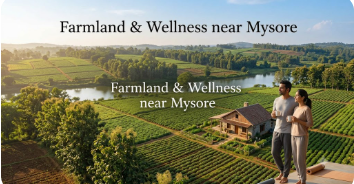
The health benefits of time spent in natural environments are no longer soft claims made by wellness influencers — they are documented findings from environmental psychology, preventive medicine, and occupational health research. For urban professionals who take their health seriously, understanding the specific wellness dimensions of owning managed farmland near Mysore helps explain why a growing number of health-conscious investors are describing this investment as part of their health strategy alongside gym memberships, nutrition programs, and medical check-ups.
The Air Quality Dimension
Mysore‘s agricultural belt offers air quality that is categorically different from Bangalore’s — not marginally better, but in a different tier entirely. Particulate matter (PM 2.5) concentrations in Mysore’s rural agricultural zones are a fraction of Bangalore’s urban readings, and the absence of diesel vehicle exhaust and construction dust creates an air environment that the human respiratory system evolved to inhabit.
For professionals with respiratory sensitivities, those who have noticed the cumulative toll of years of urban air quality on their breathing and general health, or simply those who value breathing genuinely clean air with regularity — regular visits to a farmland estate near Mysore provide a biologically restorative air quality that no urban environment in Karnataka currently offers.
The Physical Activity Pattern of Farm Visits
Walking a managed farmland estate during a visit is not structured exercise — there is no treadmill count, no calorie target, no heart rate zone being tracked. But it is genuine physical activity in an outdoor environment: walking uneven ground, traversing slopes, moving between sections of the estate that may require navigating natural obstacles, standing and crouching to inspect plants at different heights.
Investors who visit their Mysore estate regularly report a characteristic pattern: they walk more during farm visits than on any typical urban day, without the artificial motivation that exercise culture usually requires. The walking happens naturally as part of estate engagement — you are walking to the mango orchard, to the water source, to the boundary corner, to the section the farm manager wants to show you. The physical activity is incidental to the agricultural engagement rather than the goal.
The Food Relationship Dimension
Estate produce from managed farmland near Mysore — fresh mangoes, guava, coconut — consumed during visits or brought back to Bangalore creates a direct relationship between the investor and the food they eat that urban food supply chains systematically eliminate. Knowing that the mangoes in your kitchen came from trees you walked past last weekend, grown with the farming practices you have discussed with the management team, without chemical residues you would not knowingly expose yourself to — this relationship with food has genuine health value beyond the nutritional content of the fruit itself.
Research on the psychology of food consumption consistently shows that people who have greater awareness of and connection to where their food comes from make better food choices overall and derive greater satisfaction from eating. The farm estate as a source of personally connected food is a wellness dimension that is difficult to replicate through any urban food channel however premium.
The Social Wellness Dimension
Farm visits with family, friends, or colleagues create a social context that is qualitatively different from urban social environments. The absence of competing digital stimuli, the shared engagement with a natural environment, and the specific conversations that farm walks generate — about what is growing, about the seasons, about the agricultural decisions being made — create conditions for genuinely present social interaction that urban social settings rarely produce.
Multiple Nature N Me investors have described their Mysore farm visits as the occasions when they have their most meaningful conversations with spouses, children, or close friends — not because the farm conversation itself is profound, but because the environmental conditions of the estate create the space for genuine presence that urban environments routinely prevent.