
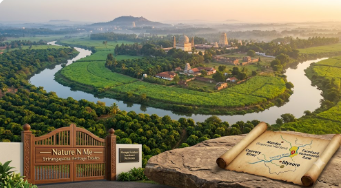
The agricultural landscape between Mysore and Mandya — the thirty to fifty kilometre zone straddling the Cauvery river system and passing through one of Karnataka’s most historically significant territories — is not typically the first zone that comes to mind when investors think about Mysore farmland. Most attention focuses on zones south and southwest of Mysore city. But the Srirangapatna-Mandya belt has agricultural and contextual characteristics that make it worth understanding as a farmland investment zone.
Historical Significance That Adds Context
Srirangapatna is the island-fortress city that served as the capital of Hyder Ali and Tipu Sultan’s Mysore kingdom — one of the most powerful and culturally significant polities in 18th century South India. The island, formed by a bifurcation of the Cauvery river, contains the remains of Tipu’s summer palace (Daria Daulat Bagh), his mausoleum (Gumbaz), the Sri Ranganathaswamy temple complex, and the fortifications that withstood multiple British sieges before Tipu’s fall in 1799.
This historical richness is not merely a tourism talking point — it reflects a region that has been continuously settled, cultivated, and maintained for centuries. The agricultural landscape around Srirangapatna has been productive since Mysore’s kingdom actively developed it for sugarcane, paddy, and plantation crops to supply the court. The soil has a depth of agricultural history that is expressed in its fertility.
Agricultural Character of the Belt
The Mandya district — which includes much of the Cauvery river valley agricultural zone north of Mysore — is Karnataka’s sugarcane heartland. The Cauvery waters have supported intensive sugarcane cultivation across this belt for well over a century, and the agricultural soil quality reflects generations of productive farming with good irrigation access.
For managed farmland investors, the Srirangapatna-Mandya belt’s agricultural character is most relevant in the zones between the intensively cultivated sugarcane areas and the urban fringe — where agricultural land can be acquired at prices that reflect genuine agricultural value rather than speculative urban fringe premium, and where fruit orchards and timber plantation find good growing conditions.
Mango cultivation in particular has a long history in this belt — the famous Mysore Mallige jasmine and various mango varieties have been grown in this zone for generations, benefiting from the Cauvery basin’s reliable irrigation infrastructure and deep alluvial soil.
The Tourism and Heritage Lifestyle Context
For farmland investors who value the heritage and cultural context of their estate’s surroundings — as discussed in our earlier post on Mysore’s heritage city appeal — the Srirangapatna-Mandya belt adds a specific historical dimension that most agricultural zones cannot offer. Visiting your farmland estate in this zone means living temporarily in one of Karnataka’s most historically layered landscapes.
The Cauvery river at Srirangapatna is itself a remarkable environmental feature — the island setting, the temple ghats, the riverside landscape that has been described by travellers and writers for over two centuries. For investors who care about the experiential richness of where their estate is located, this historical and environmental context is genuinely distinctive.