Among the investor profiles showing the strongest interest in Nature N Me, one stands out for the clarity of fit between what the project offers and what the investor is looking for: professionals in their late forties and fifties who are either retired, approaching retirement, or actively planning the financial and lifestyle dimensions of their retirement years.
This is not coincidental. The Mysore farmland investment — its accessibility, its timeline, its lifestyle context, and its legacy characteristics — aligns almost perfectly with the specific needs and priorities of this investor cohort.
The Accessibility Match for Retirement Lifestyle
Retired professionals and those approaching retirement have more time for farm visits than their working years allowed — but they may also have less tolerance for arduous long drives. The ninety-minute expressway journey from South Bangalore to Mysore is within the comfortable range for most people in their fifties and sixties — a genuinely easy trip rather than an endurance event. Monthly visits, or even fortnightly visits during retired years, are practically feasible in a way that a five-to-six-hour Coorg drive is not for many people at this life stage.
Additionally, Mysore as a city has specific qualities that make it particularly suited to retired life and extended stays — a livable scale, excellent Kannada cuisine, quality medical facilities (the Mysore Medical College and a range of private hospitals make healthcare accessible), walkable areas, and a pace of life that retired professionals describe as matching their preferred tempo in a way that Bangalore long ago ceased to.
The Investment Timeline Aligns With Retirement Years
An investor who purchases a Mysore plot at age fifty and holds it through their retirement years experiences the investment’s most financially productive phase during exactly the period when additional income is most welcome.
The fruit orchards reach full commercial production in years six to ten — when the investor is in their mid to late fifties, potentially in the early years of reduced income from retired life. Teak timber harvest begins from year fifteen to twenty — when the investor is in their mid to late sixties, at a point when a lump-sum timber income event is particularly valuable for estate planning, medical reserve building, or children’s financial support.
This temporal alignment — between the investment’s income maturity curve and the investor’s life stage financial needs — is not accidental. The long-term nature of timber and fruit orchard investment suits patient, long-horizon investors who are thinking in fifteen-to-twenty-year arcs rather than three-to-five-year cycles. Retirees and pre-retirees are exactly this investor profile.
The Legacy and Transfer Dimension
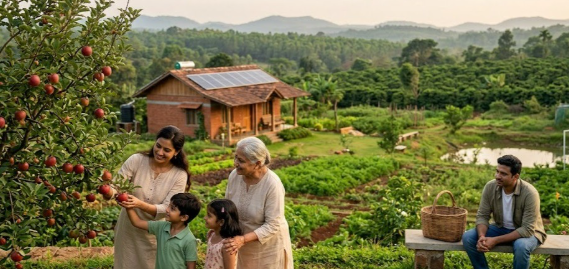
Professionals in their fifties are increasingly thinking about what they leave — not just the financial assets but the tangible, meaningful, physically real assets that their children and grandchildren will inherit and use. A managed farmland estate near Mysore is precisely this kind of legacy asset.
It is land — real, registered, located in a specific beautiful place — that carries the family’s name in the RTC, that can be visited by children and grandchildren as part of their connection to something their parents or grandparents created, and that continues producing value across generations without requiring any specific professional expertise to manage. The gift deed or will transfer of an agricultural estate near Mysore carries a different weight and meaning than the transfer of financial instruments — it is a place, with trees that were planted by the grandparent, producing fruit that was planted with an intention for the future.
The Mysore Lifestyle as Retirement Context
For professionals who are considering where they want to spend their retirement years, Mysore consistently appears on shortlists that include Coorg, Pondicherry, Goa, and various hill stations. Its specific combination of excellent climate, cultural richness, manageable city scale, and proximity to both Bangalore and Karnataka’s wildlife areas makes it genuinely livable for extended periods.
Owning managed farmland near Mysore adds a specific dimension to this retirement lifestyle consideration — the estate is not just a financial investment but a reason to be in the Mysore area regularly, a productive place to spend time that is active and purposeful rather than purely recreational, and a conversation with the land that gives retirement years a specific agricultural rhythm and engagement.
This is the deepest value of the Mysore investment for retirees and pre-retirees: not just what it returns financially, but what it gives to the quality and character of the years ahead.