
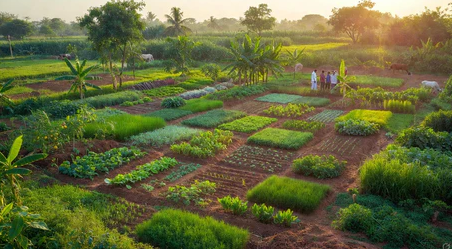
One of the most scientifically interesting and practically important aspects of agroforestry design is its use of vertical space — the layering of productive plant species at different heights so that the full vertical column of light, air, and root space above and below any given patch of ground is producing value simultaneously. This multi-layer canopy system is the architectural principle that distinguishes a well-designed agroforestry estate from both a monoculture farm and a random mixture of plants.
What are the layers of a mature agroforestry canopy?
The emergent layer — the tallest trees that extend above the main canopy. In Coorg’s agroforestry system, this is mature teak and the tallest silver oak trees — reaching fifteen to twenty-five metres in a mature estate. These trees capture the highest light levels for their own photosynthesis, produce the primary timber value, and provide the structural framework for the entire canopy system below them.
The main canopy layer — the continuous upper canopy at eight to fifteen metres. On a mature Coorg estate, silver oak forms the main canopy layer — the primary shade management tree whose canopy density is adjusted through annual pruning to deliver the right light conditions to the coffee and cardamom below. On a Mysore fruit orchard estate, mature mango trees form this layer.
The sub-canopy layer — trees and tall shrubs at three to eight metres. In Coorg, the coffee bushes at one to two metres are well below this layer, but the secondary fruit trees (orange, guava, younger mango) occupy this zone. In a Mysore estate, sapota trees occupy the sub-canopy alongside younger fruit species that have not yet reached the main canopy.
The shrub layer — productive plants at one to three metres. The coffee bushes on a Coorg estate occupy this layer — two metres of dense productive canopy below the silver oak above. In a Mysore estate, guava plants and young sapota seedlings occupy this zone during establishment.
The understorey layer — shade-tolerant productive plants below one metre. Cardamom on a Coorg estate is the classic understorey crop — growing to one to one and a half metres in the deep shade beneath coffee, in conditions that would suppress most other crops but that suit cardamom’s specific shade and humidity requirements.
The ground layer — low-growing plants at soil level. Pineapple during the establishment phase occupies this layer in Coorg and Mysore agroforestry systems, as do nitrogen-fixing ground cover plants and the natural vegetation communities that develop in well-managed agroforestry systems.
The root layer — underground. Different species root at different depths, from the shallow roots of cardamom (twenty to thirty centimetres) through the medium-depth roots of coffee and fruit trees (sixty to one hundred and fifty centimetres) to the deep roots of teak and silver oak (two to three metres). These different root depths reduce competition for soil moisture and nutrients while the deep roots bring minerals from depth to the surface through leaf litter cycling.
What does each layer contribute to income?
Emergent layer (teak, mature silver oak): Long-term timber income. Teak from year fifteen to twenty. Silver oak selective harvest from year twelve to fifteen. Annual pruning wood income from silver oak as a secondary contribution.
Main canopy (silver oak, mature mango): Annual canopy pruning wood income from silver oak. Primary fruit income from mango — the main revenue-generating species on a Mysore estate.
Sub-canopy (secondary fruit trees, younger timber): Secondary fruit income — sapota, orange, guava contributing consistent year-round production that supplements the seasonal mango income.
Shrub layer (coffee, guava): Primary coffee income on Coorg estates — the dominant annual income driver. Guava income on Mysore estates — productive year-round.
Understorey (cardamom, vanilla): High-value specialty income. Cardamom per kilogram income is among the highest of any crop on the estate, making this layer disproportionately valuable relative to its physical space.
Ground layer (pineapple bridge crop, green manures): Early bridge crop income during establishment phase. Nitrogen fixation service that reduces fertiliser cost — a financial contribution that appears in reduced input costs rather than in direct crop income.
The compounding of all layers simultaneously
The income from a mature multi-layer agroforestry estate is the simultaneous contribution of all these layers — annual crop income, seasonal fruit income, year-round spice income, and periodic timber income — creating a total return that no single-layer system can approach. This is why well-managed agroforestry plots consistently outperform monoculture farming by thirty to fifty percent on total income per acre at full maturity.