
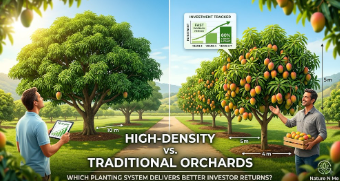
High-density planting systems for fruit orchards in India are generating significant investor interest in 2026, with operators claiming dramatically improved per-acre yields and faster payback periods compared to traditional low-density orchards. For managed farmland investors evaluating orchard planting systems, understanding what high-density planting actually is, what it genuinely delivers, and what its trade-offs are helps assess whether the HDP claims being made about specific plots are realistic.
What is high-density planting (HDP)?
Traditional mango orchard planting uses eight to ten metre spacing between trees — approximately one hundred to one hundred and fifty trees per acre. At this spacing, each tree develops a large, spreading canopy that maximises individual tree production but uses the inter-canopy space inefficiently for the first decade of the orchard’s development.
High-density planting uses significantly tighter spacing — typically five by five metres or five by four metres, producing four hundred to five hundred trees per acre, three to four times the traditional density. At HDP density, individual trees are managed to remain compact — through specific pruning techniques including hedging (cutting the canopy to maintain a defined height and shape) and canopy management practices that prevent the tree from developing the large spreading form it would naturally achieve.
What does HDP deliver in terms of earlier income and higher yield?
The primary claimed advantages of HDP are earlier commercial production and higher per-acre yield in the early to middle years of the orchard’s life. With more trees per acre, the HDP orchard can produce commercial quantities in years three to four when each tree’s individual yield is still modest — the volume from many small trees adds up faster than from fewer large trees.
In traditional orchards, only forty percent of fruit is Grade A. In HDP systems, over eighty-five percent of fruit is Grade A (premium size and colour) — this quality improvement claim is attributed to better light penetration and air circulation in managed compact canopies. Orchard Solution
In the early years (one to seven), HDP orchards typically demonstrate higher per-acre yield than traditional density orchards because the greater number of trees compensates for each tree’s lower individual output. After year ten, the comparison changes: traditional density trees, now fully developed, begin to outperform HDP trees on individual productivity while the HDP trees increasingly compete with each other for light, root space, and nutrients.
What are the trade-offs and limitations?
The primary limitation of HDP is the management intensity it requires. Compact canopy maintenance — the regular pruning and hedging that keeps HDP trees productive at high density — requires skilled, frequent management intervention. An HDP orchard that is not pruned and hedged on schedule becomes an overcrowded, shading orchard where internal canopy light penetration decreases, fruit set reduces, and the quality advantage claimed for HDP disappears.
The management cost of HDP is therefore higher per acre than traditional density orchards — more frequent skilled pruning, more intensive pest management (the denser canopy creates microclimate conditions favourable to some fungal diseases), and more frequent irrigation adjustments as the denser root system competes for water in the same soil volume.
The Long-Term Comparison
In the long term — beyond year fifteen — traditional density orchards often outperform HDP on per-acre income because the fully developed traditional trees produce higher individual yields that the HDP system cannot sustain at the same density without progressive thinning. Many successful HDP orchards are progressively thinned from four hundred to five hundred trees per acre down to one hundred and fifty to two hundred trees per acre as the trees mature — effectively transitioning back toward traditional density over time.
The Practical Recommendation for Managed Farmland Investors
For investors comparing managed farmland offerings that include HDP versus traditional density fruit orchards, the key evaluation question is not which system promises higher early-year yield, but whether the management infrastructure and expertise to maintain HDP’s intensive management requirements are genuinely in place.
An HDP mango orchard on a managed farmland plot is only as good as the pruning and hedging schedule it actually receives. Verify with the management team how frequently the canopy management is conducted, who performs it, and what the track record of the specific team is with HDP management specifically.
| Factor | High-Density Planting (HDP) | Traditional Spacing |
|---|---|---|
| Trees per acre | 400–500 | 100–150 |
| Early-year yield (1–7 yrs) | Higher per acre | Lower per acre |
| Long-term yield (>15 yrs) | May decline without thinning | Often higher as trees mature |
| Management intensity | High (frequent pruning, hedging) | Moderate |
| Disease/pest risk | Higher (dense canopy) | Lower |
| Best for | Investors with strong management team | Long-term, lower-maintenance model |
Disclaimer: The information provided in this article is for educational and informational purposes only and does not constitute financial, investment, or agricultural advice. Orchard yields, payback periods, and returns on managed farmland can vary significantly based on location, weather, management practices, and market conditions. Past performance or projections regarding high-density planting (HDP) vs. traditional orchards do not guarantee future results. Prospective investors should conduct their own independent due diligence and consult with qualified financial and legal advisors before making any investment decisions.
Frequently Asked Questions
Q: What is high-density planting in fruit orchards?
A: High-density planting (HDP) uses tighter spacing—such as 5x5m or 5x4m—to fit 3 to 4 times more trees per acre than traditional orchards. Trees are kept compact through regular pruning and hedging to maximize early yields and land use efficiency.
Q: Is HDP better than traditional spacing for investors?
A: HDP offers faster payback and higher per-acre yields in the early years (years 1–7), but requires skilled, intensive management. Traditional spacing often yields higher long-term production beyond year 15 with lower ongoing maintenance costs.
Q: How many trees per acre in high-density mango orchard?
A: High-density mango orchards typically plant 400 to 500 trees per acre, compared to just 100 to 150 trees per acre in traditional spacing models.
Q: What are the risks of high-density planting in India?
A: Key risks include higher upfront setup and management costs, increased risk of fungal diseases due to dense canopy microclimates, and potential yield decline after 10–15 years if the orchard is not properly pruned, hedged, or thinned.