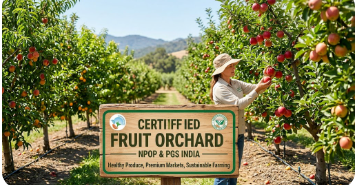
Organic certification for fruit orchards is one of the most frequently asked questions from Nature N Me investors who have heard about organic price premiums but are uncertain about the certification process, its costs, and whether it applies to their specific farming situation.
What is organic certification in the Indian context?
Organic certification in India is administered under two primary frameworks. The National Programme for Organic Production (NPOP) is the Indian government’s certification standard, administered through accredited certification bodies. NPOP-certified produce can be marketed as organic in India and is recognised for export to several countries including the European Union, the United States, and Switzerland under equivalence agreements.
Participatory Guarantee Systems (PGS) is a government-supported community-based certification model specifically designed for small and medium farmers who find the full NPOP certification process costly relative to their production volume. PGS certification is recognised for domestic marketing as organic but not for export.
For managed farmland investors with two to five acre orchards, PGS certification is typically more practically accessible than full NPOP certification, with lower cost and simpler documentation requirements while still allowing “organic” marketing in domestic premium channels.
What does the conversion period mean and why does it matter?
Both NPOP and PGS require a conversion period — a minimum number of years during which the farm operates under organic management practices without being able to market its produce as certified organic. Under NPOP, the conversion period is thirty-six months from the last application of prohibited substances (synthetic pesticides, synthetic fertilisers). Under PGS, the conversion period is thirty-six months for orchards.
This means an orchard that was previously managed with any synthetic inputs must operate under certified-organic management practices for three full years before it can certify and market its produce as organic. During the conversion period, the orchard produces at organic management costs without the organic price premium — the “cost” of certification that investors must plan for.
For orchards established from the beginning under organic-aligned management — as Nature N Me’s managed farmland orchards are — the conversion period clock starts from planting, meaning that an orchard planted organically in 2025 may be certifiable from 2028 onward.
How much does organic certification cost?
Full NPOP certification through an accredited certification body costs approximately fifteen thousand to forty thousand rupees per year for a small farm (two to five acres), depending on the certifying body and the inspection logistics involved. This cost includes the annual inspection visit, the certification documentation, and the certificate itself.
PGS certification is significantly less expensive — typically two thousand to eight thousand rupees per year through a local PGS group, where the group collectively shoulders much of the documentation and inspection overhead. The lower cost reflects the community-based nature of PGS and the simplified inspection process.
What price premium does certification unlock?
The premium depends on the specific produce and the market channel. For mangoes sold through Bangalore premium grocery retailers or direct-to-consumer platforms, organic certification documentation can support prices twenty-five to fifty percent above conventional equivalents. For guava and sapota sold through health food channels or organic delivery platforms, premiums of thirty to sixty percent over conventional prices are achievable with certification.
For corporate gifting of premium fruit boxes — a channel that several Nature N Me investors have developed — organic certification adds a documented quality and provenance story that supports premium pricing with corporate procurement buyers who have sustainability commitments.
Is it worth it for a two to five acre managed farmland orchard?
The calculation depends on the annual production volume and the market channels accessible. For a three-acre mango orchard producing five thousand kilograms per year at a twenty-five percent organic premium of ten rupees per kilogram, the annual premium income from certification is fifty thousand rupees. Against a certification cost of twenty thousand to thirty thousand rupees per year, the net benefit is twenty thousand to thirty thousand rupees — positive but not transformative at this scale.
The stronger case for certification at small scale is the market channel access it enables — certified organic produce can access channels (export, premium retail, health food platforms) that non-certified produce cannot, regardless of the actual farming practices. For investors who are interested in developing premium market relationships, the certification is the entry ticket to those channels as much as it is a direct income increment.
Disclaimer: The information provided in this article is for general informational and educational purposes only and does not constitute agricultural, financial, legal, or investment advice. Certification processes, costs, and eligibility criteria under NPOP or PGS frameworks are subject to regulatory updates and certifying body policies. Organic price premiums, harvest yields, and market channel access vary based on crop species, seasonal conditions, and local market dynamics. Nature N Me does not guarantee organic certification approvals or specific financial returns. Potential investors should conduct independent due diligence before making farmland investment decisions.