
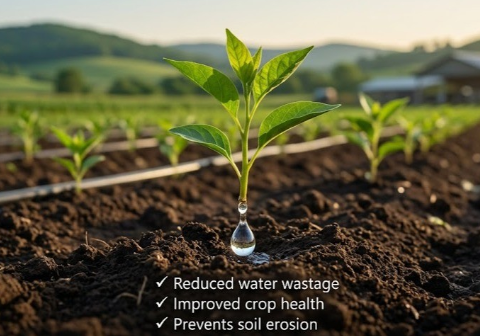
The relationship between drip irrigation and fruit orchard productivity is one of the most well-documented in Indian horticulture — and for managed farmland investors, understanding this relationship helps explain why irrigation infrastructure documentation is as important as the fruit tree composition when evaluating any orchard investment.
What is the difference in mango yield between drip-irrigated and rain-fed orchards?
Published field trials from Karnataka’s horticulture department and independent research consistently document mango yield improvements of twenty-five to forty percent in drip-irrigated orchards compared to equivalent rain-fed orchards in the same region. The improvement operates through two specific mechanisms.
First, flowering induction: Mango requires a period of water stress followed by moisture to trigger synchronised flower bud induction — a process that drip irrigation manages precisely. The irrigation team withholds water in the pre-flowering period (November to December) to create controlled stress, then applies precise moisture at the right moment to trigger synchronised flowering across the orchard. Rain-fed orchards cannot control this timing — they depend on natural rainfall patterns that are unpredictable.
Second, fruit development: The developing mango fruit requires consistent moisture from flowering through to harvest (May to June). Moisture stress during this period causes premature fruit drop and size reduction. Drip irrigation delivers consistent root zone moisture regardless of rainfall, preventing the stress events that reduce yield and fruit quality.
What does the income difference look like in specific numbers?
A productive mango acre without irrigation in Mysore’s agricultural zone, depending on monsoon timing and rainfall adequacy, might produce one thousand five hundred to two thousand kilograms per acre in a normal monsoon year.
The same acre with drip irrigation, using flowering induction protocols and consistent fruit development moisture management, produces two thousand to two thousand eight hundred kilograms per acre.
At forty rupees per kilogram farm-gate price:
Rain-fed: sixty thousand to eighty thousand rupees per acre.
Drip-irrigated: eighty thousand to one lakh twelve thousand rupees per acre.
The income difference — twenty thousand to thirty-two thousand rupees per acre annually — compounds across the orchard’s thirty-to-fifty-year productive life. Over ten years, the drip-irrigated orchard generates two lakh to three lakh twenty thousand more income per acre than the rain-fed equivalent — significantly more than the drip installation cost.
Does drip irrigation reduce water consumption even in an agricultural zone with adequate rainfall?
Yes — and in agricultural zones where bore wells supply dry-season irrigation, water efficiency directly affects the sustainability of the bore well as a long-term resource. Drip irrigation uses forty to sixty percent less water than flood or furrow irrigation to deliver the same root zone moisture — which means the same bore well can irrigate more land, or can sustain the same land with less pumping and lower risk of aquifer depletion.
In the Mysore agricultural belt — where the annual rainfall is adequate for the monsoon growing season but bore well irrigation is essential during the five-month dry season — the water efficiency of drip irrigation is not an environmental luxury but an agricultural necessity for long-term productivity.
Does drip irrigation enable any income streams that rain-fed orchards cannot access?
Off-season production: Certain sapota and guava varieties, managed with drip irrigation, can be induced to flower and fruit outside their natural seasonal pattern — producing fruit during periods of market supply shortage when prices are highest. This counter-seasonal production is only achievable with the precise moisture control that drip irrigation provides.
Export-grade fruit quality: Premium fruit buyers for export markets require consistency in fruit size, colour development, and sugar content that weather-dependent rain-fed orchards cannot reliably deliver. Drip-irrigated orchards with precise nutritional management through fertigation (fertiliser delivery through the drip lines) can consistently produce export-grade quality specifications.
Disclaimer: The information provided in this article is for general informational and educational purposes only and does not constitute financial, legal, tax, or investment advice. While fruit tree cultivation and agroforestry systems can offer long-term agricultural returns, actual crop yields, income timelines, and market prices may vary based on weather conditions, seasonal fluctuations, soil quality, and local market demand. Potential investors should conduct their own due diligence and consult with qualified agricultural and financial advisors before making investment decisions. Nature N Me does not guarantee specific yields, harvest timelines, or financial returns.