
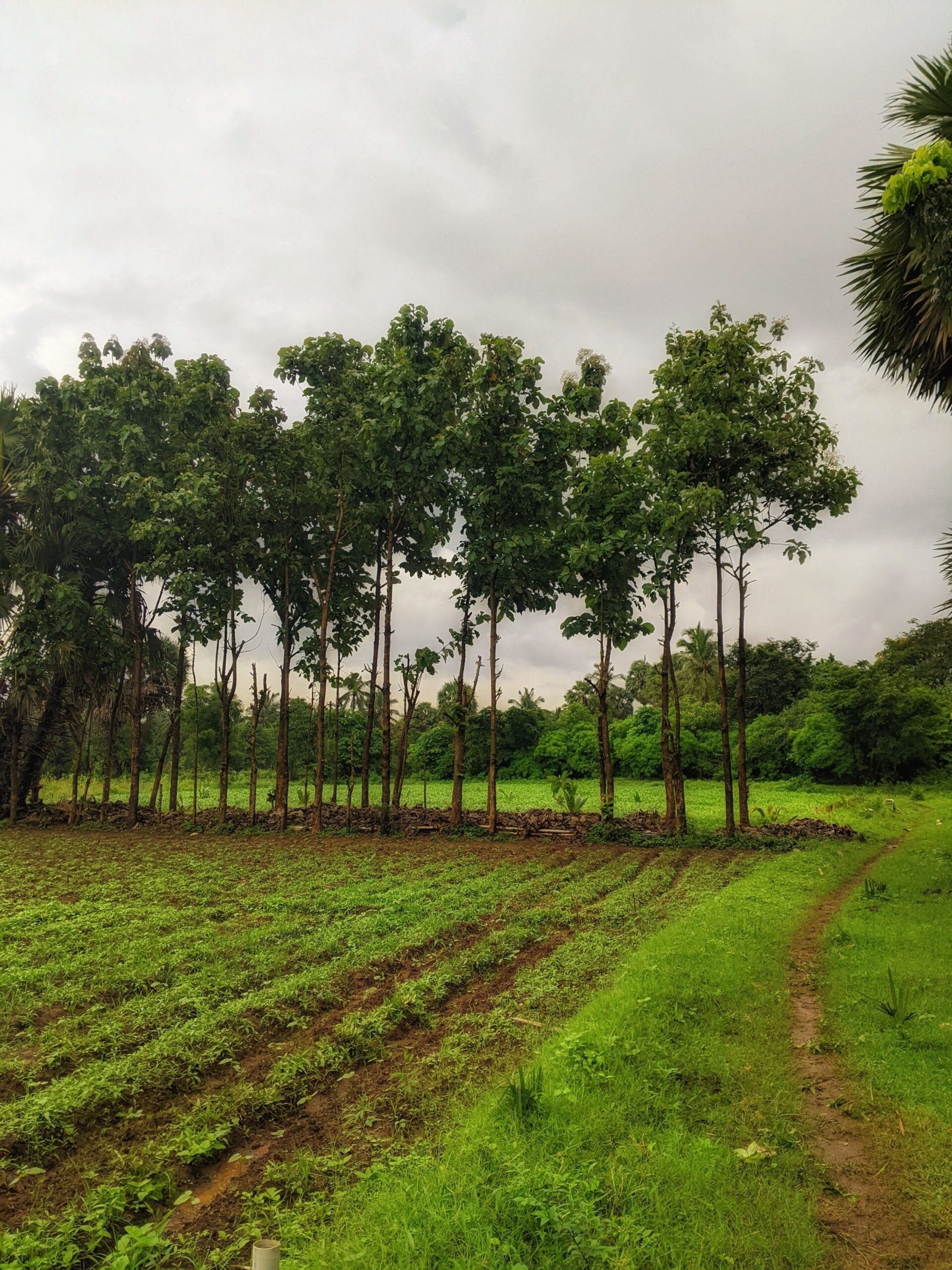
India’s rainfall patterns are changing — not in the simple direction of “getting drier” that would be easy to plan for, but in the direction of greater variability within the monsoon season itself. The total annual rainfall in many Indian agricultural regions has not dramatically decreased, but the distribution within the monsoon period has changed: longer dry spells within the overall monsoon season, followed by more intense but shorter-duration rainfall events that are harder for the soil and agricultural system to absorb efficiently.
This increasing intra-seasonal variability is one of the most practically important climate-related questions for agricultural land investors — and the answer to how well-designed agroforestry systems perform under this variability is genuinely reassuring.
How agroforestry systems handle intra-seasonal dry spells
A well-designed agroforestry system with diverse tree species and deep root architecture handles intra-seasonal dry spells significantly better than monoculture farming because the multi-layered root system accesses soil moisture from multiple depths simultaneously.
In an agroforestry system combining fruit trees, shade trees, and annual or biennial crops, the root depth distribution spans from the first fifteen to twenty centimetres (shallow-rooted annual crops) to two to three metres (deep roots of timber trees like teak). During an intra-seasonal dry spell, the shallow-rooted crops experience moisture stress first — but the deep-rooted trees continue drawing moisture from deeper, moister soil layers that the surface dry spell has not yet affected.
The canopy cover of the agroforestry system also reduces evaporation from the soil surface — the shade that the tree canopy provides means that the soil beneath it retains moisture longer than bare soil in a monoculture, extending the effective water availability during a dry spell before irrigation is required.
How drip irrigation specifically addresses intra-seasonal variability
The most important infrastructure response to intra-seasonal monsoon variability is drip irrigation — which allows precise moisture delivery to crop root zones during dry spells within the monsoon period, without waiting for the next rainfall event. As discussed in our drip irrigation FAQ, drip systems deliver water directly to where crops need it, at rates calibrated to maintain optimal root zone moisture rather than depending on rainfall timing.
An agroforestry estate with functional drip irrigation effectively decouples its crop moisture supply from the erratic timing of individual monsoon rainfall events — maintaining the consistent root zone moisture that fruit set, cherry development, and root health require regardless of whether the monsoon is delivering rain this week or is in a dry spell.
The Specific Benefit of Tree Cover for Intense Rainfall Events
At the other end of the erratic monsoon spectrum — the more intense, shorter-duration rainfall events that are becoming more common — the agroforestry system’s tree canopy provides a specific protection benefit. When heavy rain falls on a monoculture crop with bare inter-row soil, the rainfall energy hits the soil surface directly, displacing soil particles (erosion) and sealing the surface (reducing infiltration).
When the same heavy rain falls on an agroforestry system, the tree canopy intercepts a significant proportion of the rainfall before it reaches the ground, reducing the energy of the rain reaching the soil and dramatically reducing surface erosion. The water that does reach the ground encounters mulched surface organic matter from tree leaf fall — a porous, absorbent surface layer that absorbs rainfall faster than bare soil and channels it into the soil profile rather than losing it as surface runoff.
The Soil Water Holding Capacity Advantage
Decades of research on agroforestry systems consistently show improved soil water holding capacity compared to monoculture — because the continuous addition of organic matter from leaf fall and root turnover in agroforestry systems increases the proportion of fine soil particles bound in soil aggregates. These aggregated particles hold more water per unit volume than degraded, aggregateless monoculture soil.
This improved water holding capacity means that the soil in an agroforestry system can store more of each rainfall event and release it more slowly to plant roots — buffering the effects of both the dry spells (by releasing stored water) and the intense events (by absorbing the rainfall without waterlogging).
The Net Result for Investors
An agroforestry managed farmland estate — with diverse deep-rooted trees, drip irrigation, and organic-rich soil — is specifically better adapted to India’s increasing monsoon variability than any monoculture alternative. The multi-layer root system, the canopy protection, the improved soil water holding capacity, and the irrigation supplementation create a climate-resilient agricultural system that delivers more consistent income across variable rainfall years than the alternatives.
This climate resilience is increasingly a genuine investment quality differentiator — as India’s monsoon variability continues to increase, the assets that are structurally adapted to variability will outperform those that are not.
Disclaimer: The information provided in this article is for educational and informational purposes only and does not constitute financial, agricultural, or legal investment advice. Performance metrics, soil behavior, and climate resilience of agroforestry plots can vary significantly based on specific geographical location, local rainfall intensity, soil profile, and farm management practices. Past performance and scientific observations of agroforestry systems do not guarantee identical outcomes or fixed returns. Prospective farmland investors should conduct independent due diligence and consult with qualified agricultural and financial professionals before making investment decisions.