
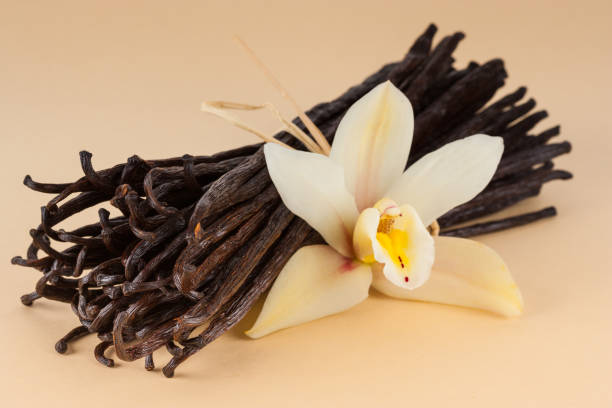
Vanilla (Vanilla planifolia) consistently appears among the world’s most expensive agricultural spices — its dried cured beans have traded at prices ranging from three hundred to six hundred US dollars per kilogram in recent years. For investors who encounter this price figure while researching high-value crops for their agroforestry estate, the question is natural: can vanilla be grown in an Indian agroforestry system and is the extraordinary price achievable?
What vanilla needs to grow commercially
Vanilla is a climbing orchid native to Mexico, adapted to a humid tropical forest environment. It requires specific conditions that are not universally available across India’s agricultural zones.
Temperature: Twenty to thirty-five degrees Celsius during the growing season, with cool nights preferred. Consistent temperatures outside this range stress the plant and reduce production.
Humidity: High relative humidity — above seventy percent — throughout the year. This is one of vanilla’s most limiting requirements in Indian agricultural zones.
Shade: Fifty to seventy percent shade from tall canopy trees — vanilla cannot tolerate direct sunlight and must be grown under a shade canopy that resembles its forest origin.
Climbing support: Vanilla is a vine that climbs living support trees using aerial roots. The support tree species significantly affects growth rate and production — certain species (commonly Gliricidia, silver oak, or other nitrogen-fixing trees) are preferred.
Hand pollination: Outside of Mexico, where specific native bee species (Melipona bees) provide natural pollination, vanilla must be hand-pollinated for commercial production. Each flower must be individually pollinated by hand on the single day it is open — a labour-intensive and skill-requiring activity that is the primary management constraint on vanilla cultivation at scale.
Where vanilla works in Indian agroforestry
The specific Indian agricultural zones that best meet vanilla’s requirements are the high-humidity, medium-altitude zones of Kerala and Karnataka’s Western Ghats — particularly in zones receiving more than two thousand millimetres of annual rainfall with high year-round humidity. Parts of Coorg (specifically the more humid, lower-altitude sections) and Kerala’s Wayanad and Thrissur districts have established vanilla cultivation with varying commercial success.
In Coorg’s prime Arabica coffee zone at Madikeri altitudes, vanilla can be grown in protected sections of the estate — specifically areas with consistent high humidity and shade canopy — as a high-value supplementary crop alongside the main coffee planting.
The Hand Pollination Challenge: Why It Limits Scale
The hand pollination requirement is the primary commercial barrier to vanilla cultivation at meaningful scale. A single vanilla plant produces multiple flowers over a flowering season, each open for only four to six hours on the single day it blooms. Missing the pollination window means zero fruit set from that flower.
At scale — say one hundred vanilla plants in flower simultaneously — the labour requirement to pollinate all open flowers daily during the flowering period is substantial and requires workers who are trained in the specific technique (splitting the flower membrane to expose the anther and stigma, then transferring pollen with a toothpick or small stick). This skilled labour is scarce and expensive in most Karnataka agricultural zones.
What Income Is Realistic From Small-Scale Vanilla
A mature vanilla vine produces two hundred to five hundred grams of cured vanilla beans per year under well-managed conditions. At current Indian vanilla pricing (Indian vanilla typically achieves lower prices than Madagascar or Tahitian vanilla in international markets, but still commands five hundred to eight thousand rupees per kilogram of cured bean depending on quality and buyer), a productive vine generates one thousand to four thousand rupees per year.
An agroforestry estate section with twenty-five vanilla vines (a modest but meaningful planting) generates twenty-five thousand to one lakh rupees per year at full production — a niche but real income from a section of the estate’s silver oak canopy.
The Honest Assessment
Vanilla is a realistic supplementary income crop for agroforestry estates in appropriate humidity zones, managed by operators with the specific hand-pollination expertise. It is not a primary commercial crop for most managed farmland investors because the hand pollination requirement limits scalable production without significant skilled labour investment. As a small-scale addition to a diversified agroforestry system where it suits the specific plot’s humidity and canopy conditions, it provides genuine premium income from a modest land area.
Disclaimer: The information provided in this article is for general informational and educational purposes only and does not constitute agricultural, financial, legal, or investment advice. Vanilla crop yields, market prices, hand-pollination success rates, and labor requirements vary significantly based on microclimate conditions, altitude, skilled management, and global supply fluctuations. Potential investors should conduct independent due diligence and consult qualified agricultural experts before establishing vanilla cultivation or making farmland investment decisions. Nature N Me does not guarantee specific yields, price realizations, or financial returns.