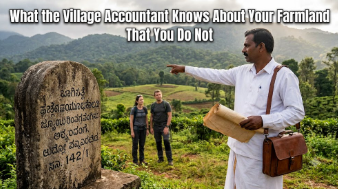
Every piece of agricultural land in Karnataka is overseen by a specific government official whose title and functions are largely unknown to urban investors: the village accountant (VA) — called patwari in some states, sometimes called shanbhog in older Karnataka administrative usage. This person sits at the most local level of Karnataka’s revenue administration hierarchy and maintains the ground-level land records that determine your ownership’s practical reality.
What the Village Accountant Does
The village accountant is a Karnataka government revenue official responsible for maintaining land records — RTCs, mutation registers, crop inspection registers, and tax demand registers — for all agricultural land within their assigned hobli jurisdiction. Every Kodagu survey number falls under a specific VA’s jurisdiction, and that VA is the person who physically updates the records when a sale is registered, inspects the land when a mutation is applied for, and certifies the current crop status when a crop inspection report is required.
When you purchase agricultural land in Coorg and apply for mutation after registration, it is the VA who visits the land, verifies that you are the new owner in possession of the land, and recommends the mutation to the Tahsildar. When your RTC is updated, it is the VA’s field verification that confirms the physical possession matches the registered ownership.
What the VA Knows That No Document Reflects
The village accountant’s knowledge of the specific land in their jurisdiction goes beyond what any document records. They typically know the local history of every significant survey number — who owned it before the current seller, whether there have been any boundary disputes in living memory, whether the plot has any history of encroachment by neighbouring farmers, whether the water sources are as claimed, and whether the current cultivation is consistent with what the RTC records.
This ground-level knowledge is genuinely valuable due diligence information — and the VA is generally willing to share it with a buyer who approaches them respectfully and through the appropriate channels (typically through the farm manager or Nature N Me’s local team who have established working relationships with the relevant VAs in our operating zones).
Why the VA Relationship Matters After Purchase
After your purchase, the VA continues to be relevant in several ways. Any future mutation — whether from an additional survey number purchase, a change in crop status, or a family transfer — goes through the VA. If any boundary dispute arises with neighbouring landowners, the VA’s field assessment is part of the resolution process. If you apply for any government agricultural scheme that requires certified land records, the VA’s certification is required.
Nature N Me’s local management team maintains working relationships with the village accountants in all our operational zones — ensuring that mutation processes move efficiently, that any land record queries are addressed promptly, and that the ground-level administrative relationships that make the land investment practically smooth are in place.
The Crop Inspection Register: The VA’s Most Useful Record
The VA maintains a crop inspection register that records, season by season, what was actually growing on each survey number in their jurisdiction — coffee, cardamom, pepper, forest, bare land. This register provides a historical crop record that no other document captures at this level of specificity. For an investor evaluating a plot’s agricultural history, the crop inspection register is the most granular and honest historical source available — because the VA physically visits and records what they observe rather than relying on what owners report.
Requesting access to the crop inspection register entries for a specific survey number — through a right-to-information application or through the appropriate channels — provides agricultural history verification that complements the financial income history provided by the seller.
Disclaimer
General Information Notice: The information provided in this article is for general educational and informational purposes only and does not constitute legal, financial, tax, or professional real estate advice.
Land revenue laws, mutation procedures, and administrative practices in Karnataka (including Kodagu/Coorg) are subject to periodic regulatory updates and local jurisdiction variations. While every effort has been made to ensure accuracy, Nature N Me makes no representations or warranties, express or implied, regarding the completeness or reliability of the information provided.
Readers and prospective buyers are strongly advised to perform independent due diligence, verify original title deeds and RTC records with official Karnataka Revenue Department authorities, and consult qualified legal counsel before making any property investment or land transaction decisions.
Frequently Asked Questions
Q1: Who is a Village Accountant (Patwari / Shanbhog) in Karnataka?
A: A Village Accountant (VA) is a ground-level revenue official responsible for maintaining agricultural land records—such as RTCs, crop inspection registers, and mutation registers—for a specific hobli jurisdiction.
Q2: What is the Village Accountant’s role when buying agricultural land?
A: When you apply for mutation after purchase, the VA conducts a field inspection to verify physical possession, confirm the new owner, and recommend the mutation to the Tahsildar.
Q3: What unique information does the VA know about a plot of land?
A: The VA knows unrecorded local history, including past ownership, historical boundary disputes, encroachment issues, water source validity, and true cultivation history.
Q4: What is the Crop Inspection Register?
A: It is a register maintained by the VA that records season-by-season observational data on actual crop growth (e.g., coffee, pepper, forest, bare land) for every survey number.
Q5: Why is the Crop Inspection Register important for buyers?
A: It provides an objective, ground-verified history of a plot’s agricultural production, helping verify the seller’s income claims.
Q6: Why is the VA relationship important after purchasing land?
A: The VA handles all future mutations, boundary dispute assessments, and land certifications required for government agricultural schemes.