
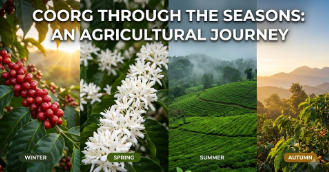
Of all the photographs in a Coorg managed farmland estate’s annual cycle — the harvest, the monsoon greenery, the silver oak pruning — none generates more interest from investors and non-investors alike than the coffee blossom photographs. For two to three days in March or April, the entire coffee estate is covered in white, jasmine-like flowers that turn the green coffee rows into something almost unrecognisably beautiful.
But the blossom season is not primarily a photographic opportunity. It is the most agriculturally consequential event of the year — the moment that determines how much the investor’s estate will earn in the December-to-February harvest eleven months later. Understanding the science behind the blossom explains why this narrow window of time matters so much and what professional management does to optimise it.
The Physiology of Coffee Flowering
Coffee flowering in Coorg (and across all Arabica-growing regions) is triggered by a specific combination of environmental cues rather than by calendar date. The primary trigger is a rain event — typically the first significant pre-monsoon shower of the year — arriving after a period of water stress during the dry season.
The physiological mechanism: during Coorg’s dry season (January to May), coffee plants experience progressive water stress as soil moisture declines. This stress triggers the development of flower buds in the leaf axils — the junction points between leaves and branches — which remain dormant in a state of readiness. When a significant rain event (typically eight to ten millimetres or more in a single event) arrives after this period of stress and bud dormancy, the physiological trigger is pulled. Within approximately forty-eight to seventy-two hours of the rain event, the entire estate erupts in synchronised flowering — thousands of flowers opening simultaneously across the canopy.
Why Synchronisation Matters for Harvest Quality
The synchronised nature of the flowering — achieved by the uniform stress-and-trigger mechanism across all plants on the estate — is critical for harvest management quality. When all cherries develop from flowers that opened within the same forty-eight to seventy-two hour window, they also reach harvest ripeness within the same window eleven months later. This harvest-stage synchronisation allows selective picking of ripe red cherries that is efficient and quality-consistent.
Asynchronous flowering — where different plants flower in different weeks due to uneven stress conditions or poor pre-blossom water management — produces an asynchronous harvest where pickers must return to the same rows many more times to collect successive ripening waves, increasing harvest labour cost and making quality management more challenging.
What the Farm Manager Does to Optimise Blossom Response
The farm management team’s role in the blossom season is specifically pre-blossom — controlling the conditions in the weeks before the expected shower to maximise the uniformity and density of the blossom response. This pre-blossom management is one of the most skill-dependent activities in the entire agricultural calendar.
Pre-blossom irrigation management: In the weeks before the expected first significant shower (typically identifiable from weather patterns and historical records for the specific location), the farm manager deliberately reduces or withholds irrigation to allow mild water stress to build uniformly across the estate. This stress intensification primes the flower buds for a more synchronised and vigorous response to the trigger shower.
The timing of this stress application requires careful judgment: too little stress produces a weak, asynchronous blossom. Too much stress — allowing plants to reach severe water stress — damages the developing flower buds and reduces the total flower count available to open when the trigger arrives.
Counting the Blossom: The First Yield Estimate
Within a week of the blossom shower and flowering, the farm manager walks the estate counting flower density — the number of flower clusters per branch across representative sections of the estate. This post-blossom census provides the first yield estimate for the coming harvest — the relationship between flower density and cherry yield is well-established in Arabica coffee agronomy, allowing reasonably accurate harvest prediction from blossom count data.
This early yield estimate — shared with investors in the spring management update — sets the income expectation for the December-to-February harvest season. It is the first data point in a chain of agricultural observations that culminates in the harvest income statement.
What Investors See in the Blossom Photographs
When the monthly update arrives in March or April with blossom photographs from your estate, the photographs are telling you more than a visual story. A dense, uniform white flowering across the coffee rows indicates good pre-blossom management, adequate flower bud development, and a synchronised trigger response — setting up a well-synchronised harvest season. Sparse or patchy flowering may indicate water stress issues, variety-related flower development problems, or pre-blossom management gaps that warrant a specific question to the farm manager.
The blossom photograph is the most informative single image in the estate’s annual update cycle — for those who know how to read it.