
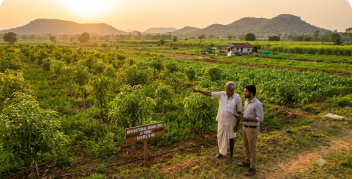
The following account is written in the first person — the perspective of a Nature N Me investor who purchased a newly established Coorg managed farmland estate and experienced the full journey from the registration day to the first commercially meaningful harvest. It is a composite of multiple investor experiences, written honestly to give prospective buyers the most accurate possible picture of what those first years actually feel like.
Year Zero: The Purchase and the First Visit
I complete the registration at the Madikeri sub-registrar’s office on a Thursday morning in September. The process takes three hours — sitting across a table from the seller while the registrar’s office enters the deed details, both of us signing in the appropriate places, witnesses doing the same. The original sale deed is handed to me when it is done. It is a thick sheaf of stamp paper with an orange seal, and it has my name on it as the owner of a specific survey number of agricultural land in Kodagu district. I hold it in the car for a moment before putting it in the document folder.
We drive to the estate afterward. The farm manager meets us at the gate — a man named Suresh who has been managing coffee estates in this taluk for fourteen years. He shows me around for two hours. The planting is new — three-month-old coffee seedlings in neat rows, silver oak saplings barely knee-height, everything recently established. It looks, honestly, like a field with some young plants in it. Nothing about it looks like a coffee estate yet.
Suresh points out the water sources — the bore well with its pump house, the small stream that runs along the southern boundary. He shows me the drip lines running between the rows. He explains the next few months’ plan — establishing the cardamom seedlings in the shaded sections, applying the first round of compost, completing the remaining silver oak planting. He speaks with the specificity of someone who knows this land already.
I drive back to Bangalore that evening with the original deed in my folder and photographs of young plants on my phone. The investment has begun.
Year One: The Establishment
Monthly updates arrive — photographs of plants that are gradually, imperceptibly growing. The coffee seedlings progress from small plants with four to six leaves to slightly larger plants with more leaf nodes. The silver oak saplings gain thirty to forty centimetres of height across the year. The drip system is running.
The first year’s crop income is minimal — some cardamom from a small established section, a token coffee yield from a few plants that are precocious early bearers. The income statement when it arrives is honest: a few thousand rupees. I knew this would be the case; the numbers confirm it rather than surprise me.
The visit in March is when the blossom happens on the small number of coffee plants mature enough to flower. Perhaps fifteen percent of the planting — the most advanced plants — produce blossom. White flowers for two days. The smell is extraordinary. Suresh shows me the flower clusters and explains that this represents next year’s cherries from these plants. The first concrete connection between what I see and what will become income.
Year Two: The Estate Begins to Look Like Itself
The second year transforms the estate’s visual character. The silver oak has grown from knee-height to shoulder-height — the estate now has a visible canopy structure forming. The coffee bushes have developed from seedlings into recognisable coffee plants — the characteristic oval leaves, the branching structure, the beginning of a real canopy. Walking between the rows has changed from walking between stakes and small plants to walking between actual coffee bushes.
The blossom in March of year two is significantly larger than year one. Perhaps sixty percent of the planting flowers, producing visible cherry clusters through the rest of the year. The November pruning is the first full silver oak canopy management — Suresh’s team works through the estate for four days, shaping the canopy to the appropriate density for the coffee below.
Income in year two is still modest — cardamom is now producing meaningfully from the established sections, pepper vines are producing their first small yields. Coffee cherry from the most advanced plants generates a small but real harvest income. The income statement is small but multiple crop lines are appearing. The diversification is beginning to express itself.
Year Three: The First Real Harvest
Year three is when everything changes. The coffee planting is in its first full commercial production season. The farm manager’s pre-harvest assessment — the count of cherry clusters per plant across representative rows — indicates a meaningful yield. I visit in January during the harvest week.
The picking crew arrives before six in the morning. Twelve workers moving through the rows, the sound of cherries dropping into collection baskets. The weighing at the day’s end: two hundred and forty kilograms of red cherry from this section alone. Over the harvest season, my plot produces eight hundred kilograms of cherry — processing down to approximately one hundred and sixty kilograms of dried parchment coffee.
The income statement arrives in April. The crop income is real — not life-changing, but genuinely meaningful. The cardamom income has been consistent through the year. The pepper is adding its contribution. For the first time, the income statement looks like what a managed farmland income statement is supposed to look like — multiple crop lines, documented harvest weights, verified sale prices.
Year Four: The Pattern Establishes Itself
By year four, the pattern is established. The blossom in March tells me approximately what the harvest will be in December. The monthly updates track a known seasonal rhythm. The farm manager’s assessments have a track record against which his projections can be evaluated. The coffee yield grows from year three’s level as the plants mature further into their productive phase.
I visit three times in year four — once in March for the blossom, once in July to see the monsoon estate, once in January for the harvest. Each visit reveals an estate that is further ahead in its development than the last. The silver oak is now eight metres tall. The coffee canopy is continuous between the rows. It looks, finally and unmistakably, like a Coorg coffee estate.
Contact Nature N Me at naturenme.in or WhatsApp +91 98805 21637 to begin your own four-year journey.
Disclaimer: This article is for general informational and educational purposes only and does not constitute financial, legal, or investment advice. Agricultural yields, crop income, and estate timelines mentioned reflect a composite account and will vary based on weather, soil conditions, market prices, and management. Prospective buyers should conduct independent due diligence and consult with qualified legal and financial professionals before purchasing farmland.