
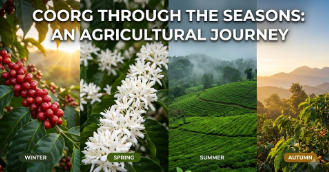
The Coorg monsoon is not a single event — it is a four-month agricultural season that is as carefully managed as the dry season, with a different set of challenges, activities, and outcomes than any other period in the farming calendar. Investors who understand what the monsoon means for their estate — month by month — have a context for evaluating the farm manager’s reports and making sense of what they are seeing in monthly update photographs.
June: The Arrival and the Scramble
The southwest monsoon typically arrives in Coorg in the first week of June — often within two to three days of its historical arrival date, driven by the orographic mechanism rather than the vaginal broader monsoon variability that affects flat agricultural regions. The arrival is dramatic: within forty-eight hours of the first monsoon shower, the estate transforms from dry-season condition to active rain.
The farm management team’s June priority is drainage. The irrigation channels and drainage cuts made during dry-season maintenance are immediately tested by the monsoon rainfall intensity. Any drainage channel that is partially blocked — by leaf litter, by small landslides of loose soil, by vegetation that has grown across the channel during the dry season — must be cleared immediately before rainfall accumulation creates pooling around coffee root zones.
Simultaneously, the first monsoon rain triggers the explosive germination of weed seeds that have been dormant through the dry season. June requires the first round of weeding before the weed growth becomes difficult to manage. The timing of this initial weed management is critical — too early and the weeds have not yet germinated; too late and the weeds have established root systems that require significantly more labour to remove.
For new plantings established during the dry season, June’s first rains are the moment the young plants experience natural rainfall for the first time. The management team monitors the establishment of new plants closely through June, replacing any that have failed to establish before the monsoon growth flush makes replanting more difficult.
July: Maximum Intensity
July is typically the most rainfall-intense month of the Coorg monsoon — average daily rainfall at the district’s meteorological stations often exceeds thirty to forty millimetres in peak July periods. The management team is in continuous drainage maintenance mode, clearing channels after each heavy event before the next arrives.
Coffee cherry development is progressing well through July — the warm, humid conditions of the monsoon support rapid cherry growth from the small green fruit that set after the March-April blossom. July photographs from your estate should show the coffee trees bearing recognisable green cherries in developing clusters.
Disease monitoring intensifies in July. Coffee leaf rust (Hemileia vastatrix) — the primary fungal disease of Coorg Arabica — reaches peak infection risk during the warm, humid monsoon period. The management team inspects the undersides of coffee leaves weekly for the characteristic orange-yellow rust pustules that signal an active infection. Early detection allows copper fungicide application timed between rain events — difficult scheduling that requires agricultural judgment about when a sufficient dry window exists for the application to adhere and take effect before the next rainfall washes it away.
August: The Cardamom Harvest Begins
August marks the beginning of the cardamom harvest on most Madikeri estates — the first flush of mature cardamom capsules reaching harvestable ripeness on the leading panicles. Cardamom harvest requires more skilled assessment than coffee harvest: the capsules must be picked at exactly the right stage of maturity — fully sized but not yet splitting, with the volatile aromatic oils fully developed but not yet beginning to dissipate.
Picking too early produces under-ripe capsules with lower volatile oil content that fetch lower prices at auction. Picking too late produces split capsules that are heavily discounted. The farm manager and experienced picking team assess harvest readiness by visual inspection and gentle tactile assessment of capsule firmness on a daily basis through August and September.
September: The Monsoon Withdrawal and Pre-Harvest Preparation
September marks the southwest monsoon’s gradual withdrawal from Karnataka. In Coorg, this withdrawal is more gradual than in the plains — the orographic rainfall sustains precipitation longer than the regional monsoon retreat. But the rain becomes less continuous and the management team begins transitioning from monsoon-mode management to pre-harvest preparation.
The November silver oak pruning — the most significant canopy management activity of the year — is planned and prepared in September. The farm manager walks the entire estate assessing current canopy density, identifying which silver oak trees require the most significant pruning and which need only light management. The harvest infrastructure — wet mill, drying beds, collection equipment — is inspected and any repair or replacement needed before January is identified and executed in this window before the harvest season demands full operational focus.