
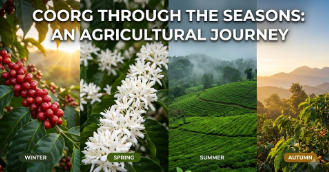
Most people’s instinct is to visit Coorg in the post-monsoon months — October to January, when the skies are clear and the landscape is green from monsoon rain. For tourism, this instinct is correct. For farmland evaluation and purchase, March to May is actually the optimal window — and investors who understand why use it to their advantage.
The Coffee Blossom: March and April’s Spectacular Agricultural Moment
As discussed in our earlier post on coffee flowering, March and April bring the coffee blossom — one of the most agriculturally significant and visually spectacular events of the Coorg estate calendar. The entire estate erupts in white jasmine-like flowers, filling the air with fragrance for two to three days following the first pre-monsoon shower.
For a prospective buyer evaluating a farmland plot, visiting during blossom season provides a specific and valuable piece of information: you can see the flowering density directly, assess the proportion of branches bearing flowers, and make an early-season estimate of the coming harvest’s potential. A dense, uniform flowering across the plot indicates good plant health and productive management. Sparse or patchy flowering may indicate water stress, management gaps, or variety-related limitations.
No photograph or harvest income statement communicates what the blossom season reveals about a plot’s productive condition. Seeing it directly during a March or April visit provides an agricultural assessment layer that no other season offers.
The Dry Season Water Visibility Advantage
The pre-monsoon dry season — March to May — is when water sources are at their minimum. This is the most revealing time to assess the water security of any farmland plot. If a bore well yields three thousand litres per hour in May, it yields at least that much throughout the rest of the year. If a stream is still running in April, it is genuinely perennial rather than seasonal.
Visiting a plot in October after the monsoon — when streams are full, water tables are high, and bore wells produce at their best — conceals the dry-season reality. The plot that looks water-secure in October may struggle in April. Visiting in March to May shows you the dry-season truth that determines whether the estate can maintain crop irrigation when it matters most.
Open Access Before the Monsoon Creates Difficulties
The pre-monsoon months are the best time for physical estate inspection from a practical access standpoint. The access roads to rural estates — often earthen or gravel tracks — are dry, firm, and easily navigable by any vehicle. The undergrowth between crop rows is lower and less dense than the monsoon flush, making the full walk of an estate more comfortable and comprehensive.
After June, heavy rain can make some estate access roads challenging for standard vehicles, and the dense monsoon vegetation makes boundary walks more difficult. The dry-season window offers the clearest physical access to the plot you are evaluating.
The Transaction Timing Advantage
March to May is also one of the quieter periods for farmland transactions in Coorg — the October to January harvest season generates more investor interest and more competition for good plots. Evaluating and committing to a purchase in the dry season means negotiating in a less competitive buyer environment, with the full harvest income documentation from the just-completed season available for review.