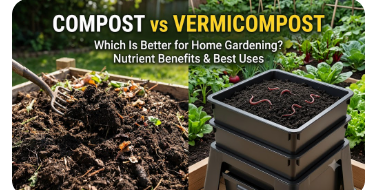
If you are looking to boost your garden’s soil health naturally, you have likely come across two popular organic amendments: regular compost and vermicompost.
While both act as powerful, chemical-free soil conditioners, they are produced differently and offer unique benefits to your plants. Choosing between the two—or knowing how to use them together—can make a massive difference in your garden’s success.
Let’s break down the key differences, nutrient benefits, best use cases, and how to choose the right one for your home garden.
What Is Compost and How Is It Made?
Regular compost (often called cold or hot compost) is produced through the natural aerobic decomposition of organic waste by micro-organisms such as bacteria and fungi.
- How it’s made: Kitchen scraps (greens) and dry yard waste like fallen leaves or cardboard (browns) are piled together. Over time, moisture, oxygen, and microbial activity break down the materials into a rich, dark, earthy soil conditioner.
- Texture & Appearance: Dark brown, coarse, and textured, often containing small visible bits of un-decomposed plant matter.
What Is Vermicompost and How Do Worms Improve It?
Vermicompost is the end-product of composting that uses specific species of earthworms—most commonly Red Wigglers (Eisenia fetida)—to process organic waste.
- How it’s made: Worms digest organic waste, passing it through their digestive tracts, where it is enriched with beneficial gut microbes and enzymes before being excreted as worm castings.
- Texture & Appearance: Extremely fine, uniform, odorless, and dark black with a soft, peat-like consistency.
- The Worm Advantage: As worms consume waste, they break down nutrients into forms that are significantly more bioavailable to plant roots right away.
Nutrient Content & Speed of Plant Benefit
| Feature | Regular Compost | Vermicompost |
|---|---|---|
| Nutrient Richness | Moderate, slow-release nutrient supply. | High concentrations of N-P-K, micronutrients, and growth hormones. |
| Microbial Activity | High in beneficial bacteria and fungi. | Extremely rich in active enzymes and beneficial microbes. |
| Absorption Speed | Slower; breaks down gradually in the soil over time. | Fast-acting; roots absorb nutrients almost immediately. |
| Soil Structure | Superior for building long-term soil bulk and structure. | Excellent for immediate root growth and seedling uptake. |
Export to Sheets
Best Use Cases in the Garden
1. For Vegetable Gardens & Heavy Feeders
- Winner: Vermicompost (or a mix)
- Quick-growing vegetables like tomatoes, peppers, and leafy greens benefit immensely from the readily available nutrients and bio-stimulants in vermicompost, leading to faster flowering and higher yields.
2. For Seedlings & Propagation
- Winner: Vermicompost
- Because vermicompost is fine-textured and non-burning, it is ideal for seed-starting mixes. It gently stimulates early root development without scorching delicate tender roots.
3. For Soil Preparation, Flower Beds & Large Pots
- Winner: Regular Compost
- Regular compost is fantastic for working into garden beds, filling large pots, or conditioning sandy/clay soil because it adds substantial organic mass and improves long-term water retention.
Which Is Better for Your Gardening Goals?
- Choose Regular Compost if: You have access to a lot of kitchen and garden waste, want an economical way to improve large areas of soil, or are prepping garden beds before a new season.
- Choose Vermicompost if: You have limited space (like a apartment balcony), want rapid results for container plants, or need a gentle, nutrient-dense boost for seedlings and potted flowers.
How to Combine Both for Ultimate Soil Health
You don’t actually have to choose just one! Combining regular compost and vermicompost creates a complete soil food web for your plants.
- The Power Combo Strategy:
- Base Foundation: Mix regular compost into your potting mix or garden bed to build soil bulk, improve drainage, and retain moisture long-term.
- Nutrient Top-Dressing: Add a top layer of vermicompost around the base of your plants every 3–4 weeks during their active flowering or fruiting stage for an instant boost.
- Liquid Boost: Use vermicompost to brew “vermicompost tea” for a nutrient-rich foliar spray or root drench.
Final Thoughts
Both regular compost and vermicompost are invaluable tools for organic gardening. Regular compost is your soil’s best long-term builder, while vermicompost acts as high-grade, fast-acting plant food. Using both ensures your plants stay healthy, vibrant, and productive year-round!
Frequently Asked Questions
Q: What is the main difference between regular compost and vermicompost?
A: Regular compost relies on natural microbial decomposition of organic waste, while vermicompost uses earthworms (like Red Wigglers) to break down waste into nutrient-rich worm castings.
Q: Which one provides faster nutrient availability to plants?
A: Vermicompost provides fast-acting, highly bioavailable nutrients and enzymes that plant roots absorb almost immediately, whereas regular compost releases nutrients slowly over time.
Q: Is vermicompost or regular compost better for starting seedlings?
A: Vermicompost is ideal for seed starting because its fine, non-burning texture gently encourages early root development without scorching delicate roots.
Q: Why should I choose regular compost over vermicompost?
A: Regular compost is best for building overall soil bulk, improving long-term soil structure, and cost-effectively filling large garden beds or containers.
Q: Will vermicompost burn my plants if I use too much?
A: No, vermicompost is gentle and non-burning, making it safe for direct contact with sensitive roots and young seedlings.
Q: Can I use regular compost and vermicompost together in my garden?
A: Yes! Use regular compost as a base foundation to improve soil structure, and top-dress with vermicompost every 3–4 weeks for a fast-acting nutrient boost during growth.