
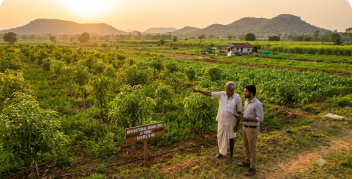
Behind every managed farmland investment is a human reality that balance sheets and return projections rarely capture: the farm management team whose daily decisions determine whether the estate produces well or poorly, whether the orchard is healthy or stressed, whether the timber planting is developing on schedule or falling behind. In Karnataka’s agricultural belt near Mysore, the best of these management teams carry something that cannot be hired from an agricultural college or trained through a management manual — the accumulated practical knowledge of families who have been farming this specific landscape for generations.
What Generational Agricultural Knowledge Actually Is
Agricultural knowledge that has been passed through generations within a family has a specific character that formal training cannot fully replicate. It includes the observation of how specific crops in specific locations responded to specific conditions across multiple decades — which variety of mango produces best on a red laterite slope facing west, which sections of the local landscape drain poorly after heavy rain, what the early signs of a particular pest look like in this specific micro-climate before they reach the point of damage.
This knowledge is accumulated through decades of daily observation, trial, error, and adjustment — a form of agricultural wisdom that is specific to the place, the crops, and the conditions in which it was developed. It cannot be imported from a different region, downloaded from an extension service, or substituted with general agricultural principles applied to a new context.
Why This Matters for Your Investment’s Agricultural Income
The quality of agricultural management on your managed farmland estate near Mysore determines the yield of your orchard crops, the health of your timber planting, and the efficiency with which management costs are contained. These factors directly calculate into the net crop income that reaches your account after the management fee.
A management team operating from generational local knowledge — knowing exactly when to initiate flowering stress irrigation on the mango orchard based on watching how the specific variety on this specific soil responds, recognising early signs of fruit fly pressure before it reaches the point requiring intervention, understanding which section of the estate holds soil moisture longest and prioritising water to the areas that need it most — will consistently outperform a management team applying general agricultural principles to an unfamiliar context.
The Continuity That Experience Provides
There is a further dimension to generational agricultural knowledge that matters specifically for long-term investors: continuity of care across the investment horizon. A management team with deep local roots — whose family members have been farming the same landscape across multiple generations, whose social relationships with neighbouring farmers, local labour, and the district agricultural office are embedded rather than transactional — provides a continuity of engagement with your estate that contract agricultural teams cannot match.
The farm manager who has been managing estates in this specific Karnataka agricultural zone for twenty years, whose knowledge of the local crop cycle is embodied rather than textbook, who is known and trusted by the local labour community whose cooperation makes harvest operations possible — this person is the human infrastructure behind your investment’s returns in a way that no financial model explicitly captures but that experienced investors consistently cite as the single most important management quality dimension.
How Nature N Me Builds Its Teams
Nature N Me’s agricultural management teams are recruited from Karnataka’s farming community rather than from generic agricultural management backgrounds. The team members managing estates near Mysore have direct experience in the specific crops, soils, and seasonal patterns of the Mysore agricultural belt — experience that is the product of years of practical work in this specific landscape.