
When comparing managed farmland options across Karnataka, investors naturally focus on the most visible differences — price per acre, crop composition, distance from Bangalore, and lifestyle context. What receives less attention but arguably matters more for a ten-to-twenty-year holding period is the underground dimension of the investment: the water table.
Near Mysore — particularly in zones like Nanjangud, Hunsur, and the broader Cauvery basin agricultural belt — groundwater tables are demonstrably higher and more reliable than in many of the agricultural zones along Bangalore’s northern and eastern periphery that are often marketed to investors as farmland alternatives.
What the Water Table Difference Looks Like in Practice
A bore well drilled to sixty to ninety metres in a productive zone of the Mysore agricultural belt typically encounters reliable groundwater that sustains yields of two thousand to five thousand litres per hour across dry-season pumping periods. The same bore well investment in some Bangalore peripheral zones — particularly in the basalt and granite-dominated geology north of the city — may need to go to one hundred and fifty to two hundred metres to find comparable yield, at significantly higher drilling cost and with less reliable year-round performance.
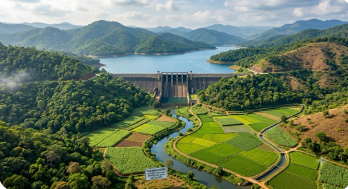
This groundwater depth difference reflects the underlying hydrology. Mysore’s agricultural belt sits within the Cauvery river basin, where river flows and reservoir storage have been contributing to groundwater recharge across the agricultural landscape for decades. The Kabini and Hemavathi tributaries add recharge to broader sections of the district beyond the immediate Cauvery corridor.
Why Higher Water Tables Protect Crop Income Across Dry Years
In a below-average monsoon year — when rainfall is sixty to seventy percent of normal — a farm estate dependent on a bore well in a water-stressed zone may see yields fall to five hundred litres per hour or less, severely limiting dry-season irrigation capacity. An estate in a higher water table zone like Mysore’s agricultural belt typically maintains significantly better bore well performance in the same year, because the deeper groundwater reservoir is less immediately sensitive to single-season rainfall shortfalls.
This resilience translates directly into crop income stability. Mango orchards that receive adequate dry-season irrigation produce reliably in below-average rainfall years. Those on water-stressed estates that cannot maintain sufficient dry-season moisture face cherry drop, uneven fruit development, and reduced commercial yield precisely in the year when market prices might be higher due to reduced supply across the region.
The Long-Term Groundwater Outlook
India’s overall groundwater situation is concerning — the Central Ground Water Board documents declining water tables across many major agricultural districts. Mysore’s situation is more favourable than most, but not immune from long-term pressure as agricultural water demand grows.
The most important protection against long-term groundwater decline on any agricultural estate is the combination of efficient drip irrigation (reducing per-crop water consumption), rainwater harvesting practices that improve on-estate recharge, and the reservoir-backed water security of the Cauvery basin system that provides a managed water source independent of purely local groundwater.
Nature N Me’s managed farmland near Mysore incorporates all three of these water security practices as standard elements of estate management.