
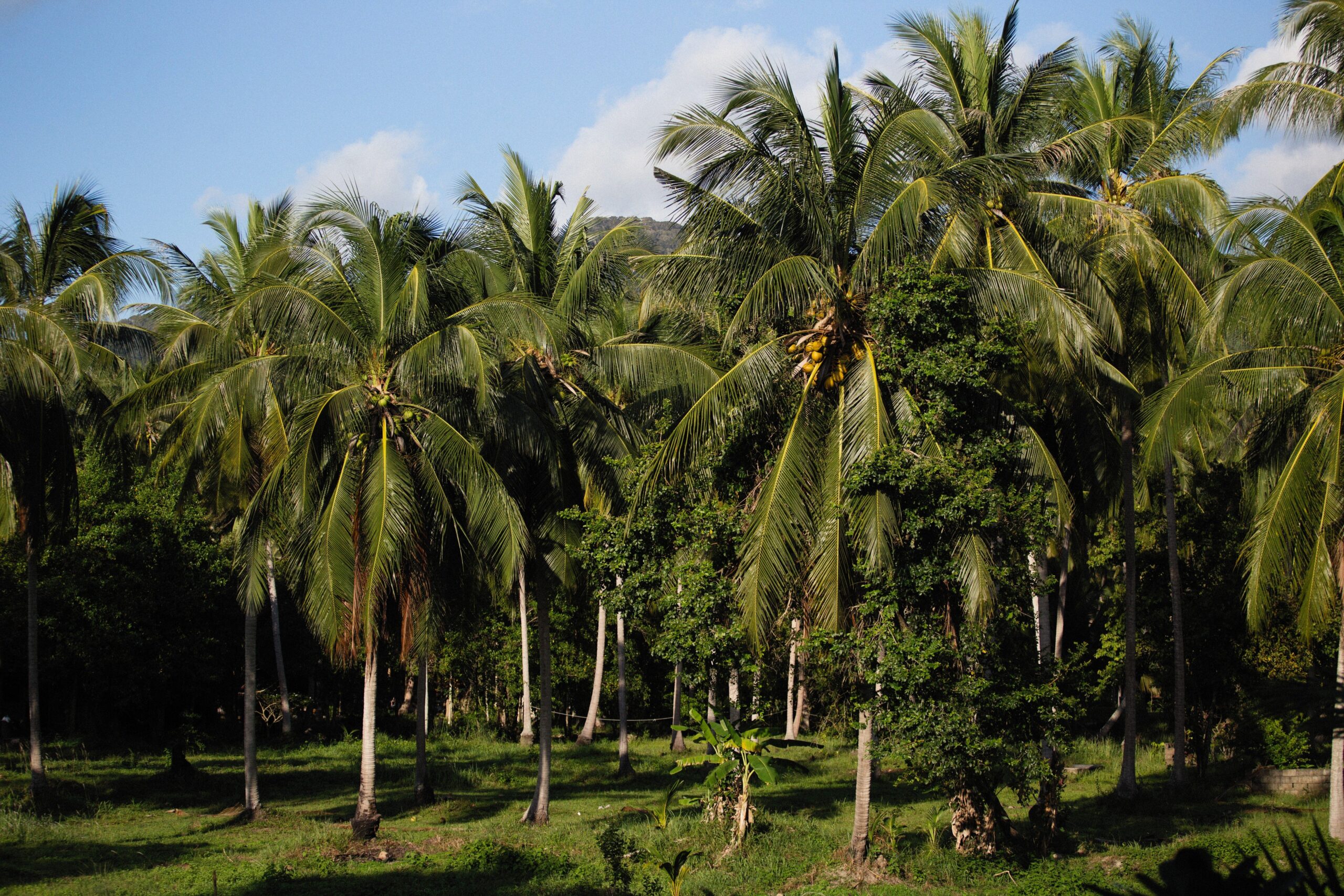
Karnataka is one of India’s major coconut-producing states, and the agricultural landscape around Mysore has a long tradition of coconut cultivation that predates most modern agricultural investment conversations. For managed farmland investors evaluating what to grow on agricultural land near Mysore, coconut deserves serious consideration alongside the teak, silver oak, and fruit orchard model discussed in earlier posts.
Why Coconut Is a Particularly Reliable Commercial Crop
Coconut (Cocos nucifera) is unusual among plantation crops in combining several qualities that are highly desirable in a long-term agricultural investment context. It begins producing commercially within four to five years of planting from hybrid seedlings. It produces year-round rather than seasonally — a mature coconut palm produces nuts continuously across all twelve months, providing a smoother income curve than seasonally concentrated crops like mango. It maintains productivity for fifty to seventy-five years, making a coconut plantation a genuinely multigenerational agricultural asset. And its market demand is essentially inelastic — coconut is a daily-use agricultural commodity in South India, consumed as fresh nuts, copra, coconut oil, coconut water, and coconut shell products.
What Mysore’s Climate and Soil Provide for Coconut
Coconut grows best in tropical and sub-tropical conditions with warm temperatures (twenty-seven to thirty-two degrees Celsius optimal), adequate rainfall or supplementary irrigation, and deep, well-drained soil with good nutrient content. Mysore’s agricultural belt — with warm temperatures, reliable bore well irrigation, and deep laterite and alluvial soils in various zones — provides adequate conditions for productive coconut cultivation.
The most productive coconut zones near Mysore are in the lower-altitude, warmer agricultural areas closer to the plains — T Narasipur, parts of Nanjangud, and areas along the river systems where deep soil and reliable water are available. In these zones, hybrid varieties like West Coast Tall, Dwarf Coconut, and the high-yielding D x T hybrids developed by the Central Plantation Crops Research Institute (CPCRI) produce significantly higher nut yields than traditional tall varieties.
Income Profile of a Coconut Plantation Near Mysore
A mature hybrid coconut palm (year five onwards) on a well-managed plot near Mysore produces eighty to one hundred and fifty nuts per year depending on variety, soil quality, and irrigation management. At current market prices of fifteen to thirty-five rupees per nut (varying by size, season, and market), a single mature tree generates twelve hundred to five thousand two hundred and fifty rupees per year.
At standard planting density of approximately one hundred and seventy-five trees per acre (in a triangular spacing system), a productive coconut acre generates two lakh ten thousand to nine lakh nineteen thousand rupees per year at current prices — a very wide range that reflects both variety-related yield differences and market price variability.
At mid-range assumptions — one hundred and twenty nuts per tree at twenty-two rupees per nut, with one hundred and seventy-five trees per acre — annual income from a productive coconut acre is approximately four lakh sixty-two thousand rupees. This is among the highest per-acre income available from any tree crop in Karnataka’s interior agricultural belt.
Integrating Coconut Into a Diversified Farmland Portfolio
For a managed farmland estate near Mysore that is primarily planted in teak, silver oak, and mango, adding a dedicated coconut section — perhaps one to two acres out of a five-acre plot — creates a near-term income layer that begins contributing commercially from year four to five. The coconut income provides cash flow during the years when the mango orchard is still maturing and before teak timber begins accumulating significant value, effectively smoothing the income curve of the overall estate investment.
Frequently Asked Questions
Q: Why invest in coconut plantations near Mysore?
A: Coconut offers year-round harvests, begins commercial yield within 4–5 years, maintains productivity for 50–75 years, and has stable local market demand.
Q: Which areas near Mysore are best for coconut cultivation?
A: Lower-altitude areas near river basins like T. Narasipur and parts of Nanjangud, where deep laterite or alluvial soil and reliable water are available.
Q: Which coconut varieties yield the highest returns?
A: Hybrid varieties—such as West Coast Tall, Dwarf Coconut, and D x T hybrids developed by CPCRI—produce significantly higher yields than traditional tall trees.
Q: How many trees can be planted per acre?
A: Standard spacing allows approximately 175 coconut trees per acre using a triangular planting system.
Q: What is the expected annual income per acre?
A: Mid-range returns yield around ₹4,62,000 per acre annually (assuming 120 nuts per tree at ₹22 per nut), though yields range between ₹2.1 lakh and ₹9.19 lakh depending on variety and market prices.
Q: How does coconut fit into a multi-crop farmland portfolio?
A: Allocating 1–2 acres of a 5-acre plot to coconut provides consistent short-term cash flow starting in year 4 or 5 while longer-term crops like teak and silver oak mature.