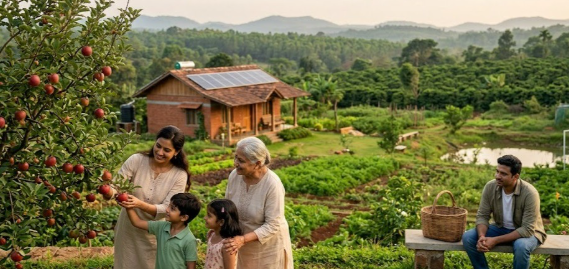
The managed farmland investment conversation is usually framed in adult terms — returns, tax efficiency, appreciation, portfolio diversification. But many of Nature N Me‘s investors describe the most unexpectedly valuable dimension of their Mysore farmland as what it does for their children. This blog is about that specific experience — the family with children dimension of owning a managed farmland estate near Mysore.
What Urban Children Are Missing
A child growing up in Bangalore in the 2020s has a remarkably sophisticated life in many respects — access to international education, diverse food, cultural experiences, technology. But one dimension of childhood experience has been systematically removed from the urban upbringing: genuine contact with the natural world and with where food actually comes from. Urban children know mangoes as objects that appear in supermarkets and on Blinkit. They have no experience of a mango tree, of fruit ripening over weeks, of harvest as a physical activity with a tangible result.
This is not a sentimental observation — it is a practical gap with measurable consequences for the development of environmental awareness, patience, and connection to biological reality that humans spent most of their evolutionary history experiencing directly.
What the Farm Visit Gives Children
A weekend on a managed farmland estate near Mysore is not structured or programmed — it is not a farm experience tourist activity with scheduled activities and a timed session. It is simply being on land that your family owns, with trees growing, fruit developing, birds moving through the agricultural landscape, and a farm manager who knows the estate and can explain what is happening.
Children engage with this environment in ways that adults cannot fully predict or programme. A six-year-old who discovers a mango flowering for the first time, and who is told by the farm manager that this flower will become a mango in three months, has received a piece of biological education that no classroom can replicate in the same visceral way. A ten-year-old who is allowed to help dig a small vegetable bed, plant seeds, and return two months later to see what grew has experienced the entire agricultural cycle at human scale.
The farm manager’s role in these family visits is important. A good agricultural manager who understands the value of explaining what they do to visiting children — who takes five minutes to show a child a teak sapling and explain that it will be a big tree when they are grown up — creates memories that urban experiences simply do not generate.
The Seasonal Rhythm as an Educational Experience
One of the most valuable things a Mysore farmland estate gives families who visit regularly across seasons is an experience of seasonal change that urban environments completely erase. Each visit, something is different — the mango trees are flowering, the mangoes are ripening, the teak has grown noticeably, the silver oak pruning has changed the canopy density, the winter birds have arrived at the water features.
For children who grow up making quarterly visits to the family estate, these seasonal changes become their reference for how the natural world works — a living, evolving, personally familiar system that they understand from experience rather than from a textbook.
Making the Family Visit Work Practically
The ninety-minute expressway journey from South Bangalore to Mysore is child-friendly in a way that five-hour mountain drives are not — no winding roads, no altitude sickness concern, no extended confinement in a car that erodes children’s enthusiasm before arrival. The journey is short enough that children arrive at the estate with energy rather than exhaustion.
The estate itself, with open land, trees to explore, and the agricultural activity of the management team providing genuine interest, keeps children engaged in ways that passive resort activities do not — because the estate is real and theirs, not a curated experience designed for visitors.