
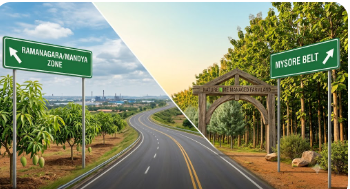
The Bangalore-Mysore expressway has created a single connectivity corridor that makes land anywhere along its length more accessible to Bangalore investors. But “along the Bangalore-Mysore road” covers a very wide range of agricultural contexts — from the peri-urban zones immediately outside Bangalore’s boundary through the distinctly rural agricultural landscapes approaching Mysore. Understanding these differences helps investors choose the location that genuinely suits their goals.
The Bangalore Periphery Zone: Ramanagara and Mandya
Agricultural land in the Ramanagara and Mandya districts — the mid-corridor zone one and a half to two hours from Bangalore on the expressway — is primarily interesting for its urban land bank potential rather than its agricultural income characteristics. These zones sit close enough to Bangalore’s expanding boundary that investors are often buying agricultural land with an expectation of future DC conversion to residential or commercial use, or simply holding for appreciation driven by Bangalore’s outward growth pressure.
The agricultural productivity of land in this zone is often secondary to the land bank thesis. Soil characteristics, water availability, and climate suitability for premium crops are not the primary evaluation criteria — the primary question is how long before Bangalore’s growth reaches this land and converts its value from agricultural to residential.
The Mysore Agricultural Belt: A Different Investment Thesis
Land in the genuine Mysore agricultural belt — the districts around Mysore city, in zones like Nanjangud, Hunsur, H D Kote, and surrounding taluks — is a fundamentally different investment thesis. This land is far enough from Bangalore that urban land bank appreciation is not the primary driver. It is valued on its agricultural characteristics: soil quality, water availability, climate suitability for fruit and timber crops, and the growing demand from Mysore’s own urban investor community and from Bangalore investors specifically seeking a genuine agricultural investment rather than a land bank position.
For an investor who wants actual agricultural income from actual crops on actual land — managed professionally, generating crop income that grows as the planting matures — the Mysore agricultural belt is where that investment is meaningful. A land bank position in the mid-corridor zone does not generate agricultural income — it generates appreciation from urban expansion expectations, which may or may not materialise on the expected timeline.
What the Mysore Agricultural Zone Specifically Offers
Fertile red laterite and loamy soils across the Mysore agricultural belt support a range of productive species — teak, silver oak, mango, sapota, guava, and various agricultural crops — at productivity levels that justify a managed agricultural model. Water tables in the Mysore zone are generally adequate for bore well irrigation, with several zones having notably better groundwater availability than the drier Deccan plateau further north.
The climate — warm but not extreme, with a reliable monsoon and a distinct cool dry season — creates the seasonal pattern that mango and other commercial fruit species need for flowering induction and fruit quality development.
The Accessibility Comparison Favours Mysore for Regular Use
Mid-corridor land (Ramanagara, Channapatna, Mandya zones) is closer in distance to Bangalore but often provides a less complete experience on arrival — the zones lack Mysore’s heritage city context, and many mid-corridor agricultural areas are neither urban enough to have city amenities nor rural enough to provide a genuine nature escape. Mysore, at the end of the expressway, is unambiguously a destination — a city with substance, a heritage context, and a genuinely different character from Bangalore that makes the journey feel worthwhile.
For investors seeking a second home agricultural experience rather than a land bank position, the Mysore agricultural belt at the end of the expressway is more satisfying than a mid-corridor plot that lacks both the city context and the genuine agricultural depth.