
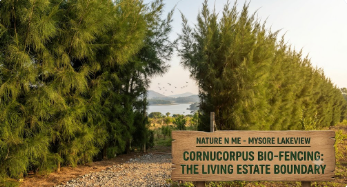
Estate boundaries are a practical necessity — they define what is yours, keep wildlife out where needed, prevent encroachment, and create the sense of a defined, managed space that makes an estate visit feel like arriving at your own place rather than walking through open agricultural land. The conventional approach to this problem is galvanized wire fencing on concrete posts — functional, durable, and completely uninteresting.
What Is Cornucorpus and Why Is It Used for Bio-Fencing?
Cornucorpus (Casuarina cunninghamiana) — sometimes also called the sheoak or Australian pine in Indian horticultural contexts — is a fast-growing, evergreen tree species with distinctive feathery, needle-like foliage. Planted at close spacing as a living fence line, it creates a dense, tall, visually impenetrable green boundary that is simultaneously a windbreak, a privacy screen, and an ecological feature.
The species grows rapidly in Karnataka’s agricultural conditions — reaching significant height within two to three years of planting and forming a continuous dense canopy when planted at close bio-fencing spacing. It is drought-tolerant once established, requires minimal ongoing maintenance compared to wire fencing (no rust, no post replacement, no wire tightening), and has economic value as a timber species at maturity — the same boundary that defines and protects the estate also accumulates commercial timber value over time.
Why Bio-Fencing Is Better Than Wire Fencing for a Managed Farmland Estate
The comparison is straightforward when examined across multiple dimensions. Wire fencing requires periodic replacement as posts corrode and wires sag — a recurring capital cost. Bio-fencing planted once grows continuously and strengthens over time rather than degrading. Wire fencing provides a visual boundary that is industrial in character — it signals enclosure rather than creating a landscape. Bio-fencing creates a green edge that is part of the estate’s natural landscape composition rather than an imposed boundary.
Ecologically, bio-fencing provides habitat — birds nest in the dense foliage, small mammals use it as cover, and the boundary itself becomes an ecological corridor rather than a barrier. This habitat value enhances the overall biodiversity of the estate, complementing the lake’s bird population with terrestrial species that use the boundary planting as shelter and movement corridors.
The Visual Experience of Arriving at a Bio-Fenced Estate
This is ultimately the most important dimension for investors who visit their estate regularly. Arriving at an estate whose boundary is a continuous green wall of mature cornucorpus, rather than a wire fence on concrete posts, is a genuinely different aesthetic experience. The green boundary integrates the estate into the agricultural landscape — the estate is part of the landscape, not a fenced enclosure imposed on it.
From inside the estate, the bio-fence frames views without blocking them — you see through the canopy gaps at some points, the boundary provides privacy at others, and the overall effect is of being enclosed in a managed green space rather than caged within a fence.
The Timber Value That Accumulates Over Time
Cornucorpus timber — dense, fine-grained, and valued for pulp, fuel, and small construction applications — has market value at maturity. A mature bio-fence line on a large estate perimeter, managed selectively over fifteen to twenty years, represents a modest but real additional income source when sections of the boundary planting are harvested and replaced with new growth.
This is the characteristic of a thoughtful bio-fencing design: the same planting that defines the estate boundary, improves the landscape character, and provides ecological habitat also quietly accumulates timber value — working in multiple dimensions simultaneously, exactly as the rest of the agroforestry planting on the estate does.
Frequently Asked Questions
Q1: What is Cornucorpus and why is it used for bio-fencing?
A: Cornucorpus (Casuarina cunninghamiana) is a fast-growing, drought-tolerant evergreen tree with dense foliage that creates a thick, living perimeter boundary, windbreak, and privacy screen.
Q2: How does bio-fencing compare to traditional wire fencing?
A: Unlike wire fencing that rusts, sags, and requires recurring maintenance costs, bio-fencing is a one-time planting that grows stronger over time, enhances estate aesthetics, and generates commercial timber value.
Q3: How long does it take for Cornucorpus bio-fencing to establish?
A: It grows rapidly in Karnataka’s climate, reaching significant height and forming a continuous green canopy within two to three years of planting.
Q4: What ecological benefits does bio-fencing bring to the estate?
A: It acts as a natural habitat corridor for birds and small wildlife, boosting local biodiversity and integrating the estate seamlessly into the surrounding natural landscape.
Q5: Does Cornucorpus bio-fencing offer any financial return over time?
A: Yes. At maturity (around 15 to 20 years), the dense timber can be selectively harvested and sold for fuel, pulp, or small construction, creating an additional income stream.