
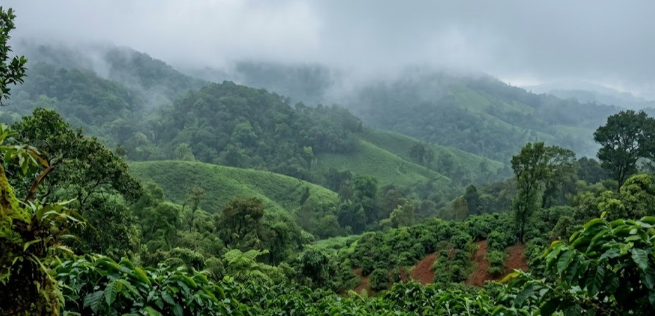
Investors who have heard that Coorg receives some of India’s heaviest rainfall naturally wonder whether that rainfall poses a risk to their farmland investment. This FAQ addresses the monsoon-related concerns that come up most often.
Can heavy monsoon rain damage my coffee and spice crops?
The monsoon is not a threat to a well-managed Coorg coffee estate — it is the primary source of the water that makes the estate productive. Coffee, cardamom, and pepper all evolved in the Western Ghats’ high-rainfall environment and are adapted to the monsoon. They do not just survive it; they depend on it.
The potential damage from heavy rain is not from the rain itself but from the consequences of poor drainage — waterlogging around coffee roots (which can cause root rot if water sits for extended periods), soil erosion on steep slopes without adequate bunding, and physical damage to plants from landslides on highly unstable terrain.
Good estate management prevents all of these. Drainage channels that direct water off the plot without pooling, contour bunding that slows surface runoff without waterlogging, and plot selection that avoids highly unstable steep slopes are the standard protective measures in a well-managed Coorg estate. Nature N Me’s plot selection and management specifically addresses these risks.
Does access to my plot get cut off during the monsoon?
Main road access to Coorg — on national highways and state highways — is generally reliable throughout the monsoon. Madikeri town remains accessible year-round. The challenge can be the last-mile access road to the specific estate plot, which may be an earthen or gravel track that becomes muddy or slippery during heavy rain.
Whether the specific access track to any given plot remains navigable in the monsoon depends on its surface material, slope, and drainage. Plots on well-maintained gravel or compacted laterite tracks remain accessible year-round with an appropriate vehicle (high-clearance SUV). Plots accessible only via steep, narrow earthen tracks may have limited vehicular access during the peak monsoon weeks of July and August.
This is a factor to specifically assess during the pre-purchase site visit and to ask the farm management team about explicitly — not just in general terms but for the specific track to the specific plot being considered.
Does farm management continue during the monsoon or does the team stop working?
Farm management activity continues throughout the monsoon — it simply shifts in nature. The harvest crew is not present (harvest is in the dry season), but the permanent farm management team is actively working throughout the monsoon on drainage maintenance, shade management in accessible sections, disease monitoring for leaf rust, cardamom early harvest preparation, and all the soil and plant management activities discussed in our farm calendar post.
The farm does not shut down in the monsoon — it changes pace and focus. The management team is arguably at its most critical during the monsoon because the decisions made on drainage and disease management in July and August directly affect the health of the crop going into the November-February harvest season.
Is my bore well pump safe during the monsoon?
A bore well pump installed with standard protective housing is not at risk from monsoon rain. The pump is submersed in the bore well casing below ground, and the electrical control panel is housed in a covered structure. Pump failure during the monsoon can occur from electrical surge during lightning events (addressed by surge protection on the electrical installation) or from physical damage to surface components (addressed by adequate housing and flood-clearance installation).
Nature N Me’s irrigation infrastructure includes standard protective measures for pump and electrical components. Any pump failure is addressed by the maintenance team as part of ongoing estate management.
What about snakes and wildlife becoming more active during the monsoon?
Wildlife activity, including snakes, increases during the monsoon as animals move more actively in the humid, rain-softened conditions. This is true of the broader Coorg landscape and not specific to any particular farm. Standard precautions — wearing boots when walking the estate, watching where you step, not reaching into undergrowth without checking — are sufficient for safe farm visits during the monsoon.
The farm management team works in the estate daily throughout the monsoon and is accustomed to the wildlife activity of the region. Serious snake encounters are rare on actively managed estates where regular human activity is present throughout the year.